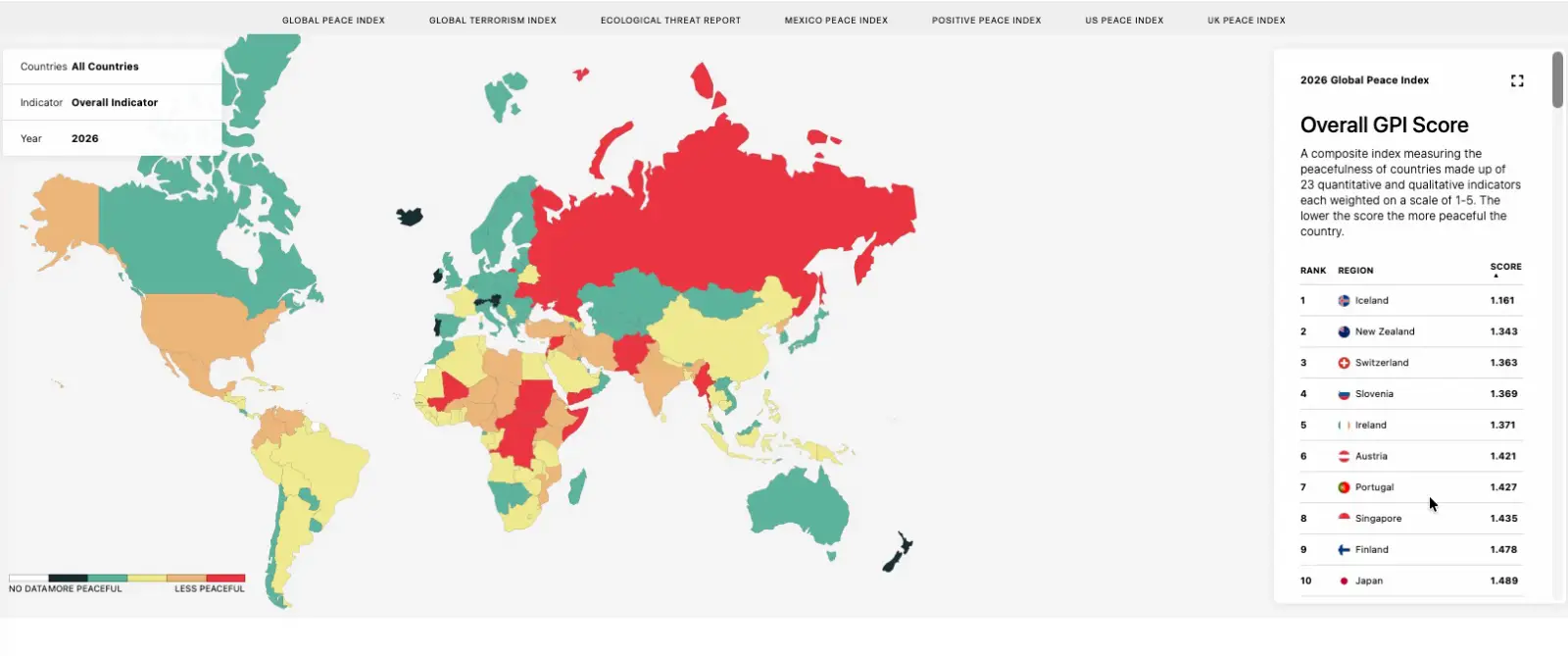
Iceland has retained its position as the world’s most peaceful country for the 19th consecutive year, according to the 2026 Global Peace Index released today by the Institute for Economics and Peace. The annual report, now in its 20th edition, ranks 163 countries and territories across 23 indicators and warns that global peacefulness has deteriorated for the 12th consecutive year, with the number of active state-based conflicts reaching 61, the highest figure since the end of the Second World War.
For travellers assessing where to go in 2026, Europe continues to offer the strongest security conditions of any region in the world. Iceland leads the top 10, followed by New Zealand, Switzerland, Slovenia, Ireland, Austria, Portugal, Singapore, Finland and Japan. Western and Central Europe accounts for 7 of the 10 safest spots on the index.
At the bottom of the ranking, Russia has for the first time become the least peaceful country globally, followed by Sudan, the Democratic Republic of Congo, Ukraine and Israel. The United States fell 4% in peacefulness, dropping to 134th place, its lowest-ever ranking since the index was created, driven by political instability and a surge in violent demonstrations.
Steve Killelea, Founder and Executive Chairman of the Institute for Economics and Peace, described the scale of the global challenge. “Conflict clusters are becoming more internationalised and larger, making them exceptionally difficult to resolve,” he said. “The most significant of these clusters is the arc of instability now stretching from South Asia through Iran and the Middle East, and into the Horn of Africa. AI and autonomous drone technology are making life and death decisions with human oversight reduced to seconds. At the same time, governance systems are lagging behind real-world events as civilian casualties soar.”
The report identifies what it calls the “Great Fragmentation” as the underlying driver of global instability. This describes a structural shift in which rising middle powers are filling the vacuum left by declining traditional great powers, fracturing the global rules that have historically maintained peace. The share of conflicts ending in a peace agreement has collapsed from 23% in the 1970s to just 4% in the last decade, while global investment in proactive peacebuilding stands at just 0.52% of total military spending.
The economic scale of the problem is significant. The global economic impact of violence rose by 3.2% to a record US$21.81 trillion in 2025, equivalent to 10.5% of global GDP. Global military expenditure reached a record US$2.9 trillion in 2025, led by Europe. Deaths from global conflict remain at historic highs, with over 181,000 people killed in 2025, a six-fold increase since 2008. The number of countries engaged in external conflict has nearly doubled from 59 in 2008 to 103 in 2026.
One of the most striking findings in the 2026 report concerns the rapid militarisation of drone technology. Recorded drone attacks rose by more than 11,500% between 2018 and 2025, carried out by 565 different armed groups including criminal cartels. In Gaza, algorithmic targeting has reportedly compressed the human review of AI-generated targets to roughly 20 seconds per strike. In Ukraine, autonomous systems are being deployed to engage targets without a human operator in the loop, raising serious concerns about meaningful oversight in lethal decision-making.
The report draws specific attention to the war in Iran as a major geopolitical force multiplier. It estimates that successful diplomacy preventing the conflict from restarting would be worth approximately US$2.2 trillion to the global economy. The first-year global GDP loss from the conflict is estimated at 0.6%, with the worst effects falling on fragile, import-dependent economies. Pakistan, Egypt and Kenya face a combined US$5.1 billion in debt rollovers in late 2026 amid disrupted trade routes, while harvest shortfalls and food inflation are expected to hit severely across South Asia and East Africa in late 2026 and into 2027.
South Asia recorded the largest regional deterioration in the 2026 index, with Nepal falling 26 places, the steepest drop of any country globally, and Pakistan falling to 152nd place. North and Central America also deteriorated, driven largely by the decline in the United States.
For European destinations popular with travellers, the picture remains broadly stable. Italy dropped two places to 35th, a modest shift that keeps it well within the safer half of the global ranking. However, the report highlighted structural economic vulnerabilities facing the country. Since 1995, Italy’s share of global GDP has fallen by 42%, a decline matched or exceeded by fellow European powers Germany, down 49%, and France, down 44%. The report warned that this fragility leaves such economies more exposed to global energy and geopolitical shocks.
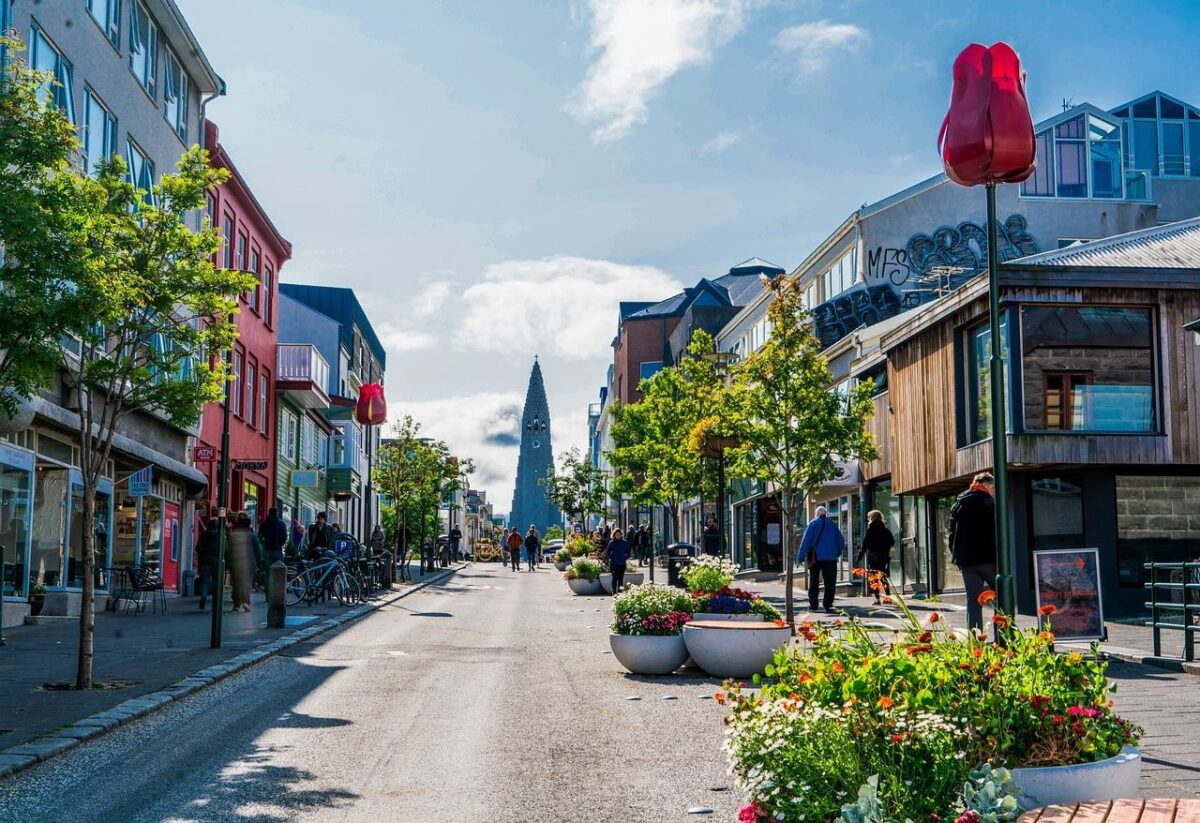
Despite the global deterioration, Iceland’s position at the top of the index reflects the enduring strength of societies built on high levels of public trust, strong institutions and low militarisation. The country has no permanent army, its police do not carry firearms, and it has maintained the top ranking every year since the index was first published in 2007. For travellers in 2026, it remains the clearest benchmark for safety in an increasingly unstable world.
The full Global Peace Index 2026 report and interactive map are available at visionofhumanity.org and economicsandpeace.org.