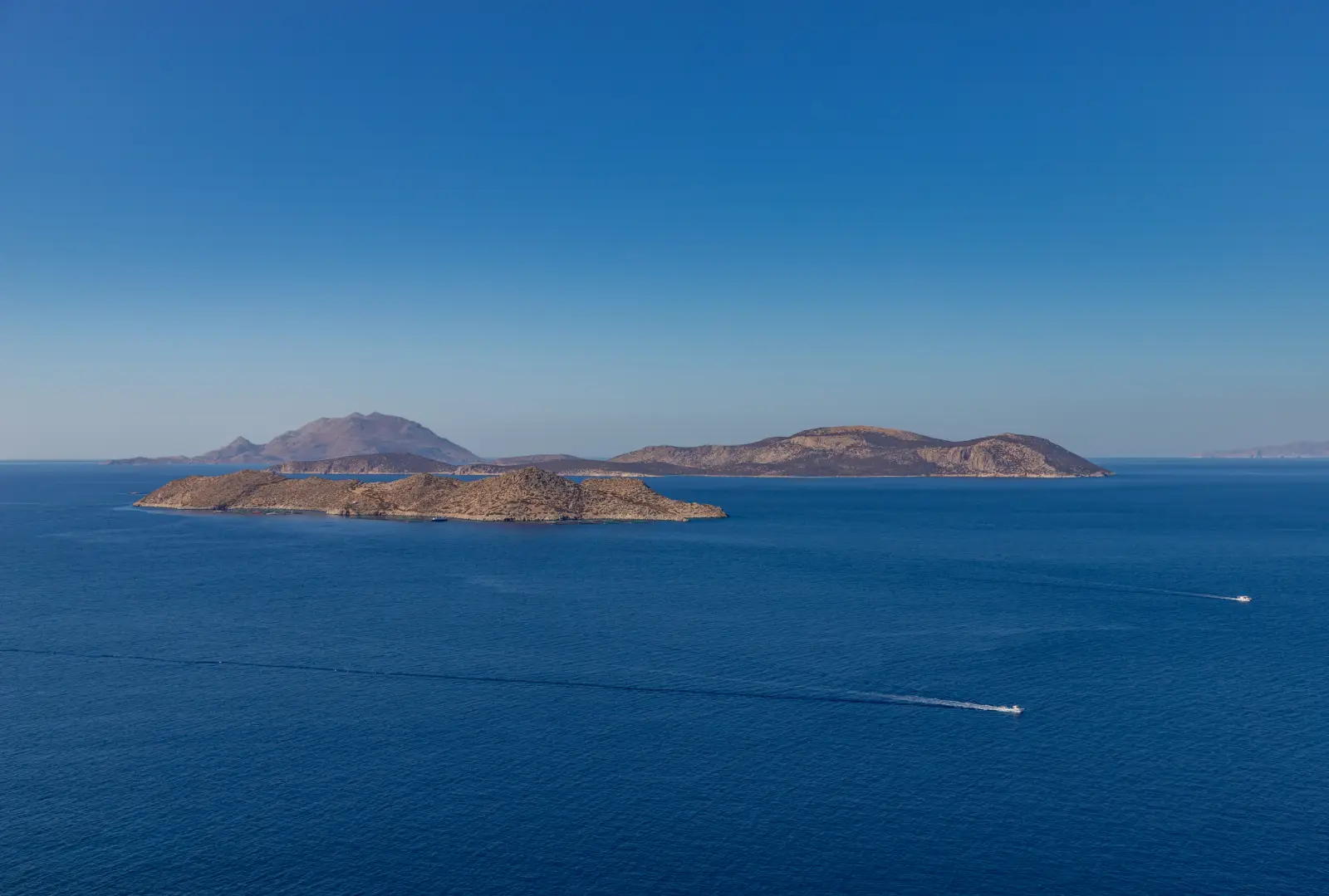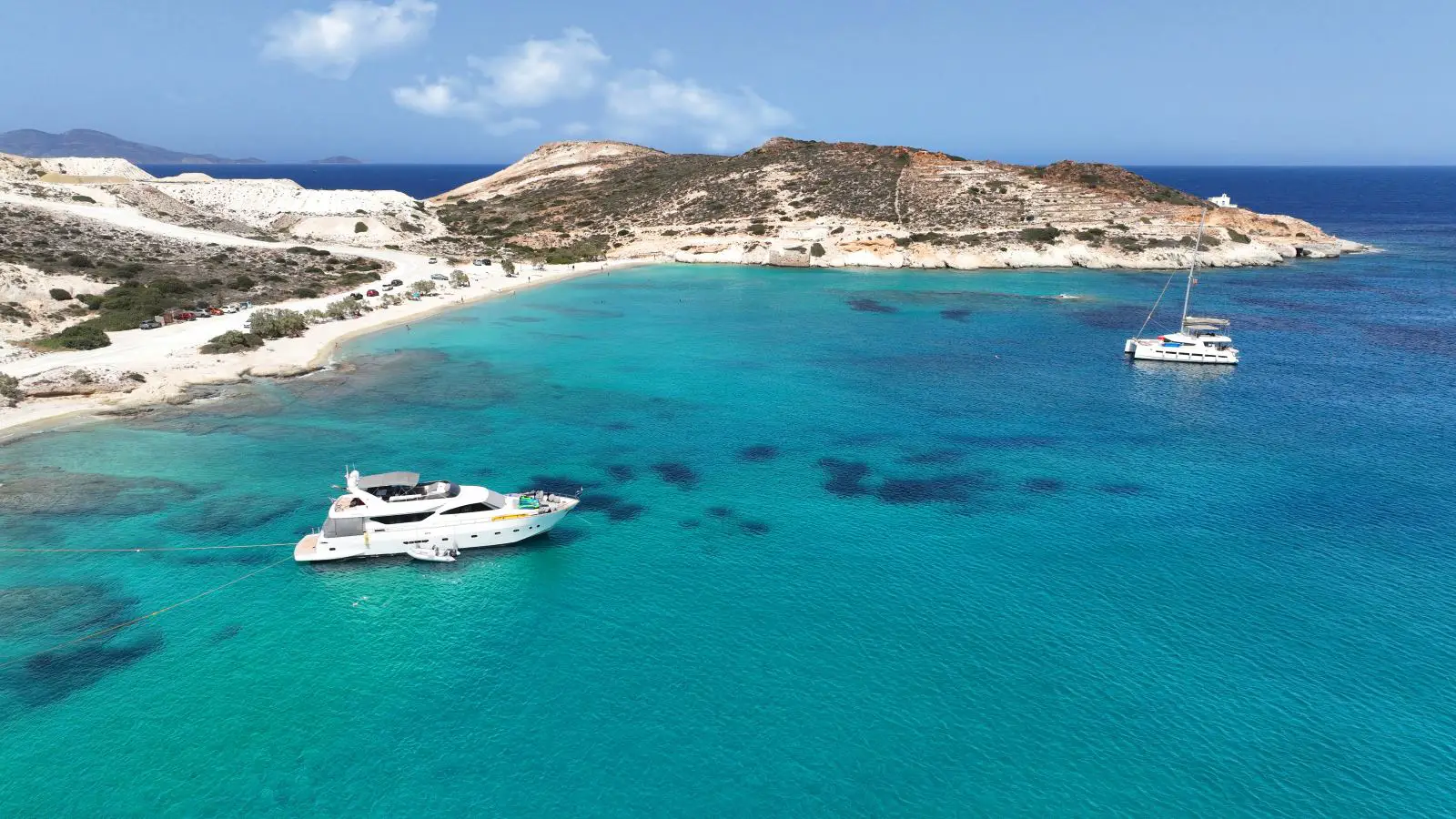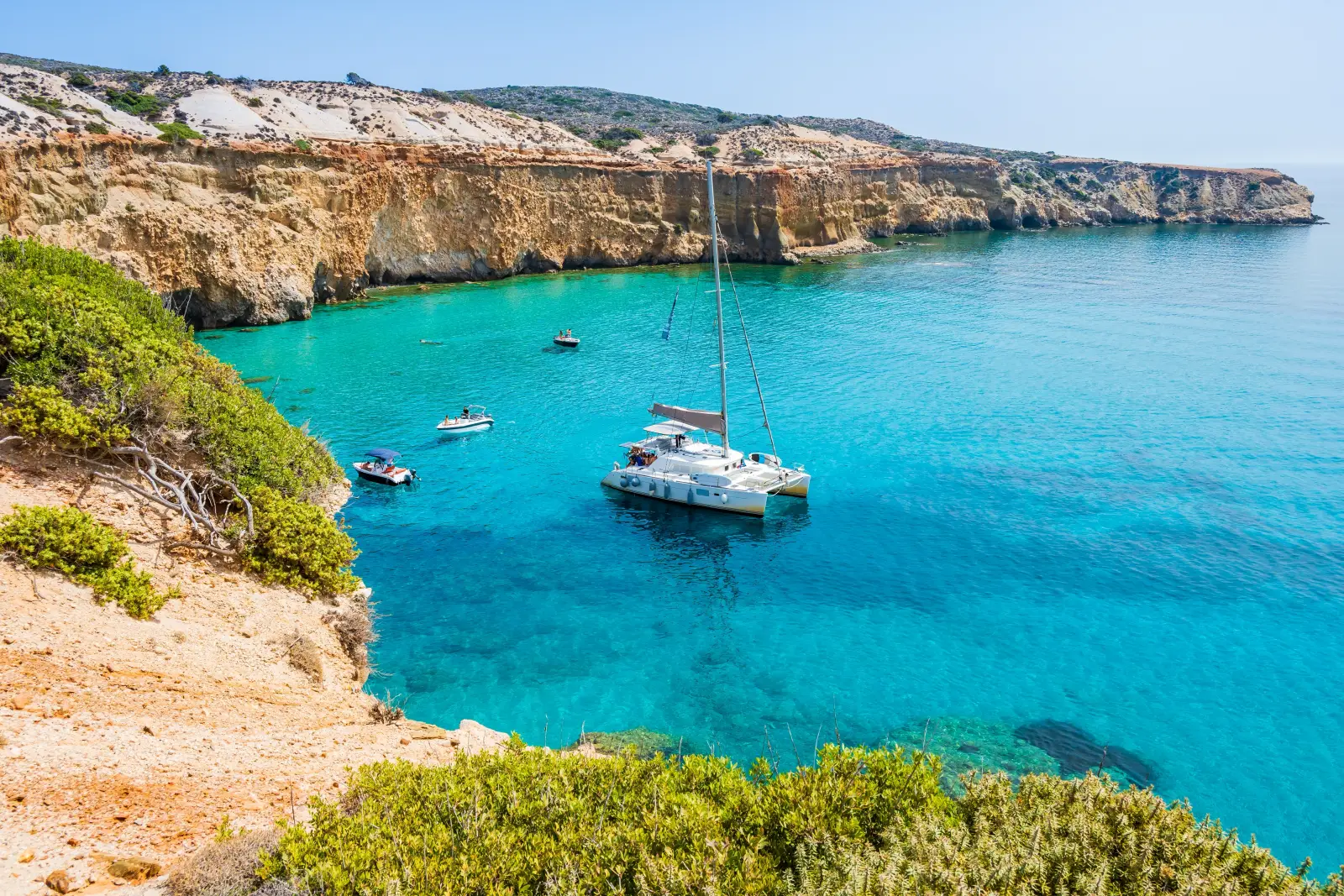
The Aegean is a sea built for sailing. Hundreds of islands scatter across it, most within a day’s passage of each other, and the prevailing summer wind — the meltemi — runs broadly from the north, making southbound legs fast and predictable. A catamaran suits these conditions well: stable enough for the afternoon chop, spacious enough for a group of eight, and shallow-drafted enough to anchor in bays and sea caves the ferries cannot reach. This guide covers the sailing angle first, then moves to five other ways to make the most of an Aegean summer: food culture, island hikes, archaeology, beaches, and the evening rhythms that are as much a part of the region as the wind and the water.
Greece Catamaran Charter: Bases, Routes, and Timing
The Aegean charter season runs from late April to mid-October, with July and August the busiest and most expensive months. The two main departure points for Aegean cruising are Lavrion, on the Attic peninsula south-east of Athens, and Kos in the Dodecanese — between them they cover the full span of the sea, from the northern Cyclades down to the Turkish coast corridor.
From Lavrion, the standard Cycladic circuit runs south-west through Kea, Kythnos, Serifos, Sifnos, and Milos, returning north via Paros and Naxos where provisioning is easy and the eastern bays offer shelter before the beat home. A second week extends to Amorgos or Koufonisia. From Kos, common routes thread through the Dodecanese — Kalymnos, Leros, Patmos — and cross to Samos or the Turkish coast for crews with time and appropriate paperwork.
Catamarans dominate charter bookings in Greece for practical reasons: wide beam means a stable platform in the short Aegean chop, twin hulls allow anchoring in shallower bays than most monohulls, and the deck space is useful for groups that want to spend most of the day outside. The trade-off is performance upwind, which matters less on the predominantly downwind Cycladic runs. Fleet sizes at main bases are large, and specific models fill quickly for peak weeks, with searches typically beginning in January for July departures. If you are planning a catamaran charter in Greece and need to compare available hulls and bases for your dates, the current selection is listed there.
The meltemi is the central fact of Aegean sailing in July and August. It builds mid-morning from the north-north-west, peaks in the afternoon at 15–25 knots (stronger in the Cyclades than in the sheltered channels of the Dodecanese), and typically eases near sunset. Experienced crews use this rhythm structurally: depart early, cover the upwind or cross-wind legs before 10am, anchor in a south-facing bay by early afternoon. June and September offer lighter and more variable conditions, which suits first-time charterers or crews with mixed experience levels.
Greek Island Gastronomy
Aegean island food is built around ingredients that keep: dried pulses, hard cheeses, cured meats, and olive oil in quantities that mainland Europeans rarely encounter. Fava from Santorini — yellow split peas grown on volcanic soil — is earthier and sweeter than the mainland version and appears on menus from Thira to Naxos. Louza (air-dried pork loin) and kopanisti (fermented pepper-sharp cheese), both from Mykonos, are genuine local specialities not easy to find off the island. See a boat rental on Mykonos here.
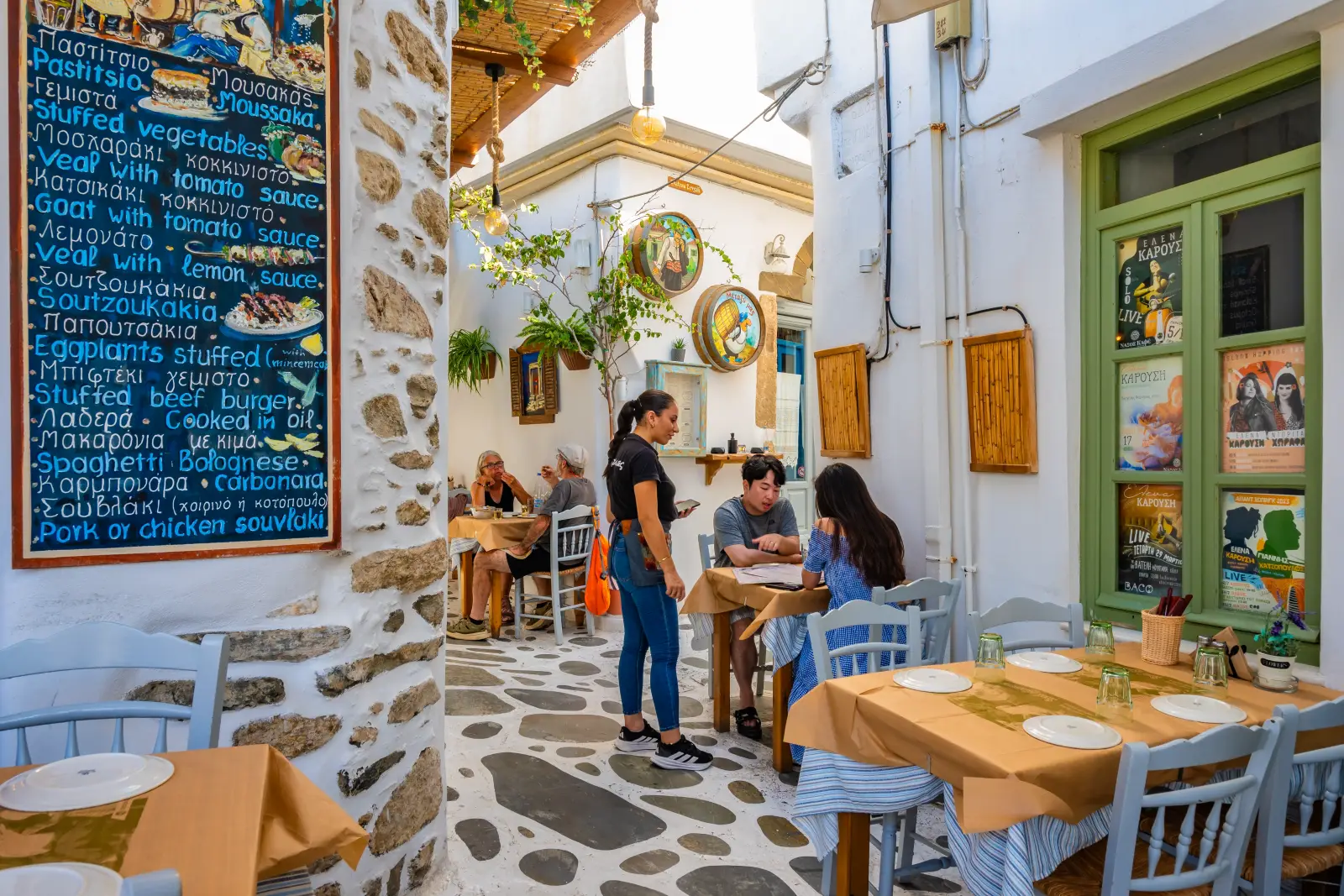
In the southern Cyclades, Sifnos has a disproportionate reputation for food: the island has produced more chefs than its size suggests, and the tradition of slow-cooked chickpeas in clay pots — revithada, baked overnight in the village bakery — is worth timing a port stop around. On Kalymnos, the sponge-diving history means seafood is treated with less ceremony and more confidence than anywhere else in the Aegean; simple grilled octopus and small fried fish sold by weight at the harbour are the standard.
For crews on passage, the provisioning routine at island minimarkets is part of the experience: bread from the morning delivery, local thyme honey, hard graviera cheese, and tomatoes that taste as tomatoes should in August. Larger islands — Naxos, Paros, Syros — have supermarkets with reliable stock. Smaller ones close by noon.
Hiking and Walking the Aegean Islands
The islands are not alpine, but the walking is more interesting than the flat-sea-and-beach summary implies. Naxos is the most serious option in the Cyclades: Mount Zas at 1001m is the highest peak in the group, and the circuit from the Zas Cave trailhead via the summit and back is a half-day effort with views across to Paros and Ikaria. The lower country offers a network of Byzantine paths connecting the interior marble villages — Halki, Filoti, Apeiranthos — through olive groves and fig trees.
Amorgos has the most dramatic terrain in the Cyclades: a long narrow ridge with sea visible on both sides, and the path from Katapola to the Monastery of Hozoviotissa — carved into the cliff face above the eastern shore — takes about two hours. Ikaria in the northern Aegean is less visited and has forested ridges, thermal springs, and a network of old paths that predate the roads. The walk toward the summit of Atheras (1041m) from Christos Rachon is a full-day circuit.
Timing matters on all island walks: the midday heat in July and August is punishing. Most trails are lightly marked, so downloading an offline map before leaving the marina is practical.
Archaeological Sites and Island History
The Aegean holds a disproportionate share of the ancient world’s most significant sites, and the density means that a sailing itinerary can include serious archaeology without detouring far off route. Delos, accessible by dinghy from an anchorage at the adjacent island of Rinia, is the obvious centrepiece for Cyclades routes: an entire uninhabited island that functioned as a sanctuary and then as one of the ancient Mediterranean’s main trading ports. The Terrace of the Lions, the mosaics of the House of Dionysus, and the archaeological museum all reward a half-day visit.
Akrotiri on Santorini is a Bronze Age town buried and preserved by the Minoan eruption, excavated since the 1960s and now covered under a modern roof that allows full access. The frescoes and storage vessels recovered from the site are among the best-preserved examples of Aegean Bronze Age material culture anywhere. The site is a short taxi ride from the marina at Vlychada; going in the morning before the caldera cruise ships disembark their passengers is the practical move.
In the Dodecanese, the Order of St John left a sequence of fortifications along the chain — the most complete is the Palace of the Grand Masters in Rhodes Old Town (UNESCO), but the knights’ castle on Kos and the hilltop kastro on Leros are worth a morning each and far less crowded. Further north, Samos has the Heraion — a sanctuary complex that was among the largest temple precincts in the ancient Greek world, now partly excavated near the south-west coast. Here we hire a boat on Rhodes.
Beaches and Coastal Swimming
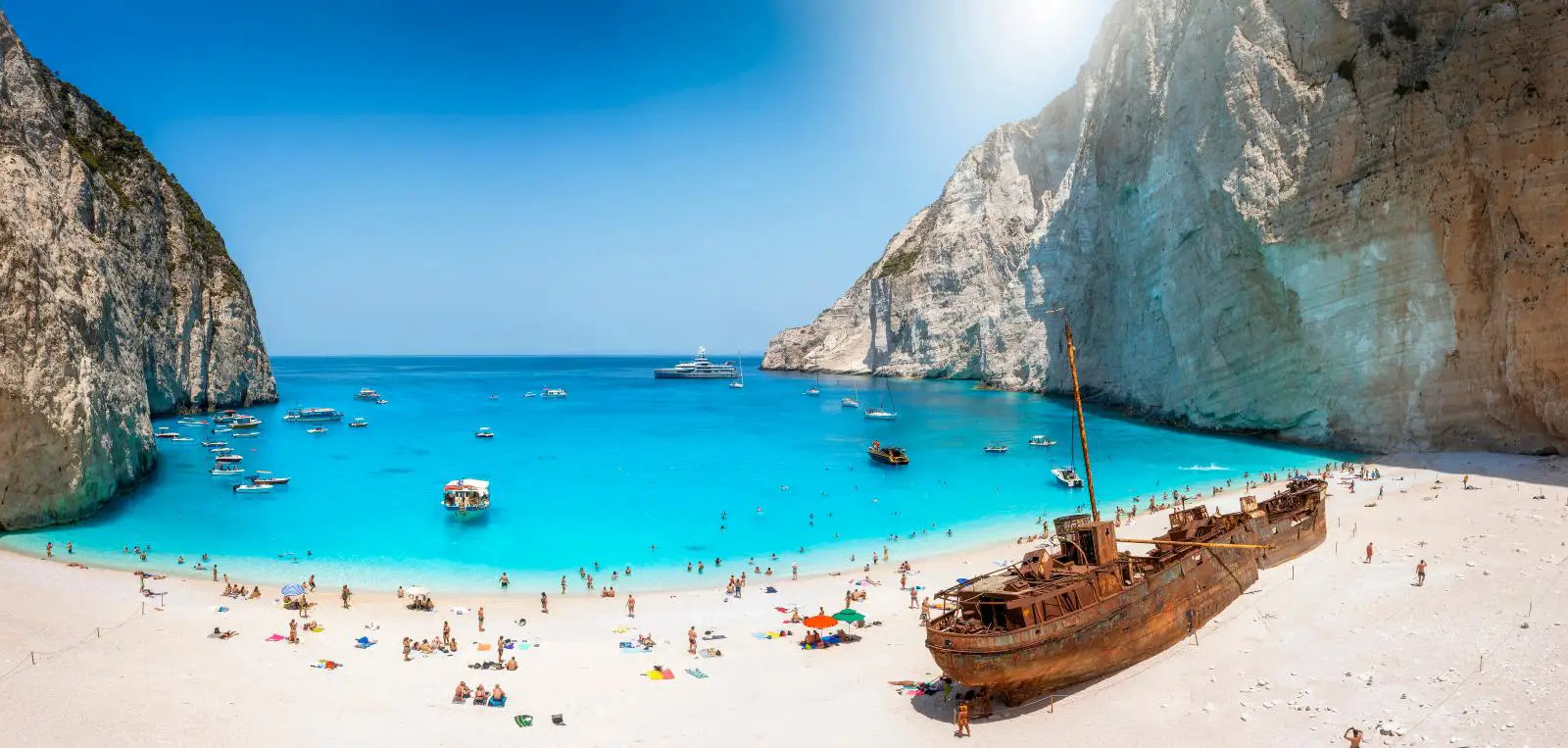
The Aegean has a wider range of beach geology than any comparable stretch of the Mediterranean: black volcanic sand at Perissa and Kamari on Santorini, pale marble pebble at Aliki on Thassos, red cliff and white chalk at Sarakiniko on Milos, long quartz sand at Plaka on Naxos, and the pale limestone sea-caves of Kleftiko on Milos where the water turns turquoise inside the arches. No single stretch of coast runs through all of these — they are separated by passages that, from a catamaran, become the day’s sailing leg.
Catamaran crews spend most of their time in bays with no road access — where the anchor holds in sand at 4–6 metres and the nearest taverna is an hour’s walk. The most rewarding of these require a passage rather than a dinghy: the south coast of Koufonisia, the east-facing bays of Folegandros, and the coves along the northern coast of Antiparos are all better reached by boat. Water temperature peaks in August and holds warm into early September.
Sunsets, Kafeneions, and Island Evenings
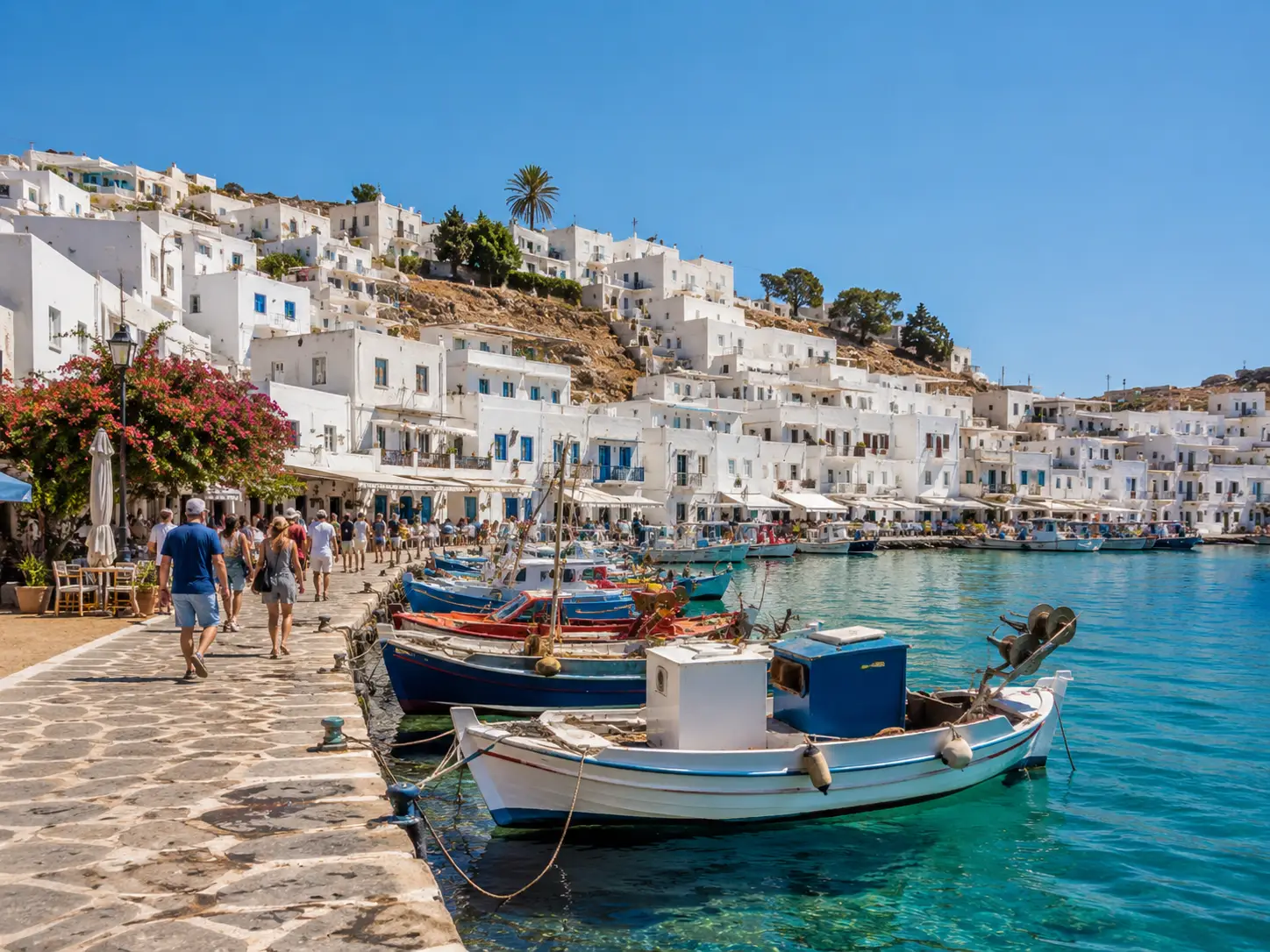
The social rhythm of the Aegean islands is late, outdoor, and unhurried. Dinner before 9pm is early; the kafeneion crowd arrives after 10. On Mykonos, Ios, and Santorini, the evening programme runs loud until well past 2am. On Folegandros, Anafi, or Symi, the evening is the harbour, a carafe of local white, and whatever the kitchen has on the board.
Syros, the administrative capital of the Cyclades, has a functioning year-round town with the Apollon Theatre (modelled on La Scala), a bakery culture built around loukoumades and halvadopita, and a harbour promenade that serves as the island’s social spine from sundown onward. It rarely appears on charter itineraries, which makes an overnight stop feel like a genuine find.
For sunset from the water: the caldera anchorage at Ormos Armenis on Thirassia puts the boat inside the basin facing the western cliff face. The light shifts from gold to deep orange simultaneously across the entire cliff, with no tour-boat traffic by 7pm.
Top Photo Credit: Pawel Kazmierczak / Shutterstock.com