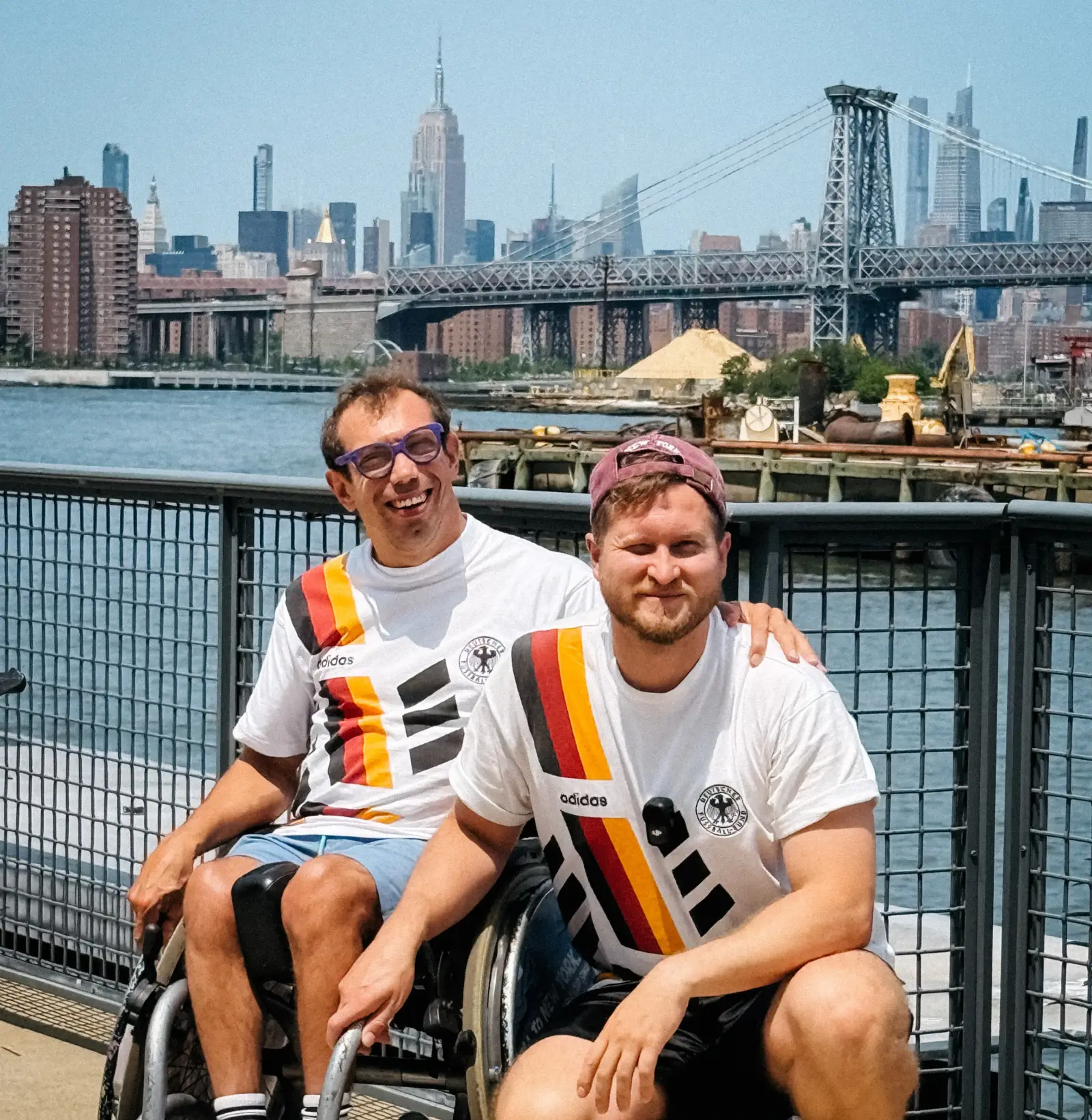
Three German travellers reached New York after an 11-day journey that began with just 2 euros in their pockets, turning a publicity stunt into a lesson about disability, generosity and the limits of public goodwill. Johannes “Johnny” Grasser, Patrick “Jolle” Deus and Simon Spädtke travelled across 4 countries and crossed the Atlantic before watching the World Cup final on the street.
The trio, who set out from Cologne two weeks earlier, also raised several thousand euros for the Peak Performer Foundation, which supports children and young people. Their challenge, called “Roll To New York“, was designed to draw attention to access barriers faced by people with disabilities, especially Grasser, who uses a wheelchair and needs daily assistance.
On the final nights of the trip, the three said they struggled to find somewhere to sleep in Manhattan and at one point were preparing to spend the night on cardboard in a park. Their search ended when a stranger named Carver handed them 500 US dollars and told them to find a hotel.
The journey, documented on Grasser’s Instagram channel, took them through Germany, Belgium, France and England before the transatlantic leg. Along the way they slept on airport floors, outside an Aldi store and in other improvised places, while also relying on donations, small gigs and spontaneous acts of support from people they met.
Grasser, who is 36 and has a severe form of tetra spasticity, said the trip exposed how difficult mobility can be for wheelchair users. He said that, in his experience, accessibility often improved the further the group moved away from Germany.
Johannes Grasser, the wheelchair user and campaign organiser, said “For a wheelchair user like me, it is not easy to move around barrier-free. It starts with toilets.”
Deus, 34, who works as a musician and teacher and has supported Grasser for years, said the trip also highlighted a gap between public claims and lived reality in Germany. “Other countries are already further ahead,” said Patrick Deus.
The group said many individuals along the route helped them with food, transport, clothes and accommodation, while larger companies declined to contribute. They said airlines and hotel chains contacted for support did not help with costs or overnight stays.
View this post on Instagram
Some of the most memorable encounters came from people who went far beyond a simple donation. In France, a supermarket worker drove them from Lille to Calais after his shift and missed his own birthday party to do so. In London, a man handed them 20 British pounds and told them to take it to a casino, where they turned it into 160 pounds after a string of wins at roulette.
At other times they had to improvise to raise money for the charity challenge. Deus performed freestyle rap in Cologne, the trio held portrait sessions in parks, gave away shirts and footballs, and even staged a push-up contest that Grasser won. They said many passers-by only donated after they were offered some kind of performance or challenge in return.
The group said the experience forced them to stretch both physically and mentally. Grasser, who trains for up to 4 hours every morning to manage his condition, said the journey pushed him beyond his usual limits, but he believed the discipline helped him cope with the stress.
He said the final stages of the trip carried a deeper meaning after repeated difficulties finding a place to sleep. “I have even greater respect now for homeless people who have to look for somewhere to stay every night,” said Johannes Grasser.
The three also said they were struck by the kindness of ordinary people, including a group of punks who let them stay in an occupied house and a hotel receptionist who paid for a room himself. Grasser said the support from strangers showed that people still listen and help when asked politely.
At the end of the trip, they gave away clothes they had been gifted along the way to homeless people in New York. Grasser said he was grateful to have completed the challenge, adding that he normally does not get to travel much.
The journey has also sharpened the message behind the campaign. The men said they wanted to show that travel, and by extension public life, remains much harder for disabled people than for able-bodied travellers, despite frequent claims of progress.
Grasser has previously taken part in a range of physical challenges, including surfing for the German Paralympics team, jumping from a 7.5 metre tower in his wheelchair and climbing the Pao de Acucar in Rio de Janeiro. He said he had always believed the 2 euro trip could end at Times Square, but added that he would never have managed it without Deus and Spädtke.
Photo Credit: Instagram / theofficial_johnny