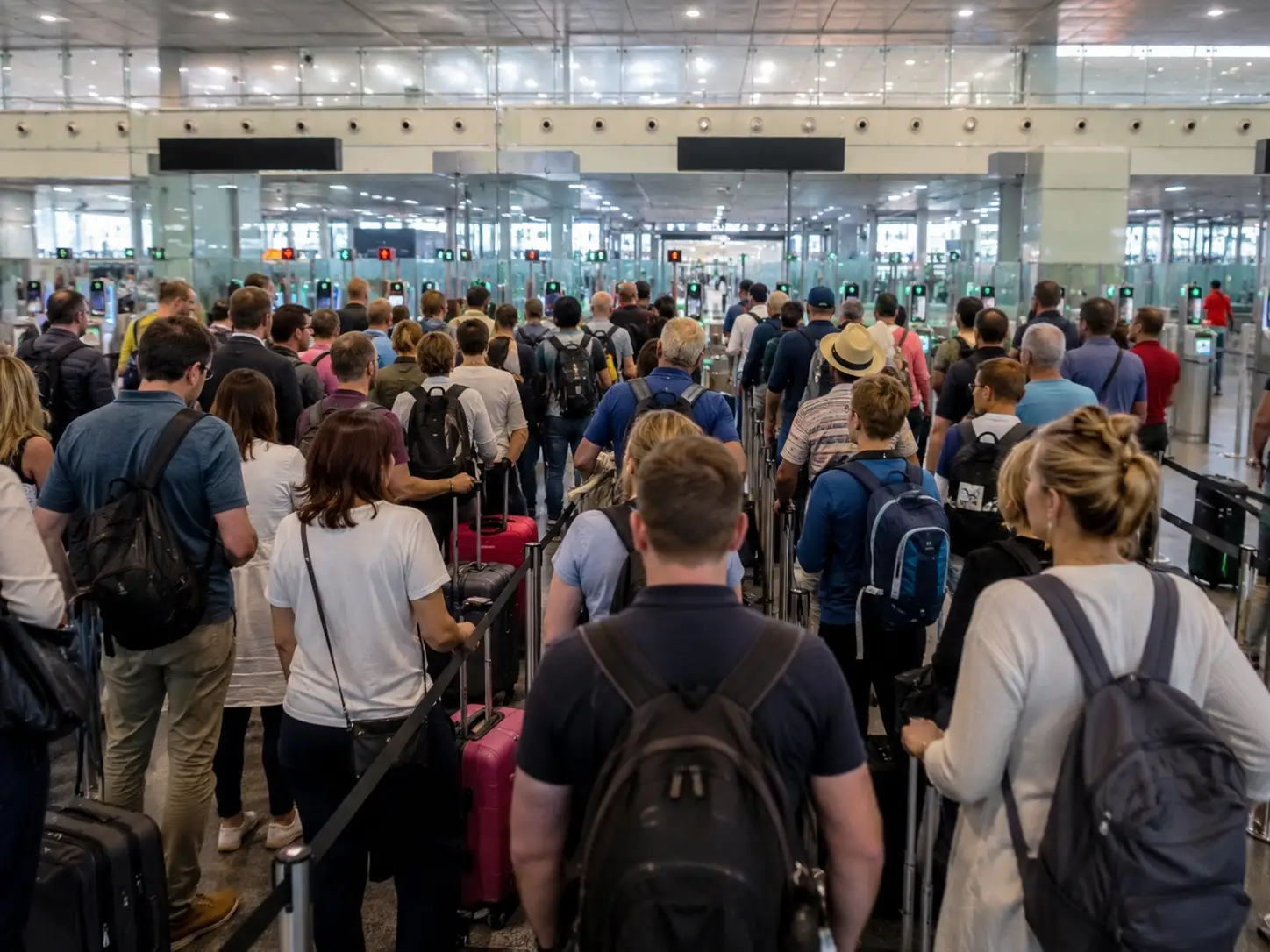
European airports are warning of long queues this summer as the European Union’s new digital border control system enters its first peak holiday season.
The Entry Exit System, known as EES, now applies to UK travellers at many Schengen area borders and requires fingerprints, a photo and a passport scan. Industry figures say the process is already causing delays at airports, while some passengers have reported waits of several hours.
EES replaces manual passport stamping and is designed to track who enters and leaves the Schengen free movement zone, which covers 29 European countries. The system began rolling out in October last year and is now fully operational, but travel groups say the busiest weeks of the summer are testing how well it works in practice.
At airports in France, Spain, Portugal and Italy, British holidaymakers must use automated kiosks on arrival to register their biometric details. The checks are verified when they leave, although some travellers, including children under 12, are checked by border staff instead.
The time needed to complete the registration has led officials and airlines to advise passengers to allow more time at border control. A representative of airline trade body IATA has warned queues in some places could stretch to 6 hours. The UK boss of Wizz Air told the BBC that passengers should be prepared for a wait and should arrive 3 hours before their flight home.
Reports from across Europe suggest the impact has varied sharply from airport to airport. Some travellers have moved through quickly, while others have faced repeated checks or long delays linked to technology problems and border staffing levels.
Some passengers have even missed flights home because they did not reach the gate in time. Airlines have taken different approaches to this risk, with some saying they will wait for delayed passengers where possible, while Ryanair has said it will not hold flights.
The system has also affected some land and sea crossings. At Dover, Eurotunnel’s Folkestone terminal and Eurostar’s St Pancras rail terminus, French border police carry out passport checks before travellers leave the UK. Automated machines are in place at these sites, but they are not yet in routine use and border staff are still handling part of the process.
At Dover, long queues of cars built up at the start of the May half term holiday despite fingerprints and photos not yet being collected. French border authorities later suspended the process.
There are signs that some countries are trying to ease pressure before the main holiday rush. Greece is not applying the biometric checks to British visitors over the peak period, and the European Commission can suspend the system in exceptional circumstances that lead to excessive waiting times until September. Portugal has also announced hundreds of extra border staff for July.
Airports and border authorities have urged passengers to follow advice from their airline on when to arrive for flights back to the UK. The message from the industry is that EES is now part of the journey, and that travellers should expect the first summer of the new system to be the toughest test yet.
Alongside EES, the EU is preparing a second border measure called the European Travel Information and Authorisation System, or ETIAS. This visa waiver scheme will apply to non-EU nationals who do not need a visa to enter the EU, including UK travellers.
ETIAS is not due to begin until the end of 2026, although the final date has not been confirmed. It will cost 20 euros, or 17.47 pounds, per application and will be valid for 3 years. People under 18 and over 70 will still need to apply, but they will not have to pay.
Officials have not yet said when the system will be fully normalised at all borders, but the summer season is likely to decide how quickly further changes are introduced. For now, passengers travelling to Europe are being told to build extra time into their plans and to expect new checks to add time to the journey.