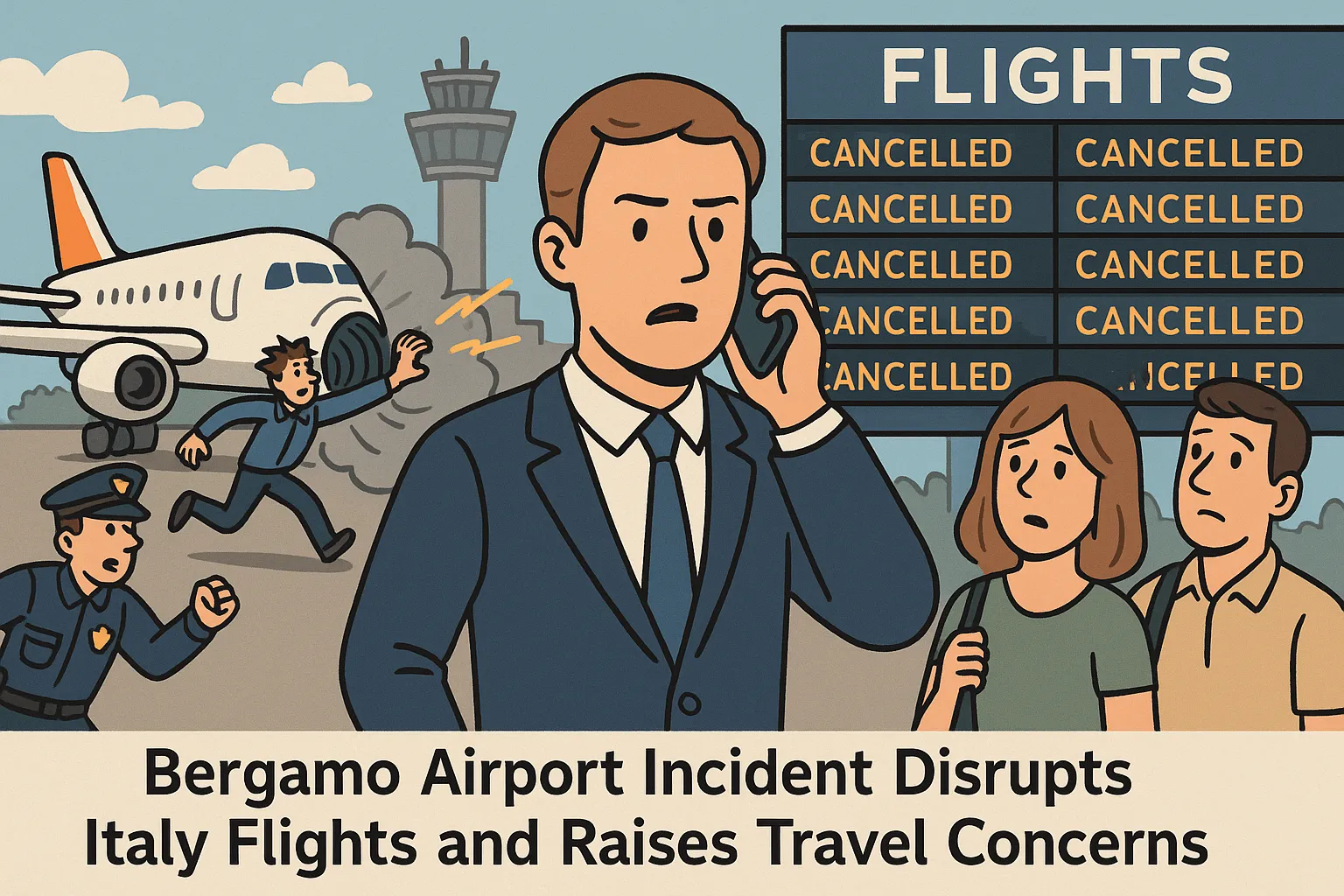
Bergamo airport incident disrupts Italy flights and raises travel concerns after a tragic event forced the suspension of operations at one of the country’s busiest international hubs. On Tuesday morning, flights to and from Bergamo-Orio al Serio Airport were cancelled or delayed for hours when a man reportedly ran onto the runway and was fatally pulled into a plane’s engine during taxiing preparations.
The shocking occurrence brought travel to a halt as emergency crews responded and investigators worked to understand how security was breached so dramatically. The incident unfolded shortly after 10am local time, with local media describing a chaotic sequence in which the 35-year-old man entered airport grounds by car before abandoning it and sprinting past security barriers to access the active tarmac.
Impact on Flights and Passenger Disruptions
SACBO, the airport’s operating company, suspended all flights at 10.20am following what it described as an “inconvenient incident” on the taxiway. Though air traffic technically resumed around noon, widespread delays and cancellations persisted well into the afternoon and evening as airlines and airport staff struggled to restore normal operations.
According to flight tracking service Flightradar24, at least 19 flights were cancelled outright—12 departing and seven arriving—while many others experienced extended delays. Ryanair services to destinations such as Prague, Zadar, Katowice, Crotone, Tirana, Kos, Malta, Naples, Porto and Alghero were among those cancelled. Eurowings’ flight to Dusseldorf was also scrapped.
Passengers faced confusion and long waits. For example, a Ryanair flight to Bristol, originally scheduled for 4.25pm Italian time, was not expected to depart until 12.25am the following day. The knock-on effect highlighted the vulnerability of tightly scheduled European short-haul routes to sudden and severe disruptions.
Details of the Incident and Investigation
Italian media reports offered a disturbing timeline of the man’s movements leading up to the tragedy. He allegedly entered airport grounds against traffic near the terminal, abandoned his vehicle, and then ran through the arrivals area, breaching a secure door that opens directly onto the aircraft parking zones. Police were reportedly chasing him as he reached the active taxiway where the incident occurred.
The plane involved was identified as an Airbus A319 operated by Spanish budget carrier Volotea, which had been preparing for departure to Asturias Airport in northern Spain. Reports indicate the jet was completing its pushback maneuver—a standard procedure for moving away from the gate—when the man ran in front of it and was sucked into an engine. Firefighters, police, and airport technicians were on-site quickly, but nothing could be done to save the victim.
Officials stated that the man was neither a passenger nor an airport employee, with early suggestions indicating he may have taken his own life. Authorities launched a thorough investigation to examine how such a security breach could have occurred, with questions swirling over airport perimeter controls and internal security measures.
Security Concerns at Italy’s Third-Busiest Airport
Bergamo-Orio al Serio Airport ranks as Italy’s third-busiest international airport, serving millions of passengers annually with a strong emphasis on low-cost and leisure travel, especially to European destinations. The incident has raised immediate concerns about airport security, perimeter safety, and crisis response protocols at such high-traffic facilities.
Travellers using Bergamo Airport in the coming days are advised to check airline communications, airport notices, and real-time flight information before departure. Even though operations resumed, residual delays were likely to ripple through schedules for hours or even days after the incident.
Airlines operating from the airport, including Ryanair, Eurowings, and Volotea, faced complex challenges rebooking affected passengers, providing accommodations where needed, and communicating changes across multiple languages and countries.
Travel Advice and Practical Guidance
For passengers planning to travel via Bergamo or other major Italian airports, it’s recommended to:
- Confirm flight status before heading to the airport using airline apps or websites.
- Allow extra time for check-in and security processes, especially given heightened alert levels.
- Monitor local news sources and airport social media for updated advisories.
- Be prepared for schedule changes, rerouting, or overnight stays if delays cascade.
Travel insurance covering trip disruptions or delays can offer valuable protection in situations like this. Policies that include coverage for missed connections, rebooked flights, and accommodation expenses can help mitigate unexpected costs caused by large-scale airport disruptions.
Italy’s Broader Aviation Landscape and Safety Culture
Italy’s aviation sector has traditionally maintained strong safety standards, but the Bergamo incident underscores the need for continuous review and reinforcement of airport security. While tragic events of this nature are extremely rare, their impact is profound—affecting not just the victim’s family and local responders, but also thousands of travellers caught in cascading delays.
The tragedy also puts a spotlight on the need for coordinated response strategies among airlines, airport operators, law enforcement, and emergency services. Bergamo’s role as a critical hub for budget carriers means that even relatively short operational halts can disrupt a vast network of flights across Europe, with significant consequences for tourism and business travel alike.
As investigators piece together the exact sequence of events, airlines and airport authorities are likely to review their perimeter security protocols and crisis management procedures to prevent similar breaches in the future.
Planning Travel to and from Bergamo
Despite the incident, Bergamo remains a popular entry point for exploring northern Italy, including destinations such as Milan, Lake Como, and the Alps. Travellers should stay informed about any follow-up security measures or procedural changes that might affect airport access and processing times.
For those planning upcoming trips, flexibility remains key. Monitoring airline communications, having contingency plans for ground transport, and ensuring robust travel insurance can all help reduce stress and manage risks when navigating major international gateways like Bergamo-Orio al Serio Airport.