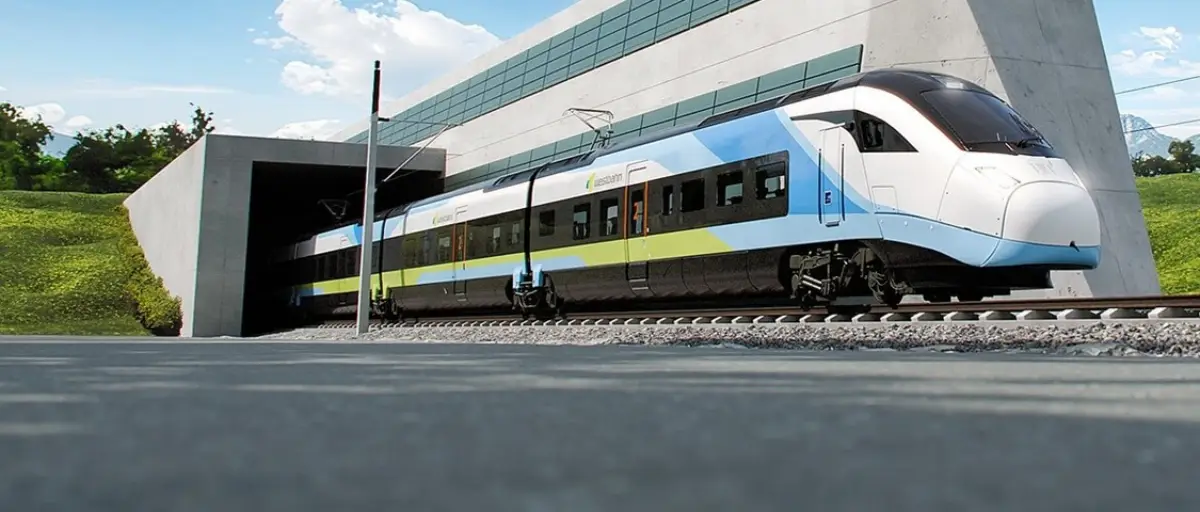
Austria’s private rail operator Westbahn has introduced four new Chinese-built double-deck trains on its Vienna–Salzburg route in early November, marking the first time long-distance passenger trains manufactured by China’s CRRC have entered service in Europe. The rollout has prompted concern across the European rail industry over competition, supply-chain dependence, and the potential market impact of lower-cost imports.
The launch follows years of technical testing and certification procedures to approve the CRRC units for European use. The trains, designated as the Westbahn Class 4100 and known as “Panda” sets, were built by CRRC Zhuzhou Locomotive Co., Ltd. and delivered under a contract signed before the pandemic. Their entry into service expands Westbahn’s operational fleet capacity by roughly 28 percent, the company said, adding nearly 10,000 seats across its network.
Political and industry reaction
The introduction of Chinese-made trains into the European passenger network has triggered political and industrial debate in Austria. Unions, the Austrian Chamber of Labour, and domestic rail suppliers have raised concerns that importing rolling stock from outside the European Union could undercut local manufacturing and threaten jobs in the sector. They argue that Chinese state-backed manufacturers may benefit from subsidies that distort market competition.
Austria’s Minister for Transport, Peter Hanke, called for a review of European procurement policies in response to the development. He said stricter evaluation and transparency rules should apply when public transport operators source critical infrastructure from non-European suppliers. “We must ensure fair conditions for European manufacturers and preserve industrial value creation,” said Peter Hanke, Minister for Transport.
Westbahn defended its decision, emphasizing the trains’ hybrid sourcing and European component integration. The company said many onboard systems, including brakes, doors, and passenger seating, were designed and supplied by European firms. According to the operator, delivery speed and cost-efficiency were decisive factors after European manufacturers offered significantly longer production timelines.
Technical and operational background
The Westbahn Class 4100 sets are six-car double-deck electric multiple units capable of speeds up to 200 kilometers per hour. They are equipped for dual-voltage operation—25 kV 50 Hz and 15 kV 16.7 Hz—allowing cross-border compatibility with neighboring countries’ power systems. Each train includes a mix of economy and comfort class seating, onboard vending machines, and accessible facilities for passengers with reduced mobility.
CRRC, the world’s largest rolling stock manufacturer, has previously supplied metro, light rail, and freight vehicles to various European cities. However, the Austrian deployment represents its first entry into the continent’s long-distance passenger train segment. The company has described the Westbahn project as a milestone for Chinese railway technology in international markets.
Before entering service, the Panda units underwent extended testing on Austrian tracks and certification under EU technical standards. According to industry reports, the approval process involved years of interoperability assessments, braking performance checks, and climate testing to meet European Union Agency for Railways (ERA) safety requirements. The trains completed final validation at test facilities in Austria earlier this year.
Market implications for Europe
The arrival of CRRC-built trains has intensified discussions about Europe’s strategic autonomy in transport infrastructure. Industry representatives warn that if non-EU manufacturers expand their market share, it could pressure European companies such as Siemens, Alstom, and Stadler to lower prices or restructure production chains. Labour organizations have also called for EU-wide monitoring of state-backed foreign competitors to ensure compliance with fair-trade principles.
Westbahn, which operates open-access passenger services between Vienna and Salzburg, remains the only major private operator competing directly with Austrian Federal Railways (ÖBB). The company has stated that fleet expansion is essential to maintain service frequency and meet passenger demand on one of Europe’s busiest intercity corridors. Westbahn said the CRRC-built trains were delivered on schedule and will be used alongside existing Stadler KISS trainsets.
In addition to the domestic debate, transport analysts note that the development could influence procurement decisions in other European countries seeking faster or cheaper fleet renewal. While no other operator has yet confirmed a similar order, CRRC’s presence in the European market is expected to grow if the Austrian deployment proves reliable and cost-effective.
According to local sources, the new trainsets are entering the final stages of preparation for regular service and will be gradually integrated into Westbahn’s timetable over the coming weeks. The operator aims to boost capacity during peak hours and improve travel comfort on the Vienna–Salzburg line, which handles millions of passengers annually. The company has not disclosed whether additional CRRC units are under consideration for future expansion.
Critics continue to urge caution, warning that greater dependence on foreign-built trains could limit Europe’s control over critical technologies. Supporters argue that the move introduces healthy competition and offers cost relief amid inflation and supply-chain constraints affecting domestic production.
As the Panda trains begin carrying passengers, the broader impact will extend beyond Austria. The European rail industry is watching closely to see whether CRRC’s entry marks an isolated event or the start of a more competitive phase in the continent’s long-distance passenger transport market.