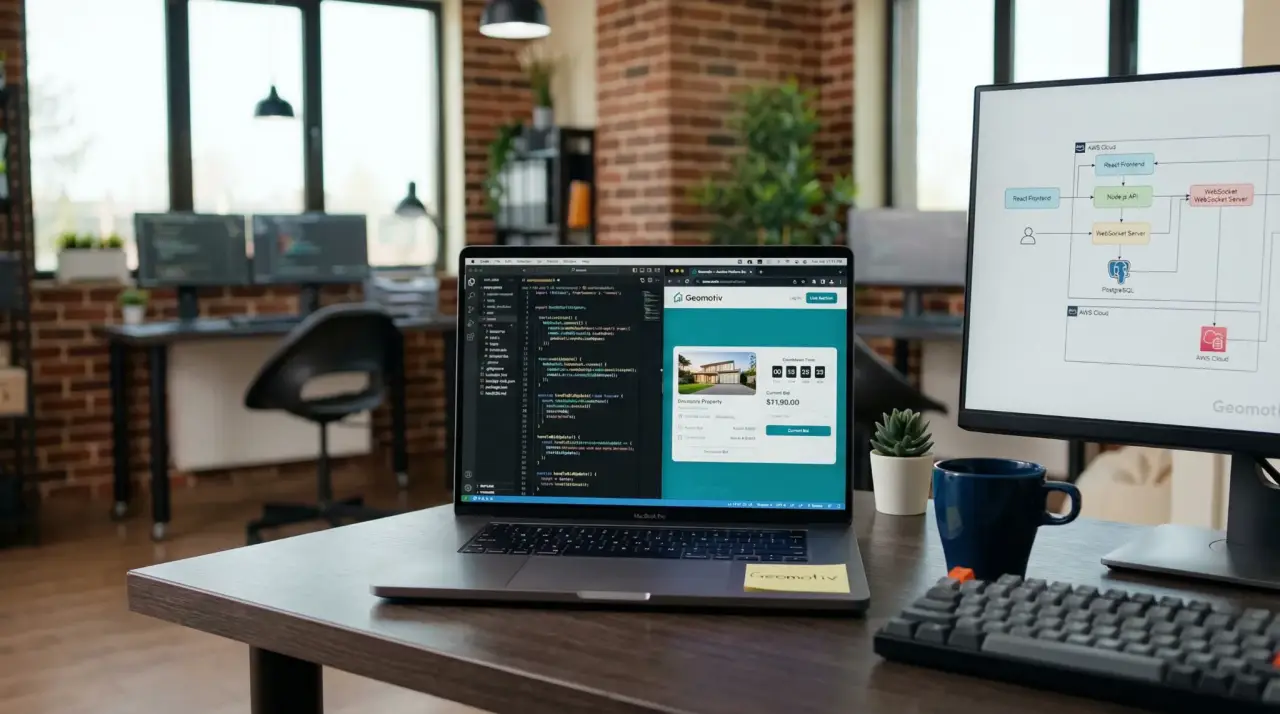
The online auction market continues to expand across industries, from eCommerce and real estate to art, agriculture, and nonprofit fundraising. Yet a lot of organizations reaching the growth stage discover that off-the-shelf platforms no longer accommodate their operational complexity. Rigid listing structures, limited bidding formats, generic user interfaces, and shallow integration capabilities create friction that directly impacts revenue and user retention.
Building a purpose-built auction platform allows organizations to design every element of the bidding experience around their specific business model, audience expectations, and operational requirements. However, custom development is a significant investment, and understanding when it is justified, what it involves, and how to approach it correctly is essential before committing resources.
What Is Custom Auction Software Development?
Custom auction software development is the process of designing, building, and deploying a digital auction platform from the ground up, tailored to the unique requirements of a specific business or industry. Unlike ready-made solutions or white-label platforms, a custom-built system gives the organization full control over architecture, functionality, user experience, and intellectual property.
In other words, every component of the platform, from the bidding engine and payment processing layer to the admin panel and analytics dashboard, is engineered to match the organization’s exact workflows. What is also important here is that custom development does not necessarily mean starting from a blank canvas. A lot of projects combine proprietary modules with open-source components or third-party integrations to balance cost, speed, and flexibility.
When Does Custom Development Make Sense?
Custom auction platform development is not the right choice for every organization. For early-stage startups testing a business model, a ready-made or white-label solution may be a more practical starting point. However, there are clear scenarios where the limitations of pre-built platforms become a measurable business problem.
The most common triggers for going custom include:
- The business requires a bidding format (English, Dutch, Vickrey, sealed-bid, penny, or ticker) that existing platforms do not support natively or combine within a single system.
- The platform needs to handle high-load scenarios with thousands of concurrent bidders and real-time price updates without latency.
- Industry-specific compliance requirements (financial regulations, export controls, data privacy laws) demand architectural decisions that cannot be retrofitted onto a generic tool.
- The user experience needs to reflect a distinct brand identity with custom interfaces for buyers, sellers, and administrators.
- Integration with proprietary internal systems (ERP, CRM, inventory management, logistics) requires deep API-level connectivity that off-the-shelf platforms cannot provide.
- The organization intends to retain full ownership of the platform’s intellectual property for long-term competitive advantage.
From a financial perspective, the upfront investment in custom development is higher than licensing a ready-made solution. However, when the limitations of a generic platform result in lost revenue, poor user engagement, or operational workarounds that consume staff time, the total cost of ownership often favors the custom path.
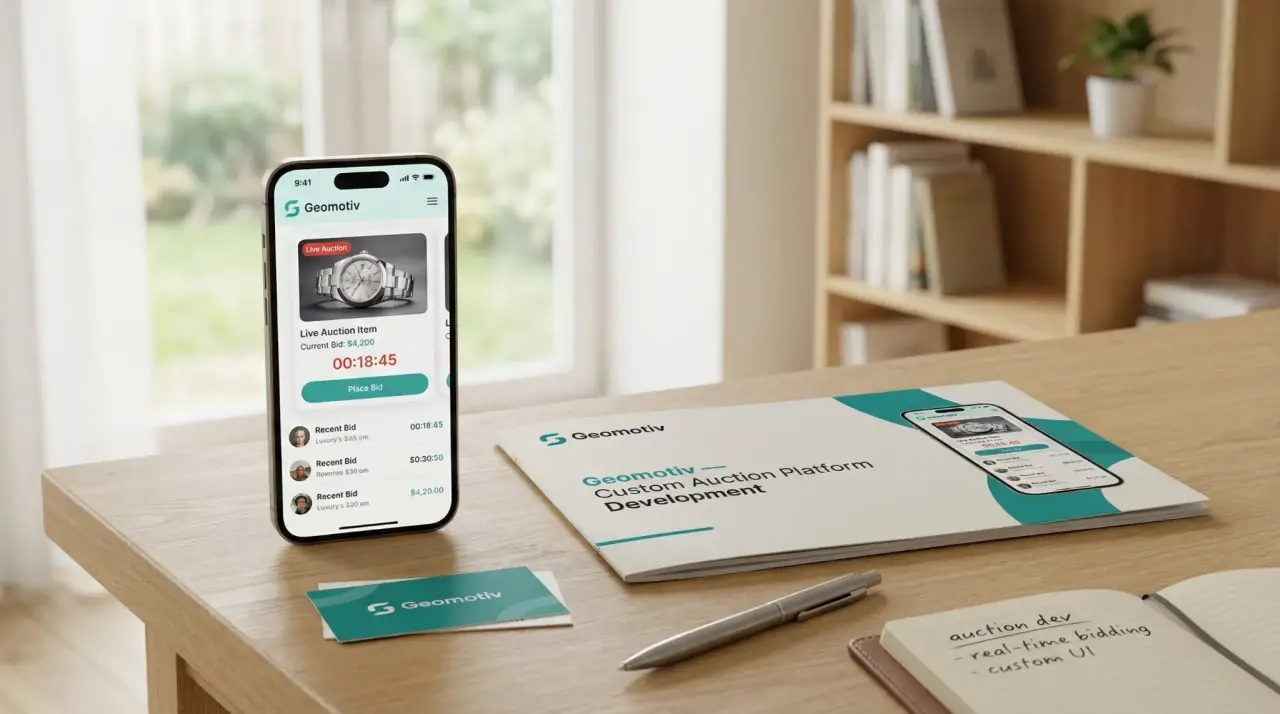
Key Components of a Custom Auction Platform
Building an auction platform from scratch involves a broad set of technical and functional components. The following areas represent the core building blocks that any comprehensive custom solution should address.
Bidding Engine and Auction Format Support
The bidding engine is the technical core of the platform. It processes bids in real time, enforces auction rules (minimum increments, reserve prices, time extensions), and determines winners. A custom engine can support multiple auction formats within a single platform, including English, Dutch, Vickrey, sealed-bid, penny, ticker, and buy-it-now models.
Thanks to this flexibility, operators can match the auction format to the product category and audience behavior rather than forcing all items through a single bidding model.
Role-Based User Management
A mature auction platform requires distinct interfaces and permissions for different user types. Role-based user management typically includes buyer dashboards (bidding history, watchlists, payment methods), seller panels (listing creation, inventory management, performance analytics), and admin consoles (platform configuration, user moderation, financial reporting).
Custom development allows each role’s interface to be designed around the actual workflows of its users, rather than adapting to the generic layout of a pre-built system.
Payment Processing and Monetization
Secure, flexible payment processing is non-negotiable for any auction platform. Custom development enables integration with multiple payment gateways (Stripe, PayPal, Adyen), support for various payment methods (credit cards, digital wallets, ACH transfers), and implementation of escrow-style flows where funds are held until delivery is confirmed.
Apart from this, the platform’s monetization model can be built directly into the architecture. The most widely used options are seller listing fees, transaction-based commissions, membership tiers with premium features, and insertion fees per item category. A custom system allows these models to be combined and adjusted without architectural constraints.
Integrations and Scalable Infrastructure
No auction platform operates in isolation. Custom solutions are built with an integration-first architecture that connects the platform to external systems across the business stack.
Typical integrations include:
- CRM systems for buyer and seller relationship management.
- Inventory and warehouse management for real-time stock synchronization.
- Shipping and logistics providers for automated fulfillment workflows.
- Analytics and business intelligence tools for performance monitoring.
- Marketing automation platforms for targeted campaign delivery.
- Identity verification services for buyer pre-qualification and fraud prevention.
What is also important here is that the platform’s infrastructure should be designed for horizontal scalability from the start. Cloud-based deployments on AWS, Google Cloud, or similar providers enable the system to handle traffic spikes during live auction events without performance degradation.
How to Approach Custom Auction Platform Development
Managing a custom development project requires clear planning, realistic expectations, and a structured decision-making process. We recommend the following approach to minimize risk and maximize alignment between the final product and business objectives.
- Define the auction model before writing any code. Map out every bidding format, user role, monetization mechanism, and compliance requirement the platform needs to support. This becomes the functional specification that guides the entire development process.
- Choose the right development approach. You should attentively analyze whether a fully custom build, a platform-based solution with custom modules, or a white-label customization best fits the project’s budget, timeline, and long-term goals. Each path offers a different balance of cost, speed, and control.
- Prioritize security and compliance from day one. PCI DSS compliance, data encryption, role-based access controls, and GDPR readiness should be embedded in the architecture, not added as afterthoughts. Pay attention to these requirements during the technology selection phase.
- Plan for iteration, not perfection at launch. It will be helpful to define an MVP (minimum viable product) scope that includes core bidding functionality, payment processing, and essential user management. Additional features, such as advanced analytics, AI-powered recommendations, or multi-format support, can be introduced in subsequent releases based on real user feedback.
- Establish clear evaluation criteria for development partners. If working with an external team, verify their experience with real-time systems, high-load architecture, payment integrations, and the specific industry vertical the platform will serve. Request case studies and technical references rather than relying on portfolio screenshots alone.
Custom vs. Ready-Made: A Quick Comparison
The decision between custom and ready-made is not binary. A lot of organizations start with a platform-based or white-label solution and migrate to custom development as their business scales. Understanding the trade-offs helps set realistic expectations.
First of all, ready-made platforms offer faster time-to-market (typically 2 to 4 months), lower upfront costs, and proven functionality. However, they come with limited customization depth, vendor dependency, and restricted IP ownership. Secondly, custom-built solutions require a longer development cycle (6 to 12 months or more) and higher initial investment, but provide unlimited scalability, full architectural control, and complete intellectual property ownership.
A combined approach that integrates open-source components with custom-developed modules can offer a middle ground: moderate cost, faster deployment than a purely custom build, and a higher degree of flexibility than a fully pre-built platform. This hybrid model is increasingly popular among organizations that need to launch quickly but plan to scale significantly over time.
Geomotiv is a platform development company with over 16 years of experience building eCommerce and auction solutions across verticals such as real estate, art, agriculture, automotive, and nonprofit fundraising. The team delivers both fully custom auction platforms and hybrid builds that combine open-source foundations with proprietary modules. Given this depth of cross-industry experience, Geomotiv can be a relevant partner for organizations that need a tailored auction solution aligned with specific business logic and scalability requirements.
Final Word
Custom auction software development is a strategic investment that makes sense when off-the-shelf platforms can no longer support the complexity, scale, or differentiation that a business requires. The key components, including a flexible bidding engine, role-based user management, secure payment processing, and a scalable integration architecture, form the foundation of any competitive custom platform.
Ultimately, the right development approach depends on the organization’s current stage, budget, and long-term ambitions. By clearly defining requirements, choosing the appropriate build strategy, and prioritizing security and scalability from the outset, organizations can create auction platforms that not only meet today’s needs but also adapt as the business and its market evolve.