
Female gamers today represent a mainstream segment of the global gaming audience. According to PC & console games data provider Newzoo’s Global Gamer Study, out of the total online population, 76% of women globally play games (vs. 83% of men) in the past six months, underscoring how widespread gaming participation among women has become.
However, how they play, discover, and spend on games differs in meaningful ways from male gamers.
The Newzoo study was carried out across 36 markets, based on the total online population aged 10–65.
Platform participation shows gender differences
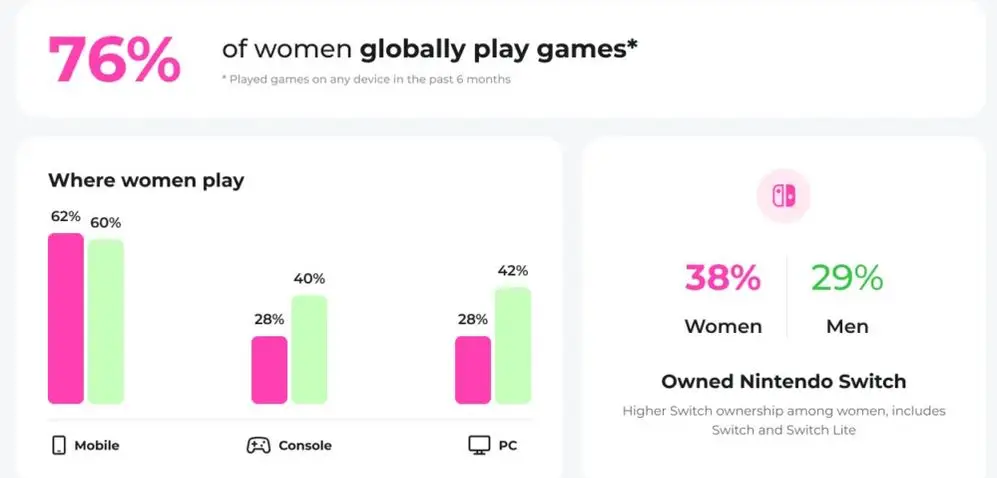
While gaming participation is widespread across both genders, platform mix reveals important differences. Mobile participation is nearly identical (62% of women vs. 60% of men), highlighting its role as a universal access point.
However, the largest gaps appear on PC and console:
- 28% of female gamers play on console vs. 40% of male gamers
- 28% play on PC vs. 42% of men
This indicates that PC and console ecosystems remain more male-skewed, while female gamers are relatively more concentrated on mobile.
Even though the console is more popular among male players, women are more likely to own a Nintendo Switch: 38% of women report owning a Nintendo Switch or Switch Lite, compared with 29% of men, highlighting opportunities within this specific ecosystem.
How women and men discover games differs
Female gamers are less likely to use gaming-endemic channels, including (sorted by the difference between female and male participants):
- Specialist gaming websites and communities (15% vs. 22%)
- From game developers/publishers (16% vs. 22%)
- Discord communities (15% vs. 21%)
- Gaming subscription recommendations (19% vs. 24%)
- Content creators and influencers on social media or gaming streaming platforms (26% vs. 30%)
YouTube remains a major discovery channel for both groups, though men report higher usage (43% vs. 36%).
By contrast, discovery through broader platforms is nearly identical between genders:
- Social media promotions (37% women vs. 36% men)
- Online or app stores (33% vs. 34%)
- Recommendations from friends (35% vs. 37%)
Spending shows a persistent gap
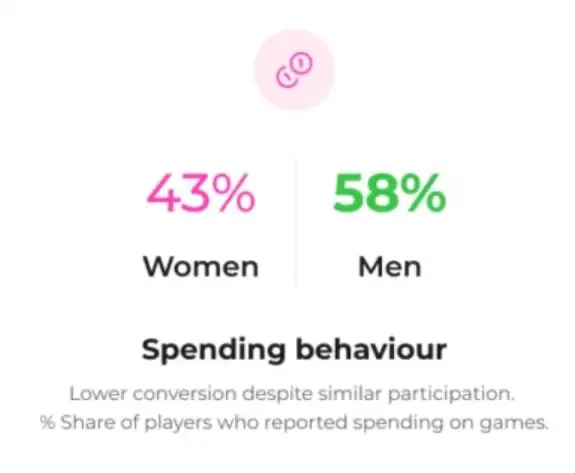
Spending behavior reveals a persistent monetization gap. 43% of female gamers report spending money on games, compared to 58% of male gamers, and this difference remains consistent across platforms.
Taken together, the data show that female gamers are highly engaged but tend to interact with the gaming ecosystem through different discovery pathways, platform preferences, and spending behaviors.
As the global gaming audience continues to diversify, success will increasingly depend on aligning distribution, platform strategy, and monetization models with how different audiences actually engage with games.
Charts courtesy of Newzoo
Photo Credit: leungchopan / Shutterstock.com