
Price charts are one of the most important tools for you as a trader or investor. Whether you’re starting out or you’ve been watching the markets for a while, knowing how to read a chart can help you make informed decisions and avoid acting on impulse.
This guide walks you through how crypto price charts work, how to decode candlestick charts, and how to use the key indicators that traders rely on most.
TL;DR
- A crypto price chart is a visual record of a coin’s price movement over time.
- Candlestick charts are the most widely used chart type. Each candle shows four data points: open, high, low, and close (OHLC).
- Key indicators to know include trading volume, moving averages (MA), RSI, and support/resistance levels.
What Is a Crypto Price Chart?
A crypto price chart is a visual representation of a cryptocurrency’s price movement over time. It maps out how a coin’s value has changed minute by minute, hour by hour, or day by day, depending on the timeframe you select.
The structure is straightforward, with the x-axis (horizontal) representing time and the y-axis (vertical) representing price.
On crypto exchanges, prices are typically displayed in USDT (Tether), though other stablecoin and fiat trading pairs are also available. This standardization makes it easier to compare price movements across different assets.
There are three main types of crypto charts:
- Line chart: connects closing prices with a single line. It’s simple and clean, but limited in data.
- Bar chart: displays open, high, low, and close for each period using vertical bars with side ticks.
- Candlestick chart: this is the most widely used format. It delivers the same OHLC data as bar charts, but with a visual body that makes bullish and bearish moves instantly readable.
How to Read a Candlestick Chart
Each candle on a chart represents the price movement within a defined time period. On a daily (1D) chart, each candle covers exactly one day of trading. On a weekly (1W) chart, each candle covers an entire week.
Every candle contains four data points, collectively called OHLC:
- Open: the price at the start of the period
- High: the highest price reached during the period
- Low: the lowest price reached during the period
- Close: the price at the end of the period
The candle has two visual components:
- The body (thick part) shows the range between the open and close prices
- The wicks (thin lines above and below) show the highest and lowest prices reached during the period, even if the price didn’t stay there
Color tells you the direction:
- A green candle means the price closed higher than it opened, indicating a bullish session
- A red candle means the price closed lower than it opened, indicating a bearish session
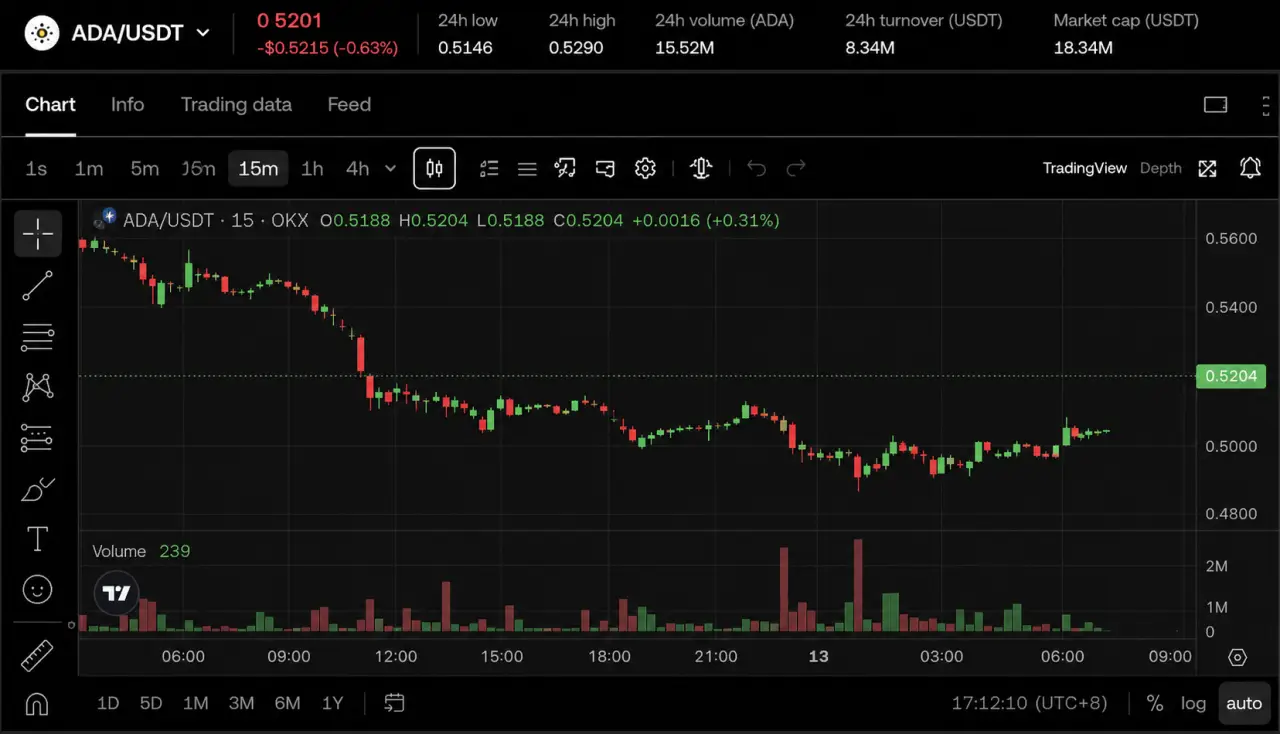
If you’re looking at current ADA price on OKX (as you can see in the chart above), each candle on the chart tells you exactly what ADA did in that time period:
- Where it started (open price)
- Where it ended (close price)
- How high and low it moved in between (wicks)
When reviewing the current daily candle, note whether it is green or red and pay attention to the size of the body. A long body with a small wick suggests strong directional momentum. A candle with a small body but long wicks shows indecision in the market. Buyers and sellers were both active, but neither dominated by the close.
Key Chart Indicators to Know
Raw candlestick data tells you what happened. Indicators help you understand why it matters and what might come next. Here are the four most important indicators traders typically look at.
Trading Volume
Volume shows how many units of any asset were traded during a given period. It’s typically displayed as a histogram (bar chart) at the bottom of the main price chart.
Why it matters:
- High volume on a green candle = strong buying conviction. The move is more likely to be meaningful.
- High volume on a red candle = significant selling pressure. The drop may have substance behind it.
- Low volume on any candle = weak participation. Price moves on low volume are often reversed quickly.
As a rule of thumb, always confirm price moves with volume.
Moving Averages (MA)
A moving average smooths out price data by calculating the average closing price over a set number of periods. The two most commonly used are:
- The 50-day MA tracks medium-term trend direction
- The 200-day MA tracks long-term trend direction, often used by institutional traders
When the price is trading above its moving average, the asset is generally considered to be in an uptrend and vice versa.
A widely watched event is the “golden cross” when the 50-day MA crosses above the 200-day MA. This has historically been interpreted as a bullish signal for crypto assets, though it’s a lagging indicator, meaning it confirms a trend rather than predicting it.
Relative Strength Index (RSI)
The RSI is a momentum indicator that measures the speed and magnitude of recent price changes to assess whether an asset is overbought or oversold. It’s displayed as a line oscillating between 0 and 100.
- RSI above 70 = overbought territory, and the asset may be due for a pullback.
- RSI below 30 = oversold territory and could indicate a potential recovery, depending on broader market conditions.
- RSI between 40 – 60 = neutral zone with no strong directional signal.
The RSI is useful for identifying potential turning points in price, but it works best in sideways or ranging markets. In a strong trend, RSI can remain overbought or oversold for extended periods, which is why it should be used alongside volume and moving averages, not in isolation.
Support and Resistance Levels
Support and resistance are price levels where an asset has historically stalled or reversed.
- Support: a floor or a price level where buying interest has repeatedly prevented the price from falling further.
- Resistance: a ceiling or a price level where selling pressure has repeatedly prevented the price from rising further.
On the price chart, you can spot these levels by looking for price points where the candles cluster, bounce, or reverse multiple times. When price breaks through a resistance level with strong volume, that former resistance often becomes the new support, a concept called “role reversal.”
What Crypto Charts Can (and Can’t) Tell You
Charts are useful, but they come with limits. They show where price has moved, can help gauge market sentiment, highlight support and resistance, and point to trend direction across timeframes.
However, they don’t predict what happens next or account for macro events, regulations, or protocol changes.
Remember, crypto is volatile, and you should never risk more than you can afford to lose, regardless of whether you’re seeing patterns in charts or not.