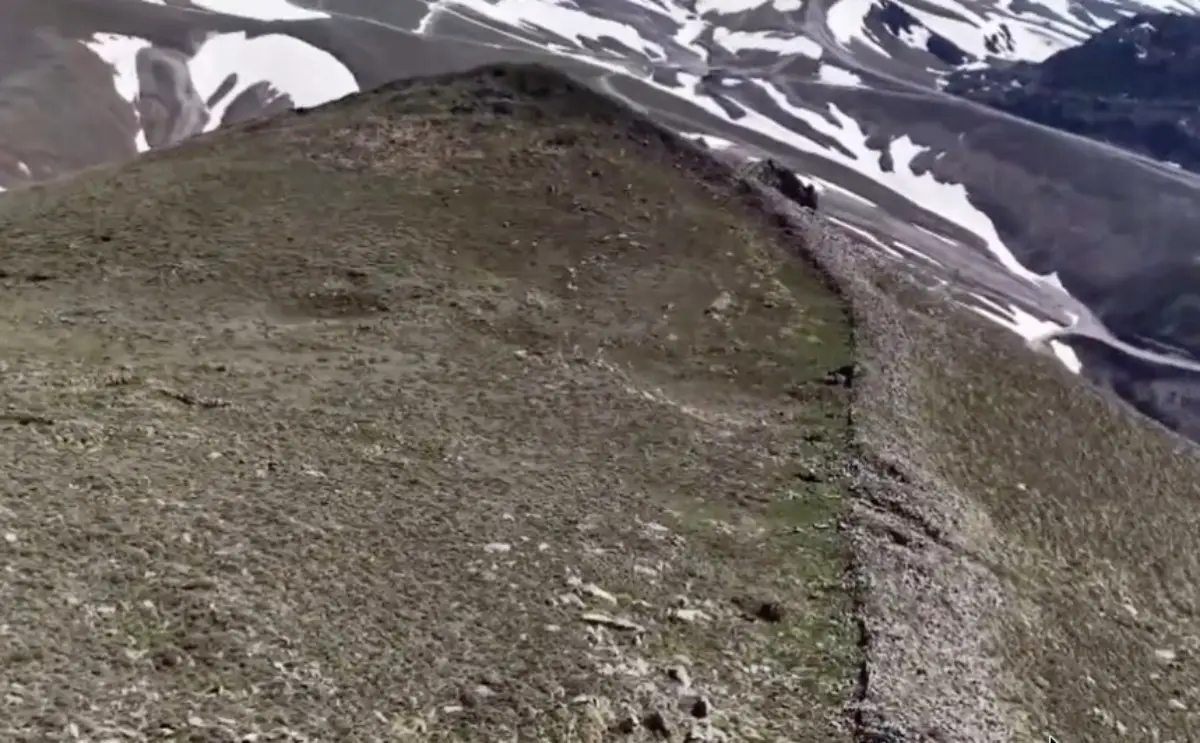
The melting of snow on Lifos Mountain in Kayseri province, central Turkey, has exposed the remains of a vast ancient settlement that researchers believe may have been one of the most significant religious centres of the ancient world. Drone footage captured the scale of the site for the first time, revealing walls, palace foundations, cisterns and defensive towers spread across a 2,509-metre peak in the Hacilar district, just north of Erciyes Mountain.
What Has Been Found
The complex covers approximately 74,300 square metres and is enclosed by around one kilometre of dry-stone walls estimated to have originally stood three to four metres high. The settlement is laid out in a rectangular form running east to west, with defensive towers positioned at intervals of 66 metres. The northern face drops into a steep cliff, leaving a rugged path from the south as the only apparent point of entry.
Inside the walled area, researchers have identified the foundations of large palace-like structures and four major cisterns. The presence of cisterns points to long-term habitation and the capacity to sustain a sizeable permanent or seasonal population. Experts say the complexity of the layout and the scale of the construction indicate the site was not built quickly and required considerable resources.
A Temple City Compared to the Vatican
Historian and writer Halit Erkiletlioglu, one of the leading voices calling for the site to be protected and excavated, described it as one of the most mysterious places in Kayseri. He compared its function to that of the Vatican, a self-contained sacred city operating within a broader state.
Erkiletlioglu said ancient pagan believers came to the site as pilgrims to be purified of their sins, drawn by the sacred status of Erciyes Mountain, which was worshipped as a deity in antiquity. Its image appeared on ancient coins, reinforcing its divine status in the eyes of people across the region. He said the temple city was most likely built on the highest nearby peak in honour of Zeus, the chief god of the ancient Greek and Anatolian religious world.
The site is also mentioned in historical and ancient geographical sources. The ancient Greek geographer Strabo, writing in his work Geographica, referred to the sacred character of the mountains around Erciyes, known in antiquity as Argaios. The 17th-century Ottoman traveller Evliya Celebi also referenced the region, though his accounts were largely based on oral tradition.
One of Anatolia’s Oldest Settlements
Researchers say Lifos Mountain, also known as Kifos, may contain one of the oldest settlements in Anatolia after Kultepe, the ancient city of Kanesh located approximately 20 kilometres northeast of Kayseri. Kultepe is already considered for UNESCO World Heritage status and dates back to at least 1900 BC, with clay tablets from its Assyrian trading post representing some of the earliest written records found in Turkey.
The summit plateau of Lifos is considered by some researchers to be a crater plain, which would mean the settlement was built within the rim of an ancient volcanic feature, adding further significance to its elevation and landscape.
Threat from Looters
Experts are raising urgent concerns about the condition of the site. Now that the snow has melted, the exposed structures are vulnerable to damage from treasure hunters and illegal digging. Signs of past disturbance are already visible, and local specialists are calling on Turkish authorities to move quickly to secure the area and prevent further losses.
Erkiletlioglu said no formal archaeological research has ever been conducted at the site, meaning its full extent and historical significance remain unknown. He is urging the authorities to launch a proper excavation before more of the site is lost to looting or natural erosion.
Tourism Potential
Experts say that if the site is protected and properly excavated, Lifos Mountain could become a major draw for cultural and archaeological tourism in Turkey. The region already attracts visitors to Erciyes, one of Turkey‘s leading ski resorts, and to the nearby landscapes of Cappadocia. The addition of a well-preserved ancient religious complex at altitude could significantly strengthen the area’s appeal as a year-round destination.
The discovery comes at a time of growing international interest in Turkey‘s archaeological heritage. Kultepe-Kanesh is on UNESCO‘s tentative World Heritage list, and excavations at sites across Anatolia continue to reshape understanding of ancient civilisation in the region.