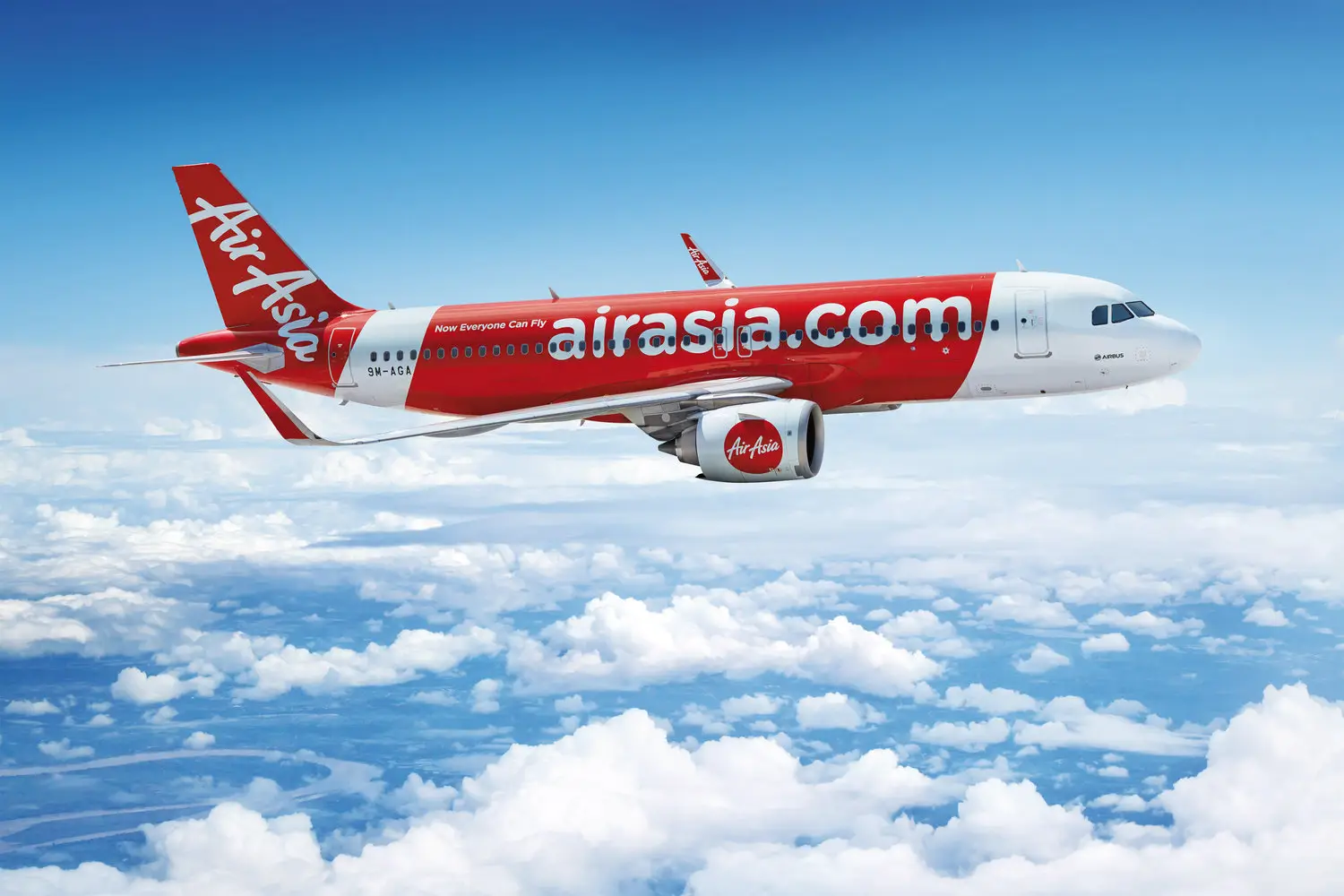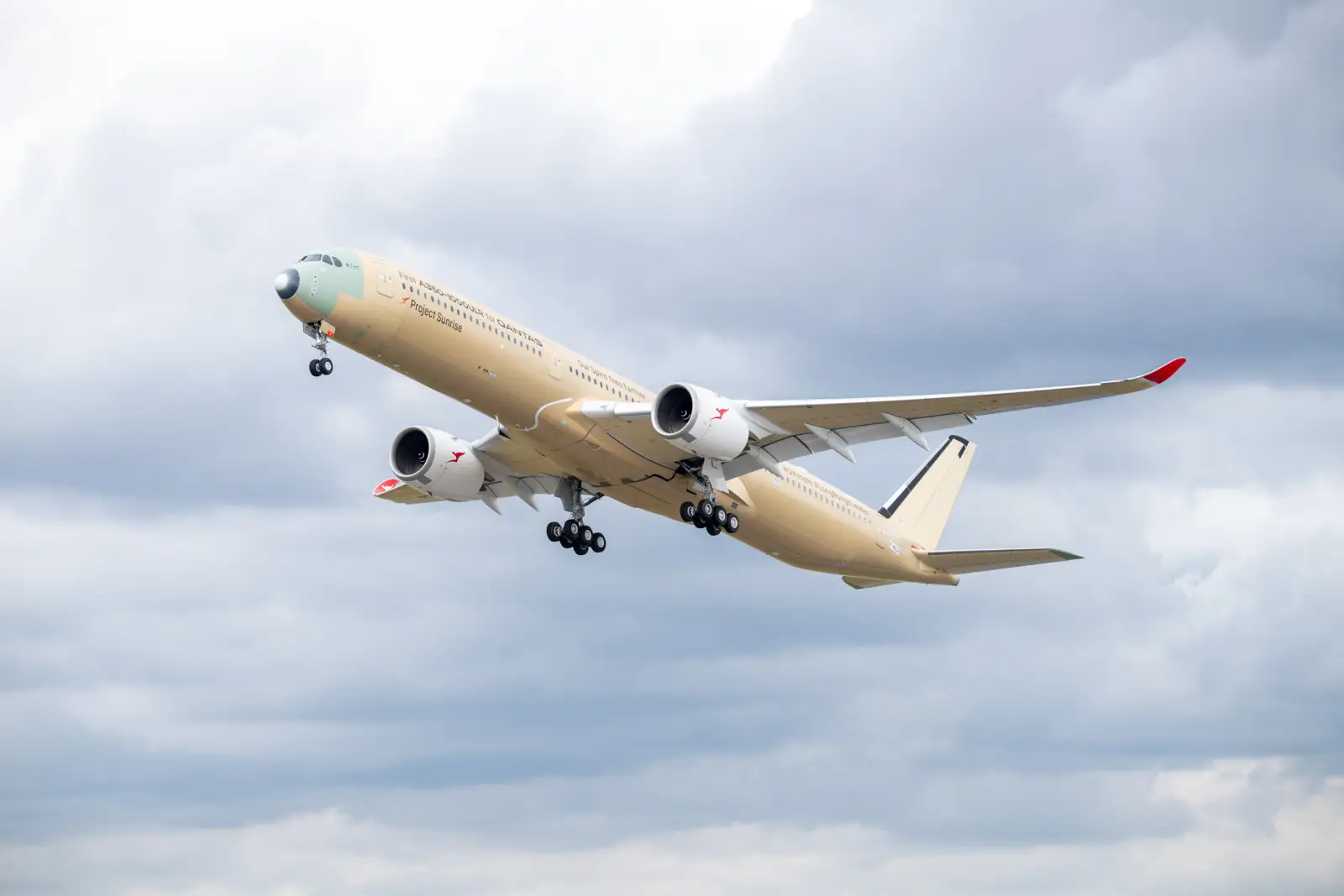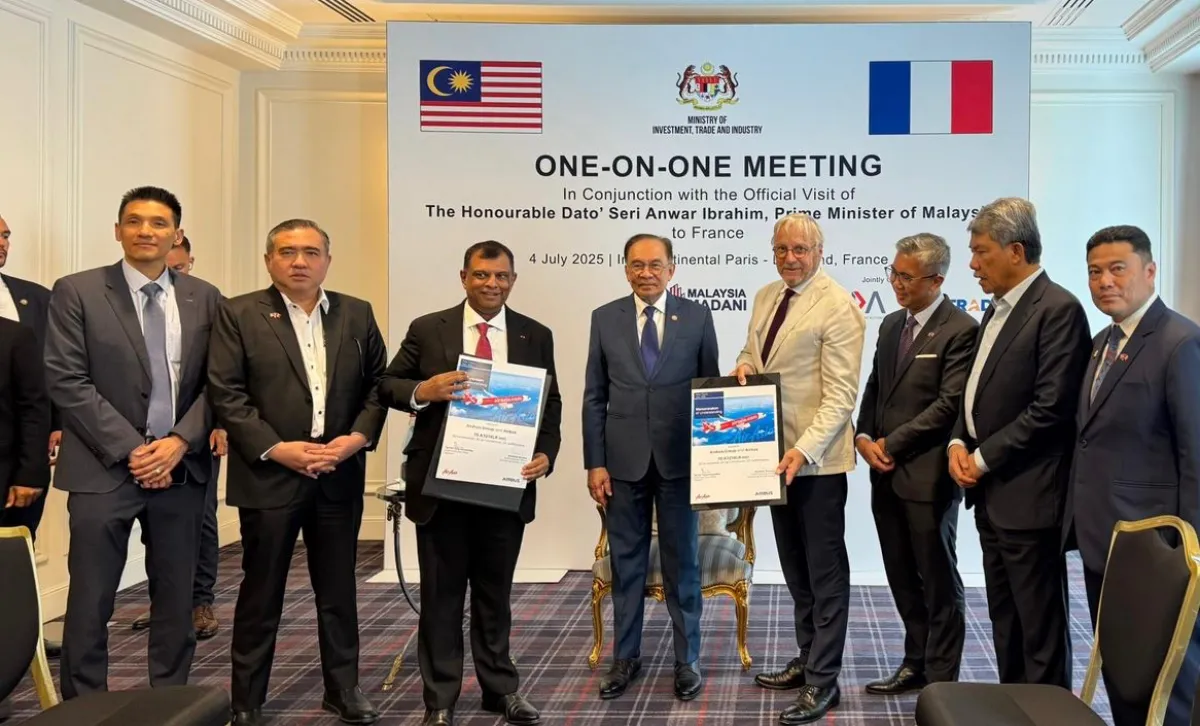
AirAsia has signed a landmark agreement with Airbus valued at USD12.25 billion for 50 A321XLRs with rights for 20 A321XLRs. With this agreement, the airline takes a major step towards becoming the world’s first low-cost narrow-body network carrier, anchored by its multi-hub strategy. The aircraft are scheduled for delivery commencing 2028 through 2032.
Witnessed by Prime Minister of Malaysia Anwar Ibrahim who was on an official visit to France, the agreement was signed in Paris on 5 July between Tony Fernandes, CEO of Capital A (parent company of AirAsia), and Christian Scherer, CEO of Airbus Commercial Aircraft.
Half price to Europe and the U.S.?
With an additional three hours of flight time and higher fuel efficiency versus the A321neo, Fernandes, who is founded AirAsia 23 years ago, said the new planes enable a low-cost long-range offering to expand AirAsia’s reach as part of a renewed strategy to expand into long-haul markets, including Europe and North America.
The new narrow-body planes can fly up to nine hours, connecting Southeast Asian airports in Bangkok and Kuala Lumpur with the Middle East, then hopping on to Europe in the westerly direction, while for the east, from Southeast Asia to Taiwan or Japan, then a network hop to the US.
Fernandes noted that the goal is to provide flights to Europe and the US at half the price, of what is currently available in the market. “The goal here is not to take anyone’s market share, it is to allow people to fly to places they never dreamt of flying to. I think the opportunity is huge, So really, the world is our oyster now,” he said.
“Obviously with a narrowbody fleet, with efficiency, we believe our fares to the rest of the world will be very, very, very competitive, and we will open up whole new markets,” Fernandes said. AirAsia, which operated long haul flights under AirAsia X previously, has not operated flights to Europe since 2012 and to the US since 2020.
It also means, said Fernandes, when asked by Khaosod English how the new planes will alter low-cost air traffic from Thailand, that Phuket and Chiang Mai Airports will see many direct flights between these Thai airports and cities in India and China.
Expansion in the Middle East
The airline’s parent company, Capital A, had earlier announced in May, its plans to significantly expand into Saudi Arabia, marking a pivotal step in the Group’s Middle East growth strategy. The multi-faceted initiative will begin with AirAsia introducing new routes to Riyadh and Dammam, while increasing flight frequencies to Jeddah from Kuala Lumpur.
It said that the new Riyadh route is projected to serve close to one million two-way passengers by 2026 and more than seven million by 2030.
The Group is also studying new connections from Bangkok and Jakarta to Riyadh, as part of its wider ambition to enhance Middle East connectivity across the Asean region.
Long term strategy of improving connectivity and sustainability
The next-generation A321XLRs will operate alongside AirAsia’s all-Airbus fleet of A320 Family and A330 aircraft, supporting its long-term strategy to deliver unmatched connectivity across Asia and beyond, while maintaining a low-cost model through improved route economics, enhanced aircraft utilisation and fleet efficiency.
The new fleet plays a pivotal role in this transformation. AirAsia’s multi-aircraft strategy enables the airline to match capacity with demand, reduce fuel consumption, and support a sustainable, cost-effective growth model in a highly competitive global landscape. The A321XLR also offers up to 20 per cent lower fuel burn per seat than the Airbus A321neo aircraft, significantly improving emissions performance and operating efficiency.
The first A321XLR is expected to enter service between 2027 and 2028, with long-haul operations initially handled by the A330 fleet. The group is also scheduled to take delivery of four A321LRs in 2026 as reported by Aviation Week.
150 new aircraft in the pipeline
Tony Fernandes also has been reported by NST.com that AirAsia Group is looking to order up to 150 new aircraft as part of its 15-year fleet strategy. and will be announcing its decision as early as August.
He confirmed that the airline group is in discussions with at least two aircraft manufacturers about the order, which are Embraer, for E2-family aircraft, and Airbus for its A220 programme. Fernandes also says that AirAsia is in talks with Chinese airframer Comac.
On a 10-year horizon, Fernandes noted that AirAsia plans to expand its fleet to comprise more than 500 purely narrowbody planes from its current 255 narrowbody and widebody aircraft.
Meanwhile, within the next five years, the aviation group plans to raise annual passengers carried to 130 million from 70 million currently, and boost destinations served to 175 from 143.
Malaysia Airlines orders 20 additional A330-900
Malaysia Aviation Group confirmed an order for 20 additional A330-900 aircraft, which was also announced during Prime Minister Anwar Ibrahim’s visit to France. This latest agreement effectively doubles the airline’s future A330neo fleet to 40 aircraft.
Malaysia Airlines has already begun operating its first A330neo jets on popular routes linking Kuala Lumpur to destinations such as Melbourne, Auckland, and Bali.