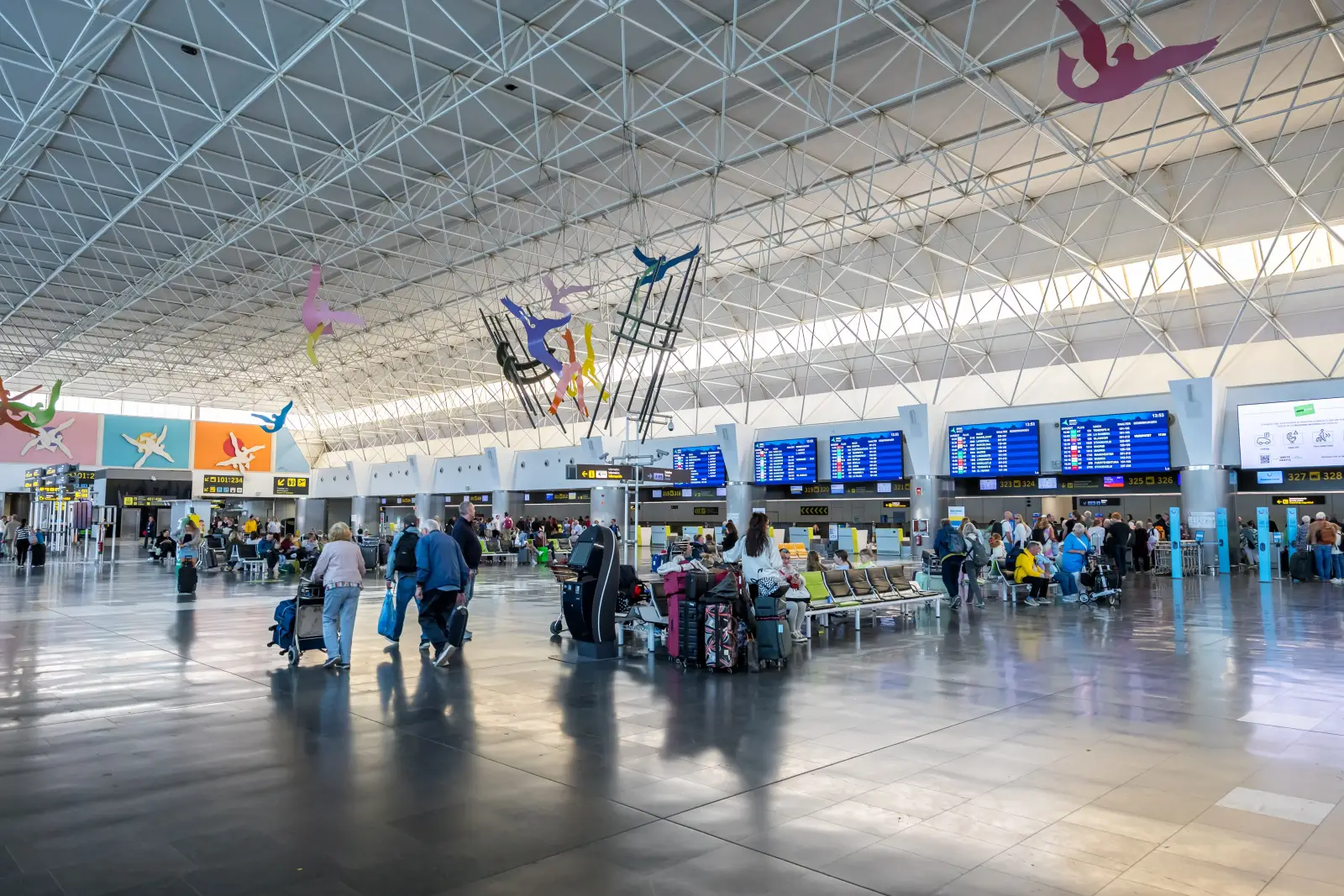
Spanish senators have increased pressure on Aena over the management of airports in the Canary Islands and the Balearic Islands, calling for island governments to have a greater role in decisions that affect air connectivity.
The motion, backed by senators Fabián Chinea and Juanjo Ferrer of the Confederal Left Group, urges Spain’s central government to create a stable co-governance model for the two archipelagos.
The proposal argues that airports in the islands are not simply transport infrastructure, but essential public services for residents, workers, businesses and visitors. It says decisions on airport charges, route planning, investment and service changes have a direct impact on mobility and economic resilience.
The debate comes at a sensitive time for Spain’s airport network. Aena said its Spanish airports handled more than 321.5 million passengers in 2025, up 3.9% from the previous year, underlining the scale of the system managed by the state-linked operator.
The Canary Islands and the Balearic Islands are among the most aviation-dependent parts of Spain. Air links connect residents with mainland Spain, support tourism and provide access to health, education, business and administrative services.
The motion says the autonomy statutes of both regions already recognise a role for the islands in planning and managing airports of general interest. However, supporters argue that this has not translated into real decision-making power.
The senators want the government to review existing airport coordination committees, which they describe as largely advisory. They say the current model gives regional authorities limited influence over decisions made by Aena and central government bodies.
The proposal also leaves open the possibility of including island councils, known as cabildos in the Canary Islands and consells in the Balearic Islands, in a future participation structure.
Supporters of the motion say the aim is not to break up Spain’s national airport network. Instead, they argue that a shared management model could be adapted for territories that depend heavily on air travel.
The issue has gained momentum in the Canary Islands, where the regional government has stepped up criticism of Aena. Pablo Rodríguez, the Canary Islands transport councillor, has argued that the region should have a stronger say in airport planning and revenue-related decisions.
Aena has defended the current model, saying existing participation mechanisms already allow regional and local institutions to contribute. The operator has also pointed to planned investment in the Canary Islands airport network, including major works expected in the 2027 to 2031 period.
The dispute also comes as airport charges are rising in Spain. The CNMC, Spain’s competition regulator, approved an average 6.44% increase in Aena airport charges for 2026, setting maximum adjusted income at €11.02 per passenger.
For island regions, the question is politically sensitive because any change in charges, routes or investment priorities can affect ticket prices, airline capacity and tourism flows.
The Canary Islands and Balearic Islands have long argued that their geographic position requires a different approach from mainland airports. Tourism remains a major part of both regional economies, while residents rely on air travel for connections that mainland communities can often make by road or rail.
The Senate motion is unlikely to change airport policy immediately, but it adds political pressure on the Spanish government to reconsider how island airports are managed.
It also raises a wider question for Spain’s aviation sector: whether a centralised airport model can continue to satisfy regions where air connectivity is not optional, but essential to daily life.
Canary Islands airports: Gran Canaria Airport, Tenerife South Airport, Tenerife North-Ciudad de La Laguna Airport, César Manrique-Lanzarote Airport, Fuerteventura Airport, La Palma Airport, La Gomera Airport and El Hierro Airport.
Balearic Islands airports: Palma de Mallorca Airport, Ibiza Airport and Menorca Airport.
Photo Credit: Markus Mainka / Shutterstock.com