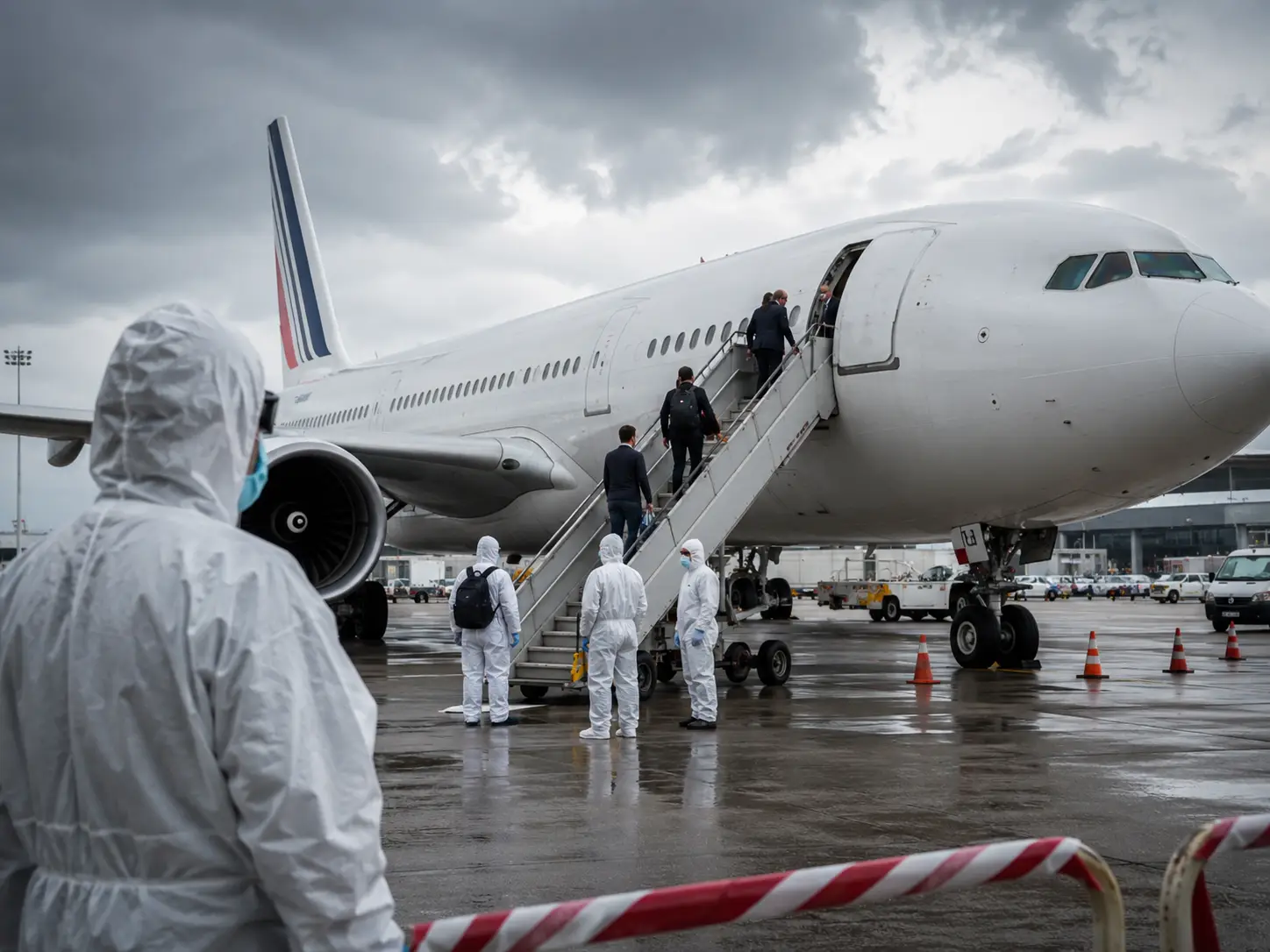
A Detroit-bound Air France flight was diverted to Canada after a passenger who had recently travelled from central Africa was found to be on board during newly introduced US Ebola travel restrictions, as health authorities warned the outbreak could continue to spread across the region.
Air France flight 378 was travelling from Paris to Detroit Metropolitan Wayne County Airport when it was rerouted to Montreal for additional screening procedures. US Customs and Border Protection confirmed the aircraft carried a passenger from the Democratic Republic of Congo but said there was no immediate indication the traveller was showing Ebola symptoms.
The diversion came just days after US authorities introduced emergency travel measures aimed at slowing the spread of the Bundibugyo strain of Ebola, which has triggered growing international concern.
The US Centers for Disease Control and Prevention and the Department of Homeland Security announced a 30-day restriction on entry for non-US passport holders who have recently been in the Democratic Republic of Congo, Uganda or South Sudan. Enhanced health screening and traveller monitoring measures also came into force at selected US airports.
Under the new policy, passengers who have travelled through the affected countries within the previous 21 days are being routed through Washington Dulles International Airport, where US authorities have concentrated specialised public health resources and screening teams.
The outbreak has rapidly escalated in recent weeks. The World Health Organization declared the Ebola outbreak in the Democratic Republic of Congo and Uganda a Public Health Emergency of International Concern on May 17.
Health agencies say the outbreak involves the rare Bundibugyo strain of Ebola, for which there is currently no approved vaccine or targeted treatment. The strain was first identified in Uganda in 2007 and has only caused a small number of outbreaks since then.
According to the European Centre for Disease Prevention and Control, more than 500 suspected cases and over 130 deaths have been reported in the Democratic Republic of Congo, with infections concentrated in the Ituri province near the Ugandan border.
Reuters reported that a confirmed Ebola case was also detected in South Kivu province, hundreds of kilometres from the main outbreak zone, increasing fears that the disease may already be spreading beyond the initial cluster.
The World Health Organization said transmission has been complicated by armed conflict, population displacement, weak healthcare infrastructure and mistrust among local communities. International aid groups have warned that the true scale of infections may be significantly higher than officially recorded numbers.
The outbreak has already disrupted regional aviation and cross-border travel. Uganda temporarily suspended some flights linked to affected areas, while Rwanda tightened border controls. Airlines and airport authorities across North America and Europe are also reviewing screening procedures for passengers arriving from central Africa.
US health officials continue to stress that the immediate risk to the American public remains low. However, authorities acknowledge the disease circulated undetected for weeks before being formally identified.
One American doctor working in the Democratic Republic of Congo tested positive for Ebola while treating patients at Nyankunde Hospital, according to Reuters and the Christian medical mission organisation Serge. Several other Americans considered to have had high-risk exposure are being medically monitored in Europe.
During a CDC briefing, Dr Satish K Pillai, incident manager for the agency’s Ebola response, said exposed US citizens were being transported to specialised medical facilities in Germany and the Czech Republic.
“These people, who remain asymptomatic, are being moved to ensure that they have access to the specialized care if needed,” said Dr Satish K Pillai, incident manager for the CDC’s Ebola response.
He added that strict medical transport procedures were designed to protect the public, healthcare workers and airline staff throughout the process.
The Africa Centres for Disease Control and Prevention criticised broad travel bans, warning they could discourage transparency and damage humanitarian operations in affected countries. The organisation instead urged governments to focus on surveillance, testing, healthcare support and regional coordination.
Public health experts also warned that funding cuts to international health programmes could weaken containment efforts. Several humanitarian groups said shortages of protective equipment, laboratory supplies and medical staff were already affecting the response in eastern Congo.
For travellers, the most visible impact is likely to be increased airport checks, possible rerouting and longer processing times for passengers who recently visited the affected region.
The CDC currently advises travellers to avoid non-essential travel to the Democratic Republic of Congo and to monitor for symptoms including fever, fatigue, vomiting and unexplained bleeding after returning from affected areas.
While officials say there is no sign of widespread international transmission at this stage, the rapid expansion of the outbreak and the absence of a vaccine for the Bundibugyo strain have raised concern among global health authorities.