Spain plans to invest nearly €13 billion in its airport network between 2027 and 2031, in what the government describes as the largest aviation infrastructure program in decades.
The funding, announced by Prime Minister Pedro Sánchez, will be managed by Aena to expand capacity at key hubs and support rising tourism demand.
The investment program targets major airports including Madrid-Barajas, Barcelona-El Prat, Málaga, Alicante-Elche, and facilities in the Canary and Balearic Islands, as well as Valencia and Bilbao. The projects aim to expand terminal capacity, modernize security areas, and extend runways, enabling Spain to handle projected growth to more than 320 million passengers annually.
Major Projects in Madrid and Barcelona
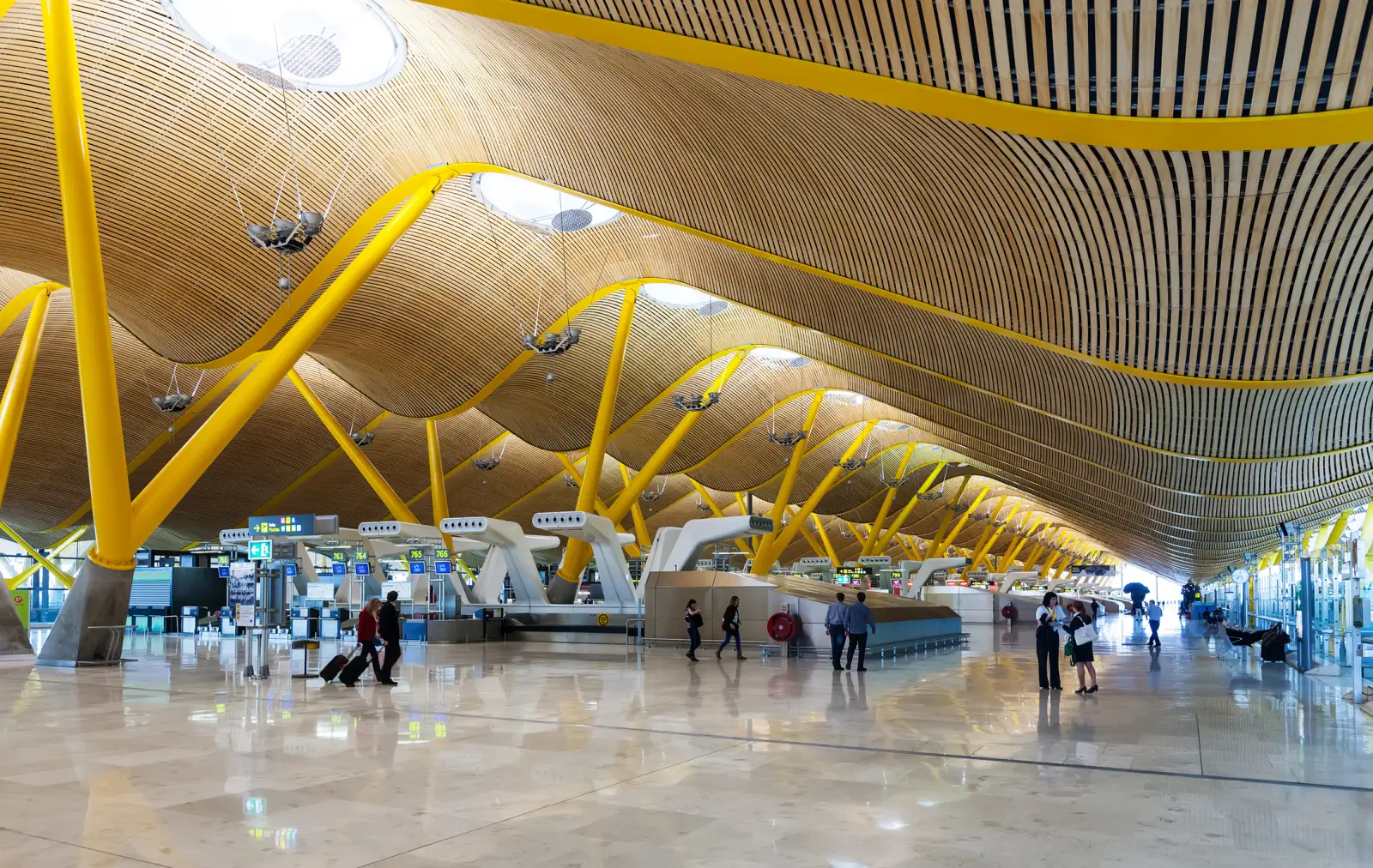
Aena will allocate €4 billion for Madrid-Barajas and €3 billion for Barcelona-El Prat over two regulatory periods. Initial works in 2027–2031 include around €2 billion in Madrid and €1 billion in Barcelona. Plans call for expanding Barajas’s T4 terminal by 171,000 square meters, adding 133,000 square meters to its satellite building, and integrating T1, T2, and T3 into a single complex. At El Prat, T1 will be expanded by 70,000 square meters, the sea-facing runway extended by 500 meters, and a new satellite terminal constructed.
These expansions are expected to increase Madrid-Barajas’s annual capacity to 90 million passengers and Barcelona-El Prat’s to 72 million, a combined rise of 20 million passengers. Aena states that the upgrades are necessary to maintain service quality and comply with evolving safety regulations while supporting Spain’s role as one of the world’s top tourist destinations.
Regional Airport Upgrades
The plan also earmarks €2 billion for airports in the Canary Islands, including a new 74,000-square-meter terminal at Tenerife Sur and expansions of Tenerife Norte and Lanzarote César Manrique airports. Málaga will receive €1.5 billion for a 100,000-square-meter terminal enlargement and runway improvements. Alicante-Elche is slated for €1 billion in upgrades to its passenger terminal.
Further works include expanded facilities at Ibiza and Menorca, with 20,000 and 9,000 square meters of new terminal space respectively, and future upgrades at Valencia and Bilbao beginning after 2031. The government and Aena emphasize that these investments are designed to relieve congestion and prepare airports for long-term growth.
“The investments announced seek to accommodate the future demand of Spanish airports, which this year are expected to reach a new record of over 320 million passengers,” said Maurici Lucena, President and CEO of Aena.
Economic and Strategic Impact
Spain’s airport network has seen passenger traffic more than double in 20 years, from 128 million in 1999 to 275 million in 2019, and is projected to surpass 335 million at full capacity. The International Airports Council forecasts that by 2042 Spain will rank among the world’s top five markets for air travel, behind China, India, the United States, and Indonesia.
The Valencia region has raised concerns about delays in airport upgrades. The regional minister of Industry, Trade and Tourism, Marián Cano, urged the government to accelerate projects in Manises and Alicante-Elche, saying, “Lo único que esperamos ya del presidente del Gobierno es que anuncie que las obras de los aeropuertos de la Comunitat Valenciana empiezan inmediatamente.” She added that capacity limits had already been reached, calling the planned works “urgent.”
Studies by the Council of Chambers of the Valencia region and the Chamber of Commerce of Alicante warn that without expansion, Valencia airport could face annual economic losses exceeding €933 million, risk more than 17,000 jobs, and lose close to 4 million passengers by 2030.
Funding and Regulatory Framework
Of the €12.9 billion announced, €9.99 billion will be classified as regulated investment under Spain’s next Airport Regulation Document (DORA III) for 2027–2031. These funds cover capacity and service quality upgrades, with costs passed to airlines through airport fees. The remaining €2.9 billion will go toward non-regulated areas such as commercial spaces, parking, and sustainability projects.
Aena, the world’s largest airport operator by passenger volume with 369 million travelers in 2024, operates 46 airports and two heliports in Spain, along with international stakes in the UK, Brazil, Mexico, and Jamaica. The company reported record profits of €1.93 billion in 2024 and remains majority-owned by the Spanish state with a 51% stake.
Prime Minister Sánchez has described the investment program as a “historic” step to secure Spain’s tourism leadership, while analysts note that the scale of spending may pressure tariffs and face scrutiny from airlines. Ryanair has already criticized a 6.5% increase in airport fees set for 2026, warning of route cuts.
The multi-phase investment program will run through 2036, with final project approvals and detailed budgets expected as Aena submits its proposals for DORA III to regulators in 2026. The government maintains that expanding airport capacity is critical to sustaining Spain’s position as the second most visited country in the world.