Istanbul‘s Yerebatan Sarnici, also known as the Basilica Cistern and one of the city’s most visited heritage sites, was evacuated and handed over to Turkey’s state foundations authority on Monday, deepening a long-running dispute over who controls the city’s landmark properties.
The handover began at about 10.00 as visitors waited in line at the entrance, according to reports from the site and local officials. The municipality emptied the structure and dismantled its own ticket booths, and the cistern was closed to the public. Officials said it would remain shut until the new operator installs its own ticket booths, with no reopening date announced.
Control of the site passed from the opposition-run Istanbul Metropolitan Municipality, known as IBB or IMM, to the General Directorate of Foundations, a state body affiliated with the Ministry of Culture and Tourism. The directorate manages properties linked to historic foundations.
The roots of the transfer date to earlier in the year. The municipality says the title deed was taken on April 1, 2026, and registered to the General Directorate of Foundations on behalf of several historic foundations, including those tied to Hagia Sophia (Ayasofya), Fatih Sultan Mehmet Han and Kanuni Sultan Suleyman Han. The IBB says it received no prior court order, administrative notice or formal service of documents, and only discovered the change while reviewing land registry records.
The transfer was first made public by detained Istanbul Mayor Ekrem Imamoglu, who said the deed had been registered to the Foundations directorate without legal or moral basis. The mayor, the main opposition Republican People’s Party (CHP) figure who has been held in pre-trial detention, framed the move as part of a wider pattern, citing earlier disputes over Galata Tower and Gezi Park.
A legislative change appears to have eased the path for such transfers. Under the country’s Foundations Law, numbered 5737, authorities previously needed concrete documentation tying a property to a foundation. An amendment in late 2025 broadened the criteria, allowing properties that are partly maintained, supported or associated with foundations to be registered as foundation assets.
The handover went ahead despite a court intervention. After the municipality challenged the action, the Istanbul 8th Administrative Court on May 9 issued a stay of execution on the evacuation order, pending defences from the Fatih District Governor’s Office and the General Directorate of Foundations. The IBB says the change took place without any final court ruling, and has pledged to pursue the matter through the judiciary.
The cistern was restored by IBB Heritage and reopened in 2022 after a multi-year project that included seismic reinforcement led by the municipality’s cultural heritage team. Since then it has drawn more than 11 million visitors, according to Cenk Akin of a municipal cultural subsidiary, who said about 500,000 people came after the entrance fee for Turkish citizens was cut to 1 lira on April 18.
The dispute fits a broader run of contested transfers in Istanbul. In March 2021, ownership of Taksim Gezi Park was moved to a foundation, a step the IBB said was intended to block its Taksim Square project. Other sites later identified as transferred to the Foundations directorate include Galata Tower, Sisli Hamidiye Etfal Hospital, the Pera Palace Hotel, Selimiye Barracks, Adile Sultan Palace, Vefa High School and Sait Halim Pasa Mansion. The municipality has taken several of those cases to court.
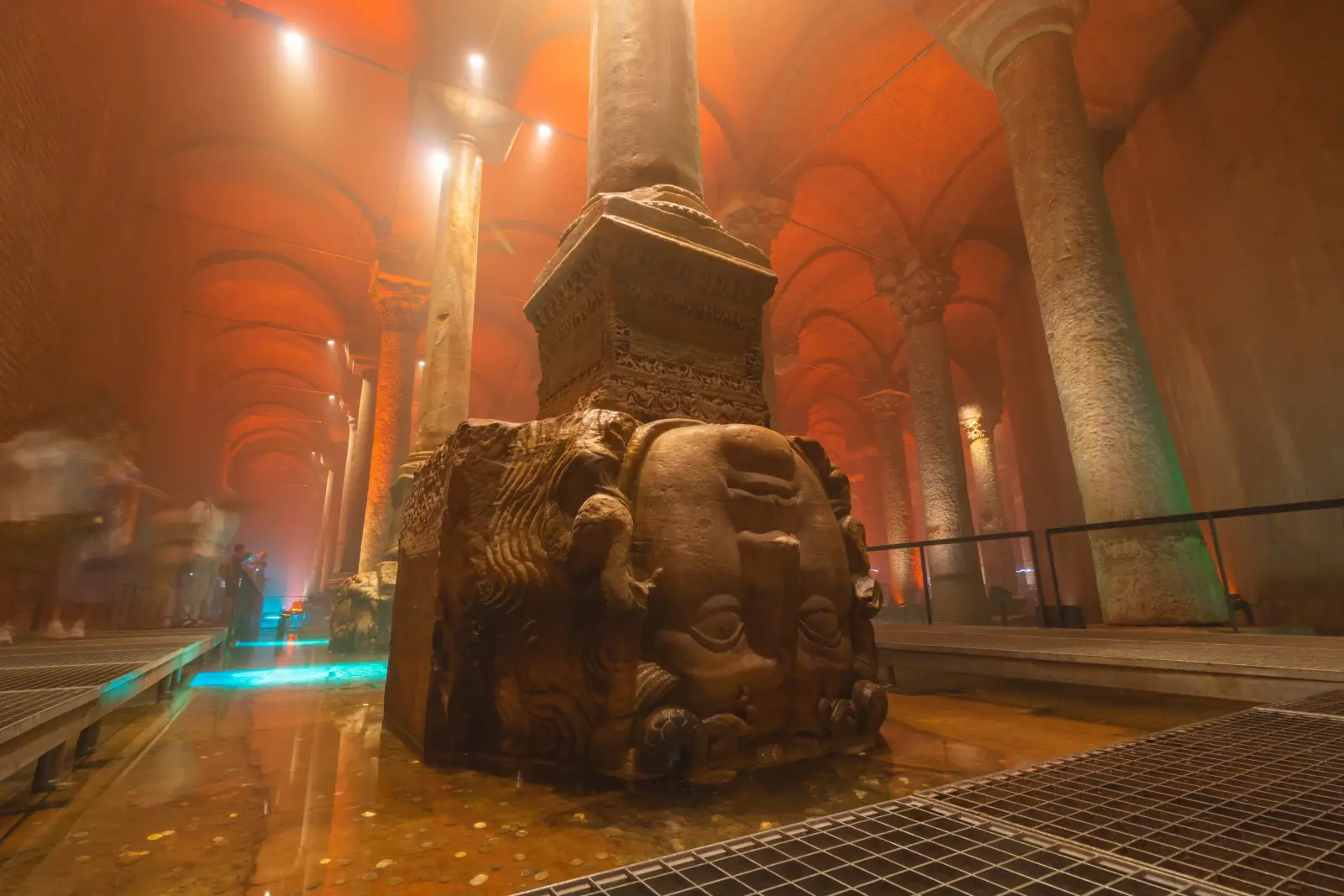
Built in 542 A.D. during the reign of the Byzantine emperor Justinian I, the Basilica Cistern sits beneath the historic Sultanahmet district, a short walk from Hagia Sophia, Topkapi Palace and the Blue Mosque. It is one of the largest surviving underground cisterns in the city, known for its forest of columns, dim lighting, the upside-down Medusa heads at its base and the atmospheric walkways that have made it a staple stop on Istanbul itineraries.
For now, tour operators and travellers face uncertainty. The closure removes one of the city’s signature attractions from the visitor circuit with no confirmed reopening date, and the handover raises fresh questions over how some of Turkey’s most prominent historic buildings are managed and controlled.
Photo Credit: ener Dagasan / Shutterstock.com