The legal and social climate for LGBTQ travelers has worsened in several countries over the past year, with new criminal laws, rollbacks of existing rights and political setbacks raising the risks of travel abroad.
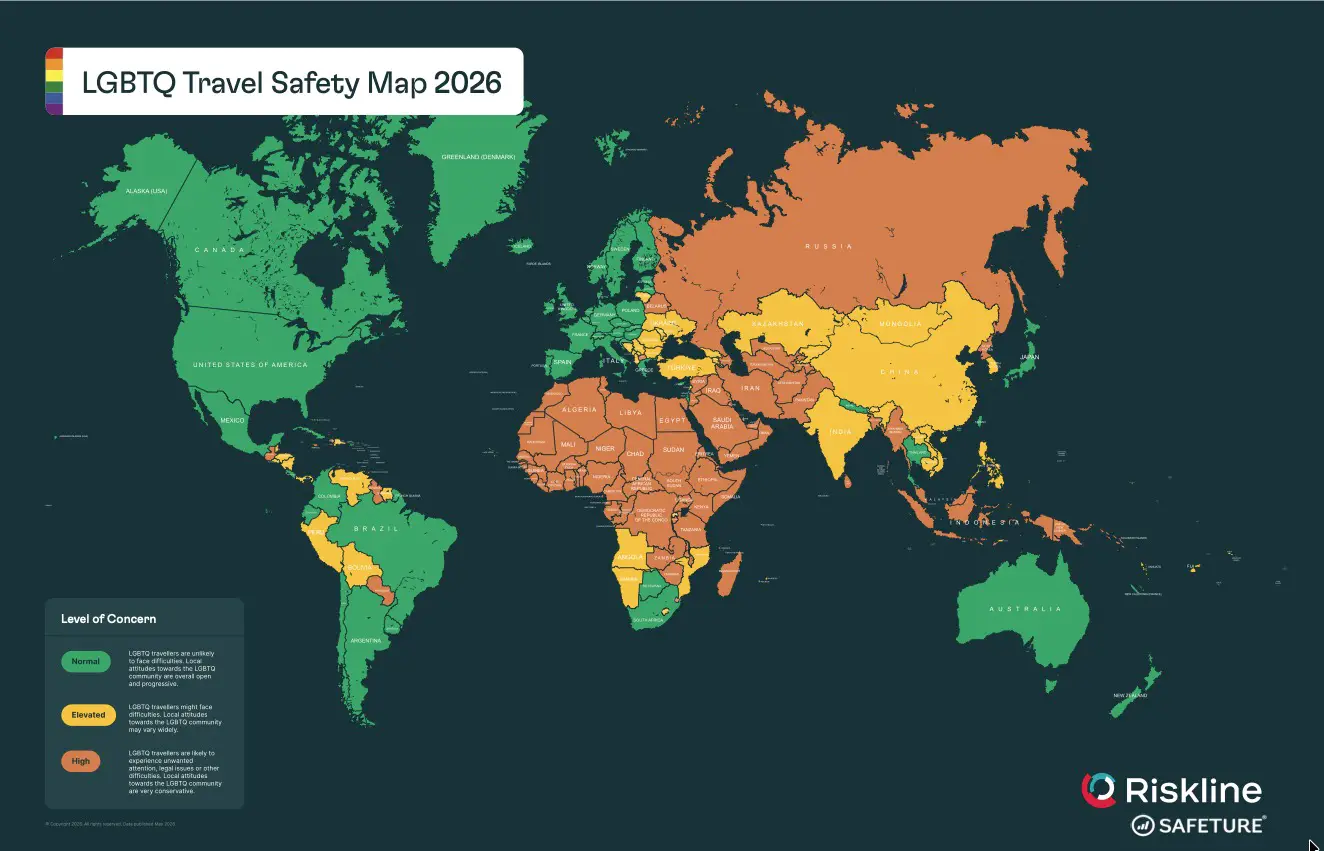
That is the central finding of the LGBTQ Risk Map 2026, released on 2 June by Safeture, a Sweden-based people risk management firm, in partnership with Riskline, a Danish travel risk intelligence provider. The map assesses conditions for LGBTQ travelers across 233 countries and territories.
Globally, the analysis classifies 91 countries as high risk for LGBTQ travelers. A further 62 are rated medium risk, and 80 are considered low risk. The overall balance changed little from the 2025 edition, but the direction of movement was clear.
Conditions have deteriorated in several countries over the past year, including Belarus, Burkina Faso, India, Japan, Kazakhstan, Senegal, Slovakia and the United States. The reasons vary, from harsher penalties and legal rollbacks to new limits on gender identity recognition and travel documents.
Regional gaps continue to widen. Western Europe remains the safest region, with every country rated low risk in the latest analysis.
By contrast, the Middle East and North Africa still contain some of the world’s highest-risk destinations. Most countries in the region are classified as high risk, with Israel rated low risk and Lebanon rated medium risk.
In Sub-Saharan Africa, the situation remains highly challenging, with about 80 percent of assessed countries in the highest risk category. The decline is especially marked in Burkina Faso and Senegal. Following the 2022 military coup, Burkina Faso enacted its first law criminalizing same-sex relations, while Senegal has doubled prison sentences for same-sex relations.
Europe and Eurasia have also recorded fresh restrictions that lowered individual ratings. Kazakhstan has limited information about so-called “non-traditional sexual orientations,” and Slovakia has further restricted the rights of same-sex couples. Belarus has adopted a law against so-called “LGBT propaganda,” which could lead to fines or arrests.
Setbacks have appeared in Asia too. In India, new legislation seeks to restrict transgender people’s ability to self-identify. In Japan, a court upheld the constitutionality of the country’s ban on same-sex marriage.
In North America, the United States has tightened rules for travel documents. Passports will now reflect only the sex assigned at birth, and the “X” gender marker will no longer be recognized. The country remains in the low risk category despite the change.
The map is not uniformly negative. Botswana and St. Lucia have repealed laws criminalizing same-sex relations between men, earning improved ratings in this year’s edition.
Riskline calculates each rating using factors such as the legal status of homosexuality and transgender people, social acceptance, and whether same-sex marriage or civil unions are recognized. The data draws on LGBTQ rights organizations including ILGA World and Equaldex.
“LGBTQ travelers face very different realities depending on where they travel. In some destinations, the risk may be primarily social. In others, it may be legal, with serious consequences,” said Magnus Hultman, CEO of Safeture. “For organizations, this makes it essential to understand destination-specific risks before travel and to ensure that travelers have access to relevant information, communication, and support if something happens.”
The findings carry weight for corporate travel programs, where duty-of-care obligations require employers to assess and manage the safety of staff sent abroad. A destination that is routine for one traveler can present legal exposure for another, depending on local law and how it is enforced.
The LGBTQ Risk Map 2026 is available as a free download. It is aimed at companies, travel managers, security teams and individual travelers seeking a practical overview to support safer international travel planning.