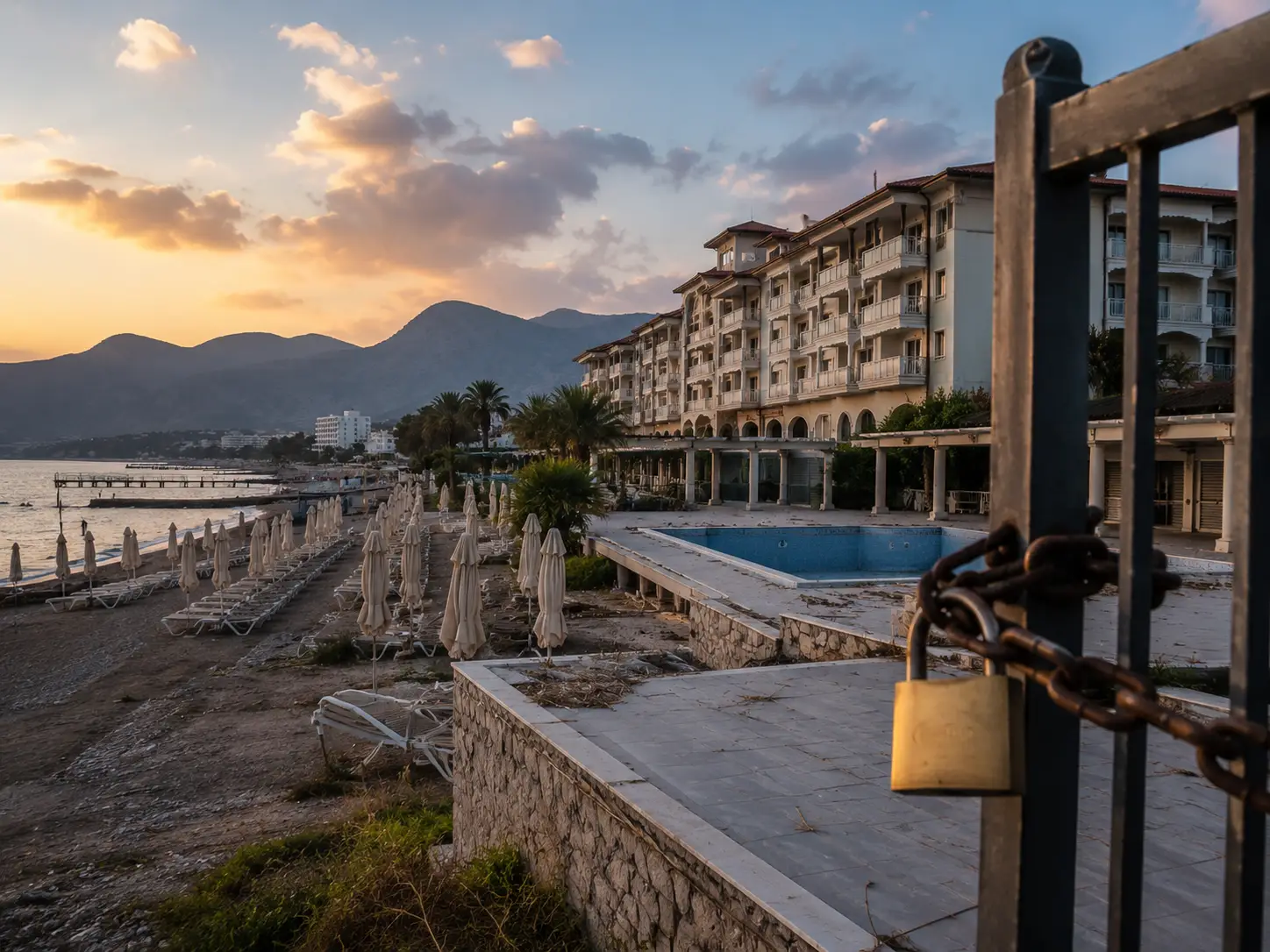
Turkey’s tourism sector is facing one of its most serious crises in years, with 1,500 hotels now listed for sale across the country as rising costs, mounting debt and regional geopolitical tensions push businesses to the brink.
The number of hotels put on the market has risen by 129% compared with the previous year, according to figures reported by Sözcü. A further 200 properties are available to rent. Occupancy rates have already fallen from 51.91% in 2024 to 49.54% last year, and industry operators warn that figure could drop further still because of geopolitical instability in the wider region.
The pressure has been building for years on businesses that were already weakened by the pandemic. Operators across the country are now also struggling with tax arrears, social security debt and enforcement actions including e-seizures. Tuğra Gönden, chairman of Cushman and Wakefield Turkey, said regional conflicts, geopolitical tensions and recessions in key feeder markets had negatively affected booking trends, average spend and traveller confidence.
Adding to the structural pressure, Turkey’s hotel supply is expanding rapidly at the same time as demand is under threat. More than 354 new hotels and roughly 70,000 new beds are expected to come onto the market in 2026, concentrated in Istanbul, Antalya and the Aegean. Industry consultant Aykut Bakay warned that this wave of supply was fuelling price competition rather than growth in occupancy, with new properties entering the market on lower rates and squeezing margins across the board.
Aykut Kaya, CHP Member of Parliament for Antalya, raised the alarm in a speech to Turkey’s Grand National Assembly, calling the situation a full-scale financial crisis for tourism businesses. He said hundreds of thousands of small traders, particularly in Antalya and Muğla, were being crushed by the combined burden of social security obligations, tax liabilities, e-seizures and rising rent. Many, he said, could no longer cover even basic operating costs.
“Our tourism businesses are in a major financial crisis today,” he said.
He called on the Finance Ministry and the Social Security Institution to ease enforcement pressure and give businesses space to recover. “Allow our tradespeople to get back on their feet this year,” Kaya added.
He proposed a 72-month, interest-free restructuring plan for social security and tax debts, the cancellation of past interest charges, and the removal of e-seizures placed on struggling businesses. Kaya said the sector had been in crisis for three years and warned that the escalation in US-Iran tensions had pushed many operators to the edge of collapse.
The geopolitical dimension of the crisis has been significant. Security concerns linked to the wider regional conflict caused a wave of cancellations in Turkish coastal destinations, with hotel prices in Bodrum dropping by more than 25% in the week following a military escalation in early March 2026. The UK and German markets, two of Turkey’s most important sources of visitors, have both been affected by reduced traveller confidence.
Turkey had previously relied on its pricing advantage to attract tourists from across Europe, but that advantage has eroded sharply. A tourism industry review published in 2025 noted that prices in Turkey had in some cases reached or exceeded those in Spain and Greece, undermining the country’s competitiveness in the global holiday market. Inflation reached 35% in 2025 and had hit 68% the year before, severely increasing operational costs and making borrowing more expensive following the government’s high interest rate response.
On the demand side, Turkey attracted more than 57 million international arrivals in 2025, and the government has set a target of 60 million for 2026. But despite those headline figures, occupancy is falling as new capacity outpaces visitor growth. The Turkish hospitality market was estimated at $5.58 billion in 2024, with projections pointing to $6.83 billion by 2029, but that growth forecast now faces significant uncertainty.
Kaya also urged the Culture and Tourism Ministry to strengthen Turkey’s image as a safe destination by bringing internationally recognised public figures to Antalya and other parts of the country to reassure prospective visitors. “The Ministry of Tourism must bring world-famous names to Antalya and across our country to show the entire world that Turkey is a safe harbour, and in doing so increase the number of tourists arriving,” he said.
He warned that without urgent action, the window for saving the sector could close. “As a member of parliament who has witnessed first-hand how our tradespeople are being worn down, if my warnings go unheeded, it will be too late,” Kaya said.
No new government relief package has been announced. The crisis underlines the fragility of Turkey’s coastal tourism economy, where hotels, restaurants and small traders depend heavily on seasonal visitor income, and where any further weakening of arrivals could accelerate the wave of closures and property sales already under way.