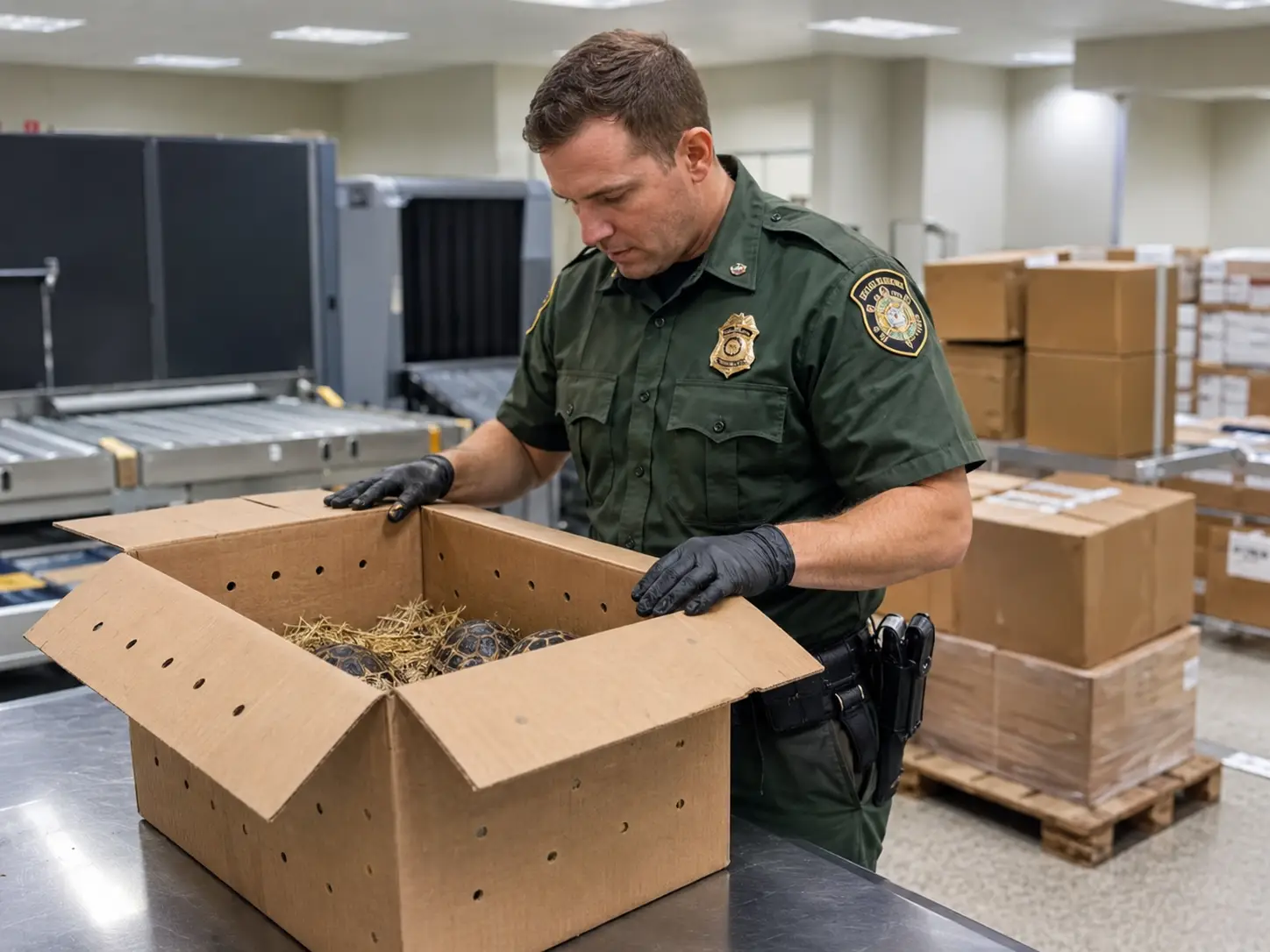
A wildlife inspector at one of Alaska’s busiest airports has described the daily reality of intercepting trafficked animals and animal products, including a major operation that began when a foul-smelling box arrived on a cargo belt labelled as car parts.
Chris Andrews, a wildlife inspector for the U.S. Fish and Wildlife Service based at Ted Stevens Anchorage International Airport, said a colleague alerted him last autumn to a box that did not smell right. When officers opened it, they found shark fins destined for Hong Kong, most likely for use in shark fin soup. More boxes followed on the same belt.
The discovery triggered a nationwide investigation that ultimately led to the confiscation of 1,600 pounds of shark fins taken from nearly 17,000 sharks. Andrews said the case illustrated how seemingly minor observations can escalate into significant wildlife trafficking investigations. “We wouldn’t have gotten that shipment if it didn’t stink,” he said.
Andrews and his colleagues enforce international conservation treaties protecting more than 40,000 species, as well as national legislation including the Marine Mammal Protection Act. The team works across airports and docks throughout Alaska, inspecting both cargo shipments and passenger baggage for protected animals and wildlife products.
Commercial seizures are common. The team regularly intercepts designer bags made from crocodile or python leather, along with unusual items carried by individual travellers. In one case, Andrews noticed two taxidermied lizards, each described as being as long as a skateboard, with their tails protruding from a large garbage bag carried by a passenger who had just disembarked a flight. The passenger had no permits for the protected reptiles and was required to surrender them.
Live animals present a different set of challenges. Andrews said monitor lizards have been discovered hidden inside speakers, packed inside socks in an attempt to conceal them during transport. Officers also once uncovered 400 baby turtles hidden inside a pair of snow boots, representing 12 different species. The discovery left the team scrambling to identify the animals and determine how to keep them alive.
“I didn’t know what they ate,” said Andrews. “I didn’t know if they liked heat. I didn’t know if they liked water. I was in here with a terrarium book, just trying to figure out what they were.”
Some trafficking is driven by collectors seeking unusual specimens. Andrews said the team encounters everything from cockroaches and pill bugs to ants in incoming shipments. Among the more alarming finds are large spiders originating from India. “There’s these spiders out of India that are the size of dinner plates that are really aggressive,” he said. “I hesitate every time I open a box, like, ‘Please don’t be the one!'”
Confiscated items are occasionally repurposed. When officers intercepted 10 electric guitars made of protected Brazilian rosewood, the instruments were passed to jazz bands at Anchorage School District schools. Other cases are less straightforward. The shark fin seizure left the team with a question that remains unresolved: “What do you do with 50,000 shark fins?”
Andrews said he did not anticipate this type of work when he studied forestry at university, expecting a career dealing with bears and moose in the Alaskan wilderness. “I’ve never dealt with a moose,” he said. Three decades into the role, he said the work continues to hold his interest, though his teenage children tend to receive news of his latest seizures with little reaction.
Wildlife trafficking remains a significant global concern. The illegal trade in protected animals and animal products is estimated to be worth billions of dollars annually and is considered one of the most serious threats to biodiversity worldwide. The U.S. Fish and Wildlife Service operates inspection posts at major ports of entry across the country, with Alaska serving as a key transit point for shipments moving between Asia and North America.