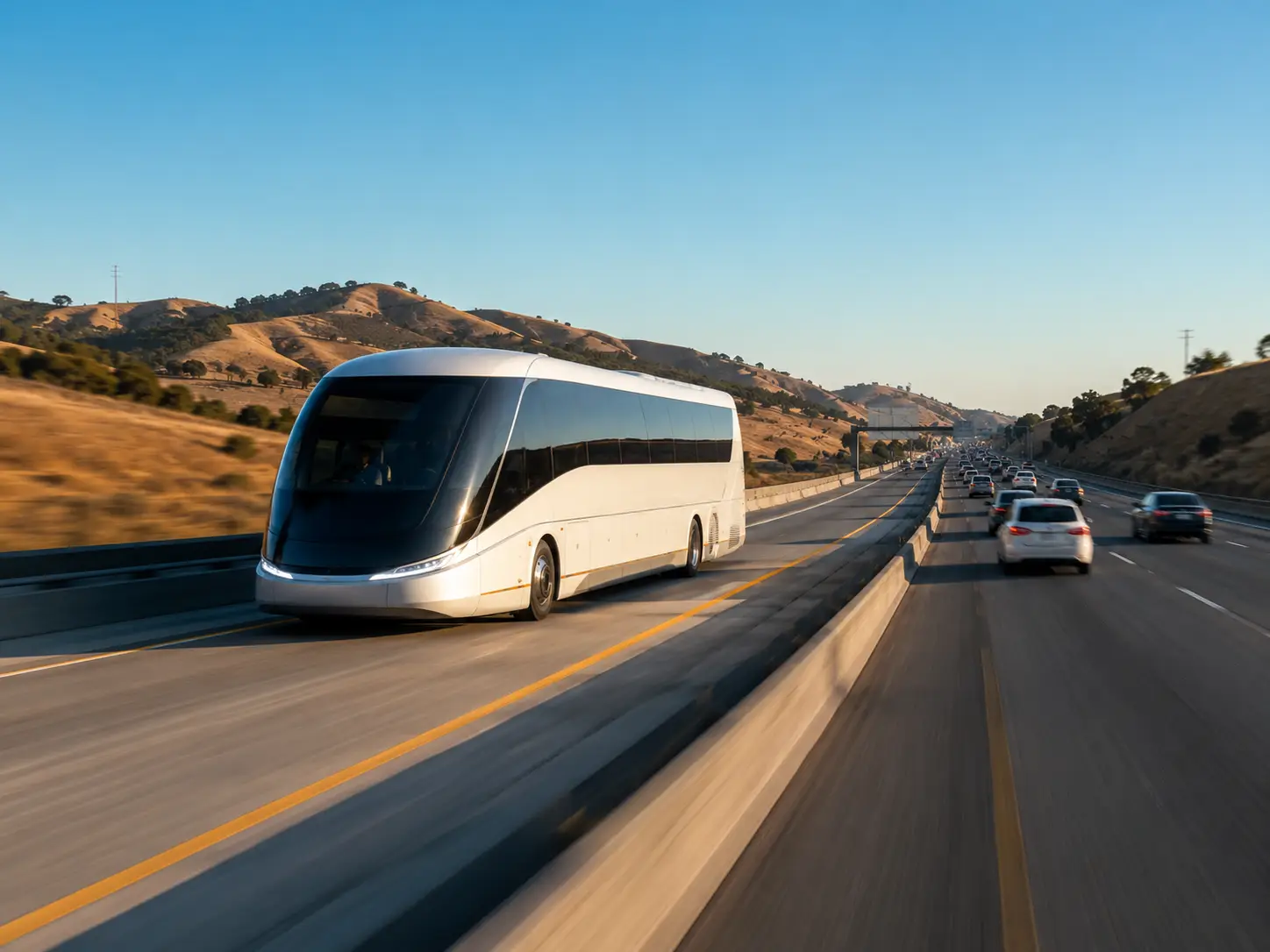
California’s state transport authority is exploring a high-speed bus network that could carry passengers between Los Angeles and San Francisco in just over three hours, travelling at speeds of up to 225 kilometres per hour (140 mph) on dedicated freeway lanes. The California Department of Transportation, known as Caltrans, presented the concept at a public webinar and confirmed the project is currently in a research phase with no launch date set.
One scenario outlined during the webinar estimated a trip between San Francisco and Los Angeles could take around three hours and 12 minutes, with buses operating at approximately 193 km/h (120 mph). The same journey currently takes between seven and a half and nine hours by direct bus, and six to eight hours by car depending on traffic.
“Long-distance travel by bus could become an attractive and affordable way to go between California metropolitan areas,” said Ryan Snyder, feasibility studies manager at Caltrans, speaking to local news station KCRA. Snyder identified Interstate 5, Interstate 80 and US Highway 101 as potential inter-regional routes, with Highway 99 through the Central Valley highlighted as a strong early corridor linking Bakersfield, Fresno, Modesto, Stockton and Sacramento.
Caltrans has noted that most US freeways are currently engineered for maximum speeds of around 85 mph (137 km/h), meaning speeds above that level would require substantial infrastructure upgrades. These would include dedicated lanes separated from regular traffic, specially designed vehicles with enhanced aerodynamics, advanced braking systems, automated driving technology, and vehicle-to-everything (V2X) communication systems capable of detecting hazards well ahead of the vehicle.
Officials are also examining international reference points to assess how such a system might work, including Australia’s Adelaide O-Bahn busway and the Netherlands’ Superbus prototype. Caltrans has suggested that future transit hubs could potentially be built over freeway corridors to help manage costs, and that the stations could serve as multimodal connection points linking high-speed buses with local services, cycling infrastructure and ride-sharing options.
The proposal emerges at a difficult moment for California’s long-running high-speed rail project. The Trump administration withdrew $4 billion in federal funding from the California High-Speed Rail scheme last year, citing missed deadlines and ballooning costs. Originally approved by state voters in 2008 and projected to cost $33 billion with completion by 2020, the estimated price tag has since surpassed $100 billion. Construction of an initial 119-mile (191 km) section between Fresno and Bakersfield in the Central Valley remains ongoing.
Some transport experts have questioned the bullet bus concept. Anthony Perl, a transportation professor cited by FOX26, challenged how the proposed bus system would fit alongside the ongoing rail project. “It would seem to me that if this is meant to replace the high-speed train system that didn’t happen yet, someone should make that clear,” he said. Caltrans has consistently stressed the bus concept is not intended to displace rail investment.
Caltrans Deputy Division Chief Christopher Clarke said the agency’s current focus is on understanding the technical requirements at a basic level. “This early stage assessment is focused on understanding how fast a bus could be safely designed to travel on our freeways, what vehicle and safety design requirements would be necessary and whether any modifications to freeway facilities would support such operations,” Clarke said.
Ryan Snyder framed the concept as a broader question about how the state is using its existing infrastructure. “Are we using and managing this asset to its highest and best use? And if not, what could we do differently to meet today’s and tomorrow’s goals?” he said during the webinar.
For now, the bullet bus remains a research concept. No funding has been committed, no route has been approved, and no vehicle has been commissioned. But for travellers on one of the busiest and most congested corridors in the United States, the prospect of a three-hour bus journey between California’s two largest cities has already attracted attention.