International tourist arrivals across the OECD (Organisation for Economic Co-operation and Development) reached a record 847 million in 2025, up 3.4% on the previous year, according to a new report from the Organisation for Economic Co-operation and Development. The growth builds on an 8.1% rise recorded in 2024. The findings appear in the OECD’s Tourism Trends and Policies 2026 report.
The report says conflict in the Middle East has disrupted global travel flows and pushed up costs, weighing on traveller confidence. Countries in the region, along with destinations reliant on Gulf air connectivity, have been affected most. The OECD expects these effects to persist in the near term.
The OECD, a Paris-based intergovernmental organisation with 38 member countries across Europe, North America and Asia-Pacific, publishes the report to track tourism performance and policy across advanced economies.
Costa Rica was the most recent addition to OECD, joining in May 2021.
The OECD countries are: Australia, Austria, Belgium, Canada, Chile, Colombia, Costa Rica, Czechia, Denmark, Estonia, Finland, France, Germany, Greece, Hungary, Iceland, Ireland, Israel, Italy, Japan, South Korea, Latvia, Lithuania, Luxembourg, Mexico, Netherlands, New Zealand, Norway, Poland, Portugal, Slovak Republic, Slovenia, Spain, Sweden, Switzerland, Türkiye, the United Kingdom, and the United States.
Growth Masks Widely Different National Trends
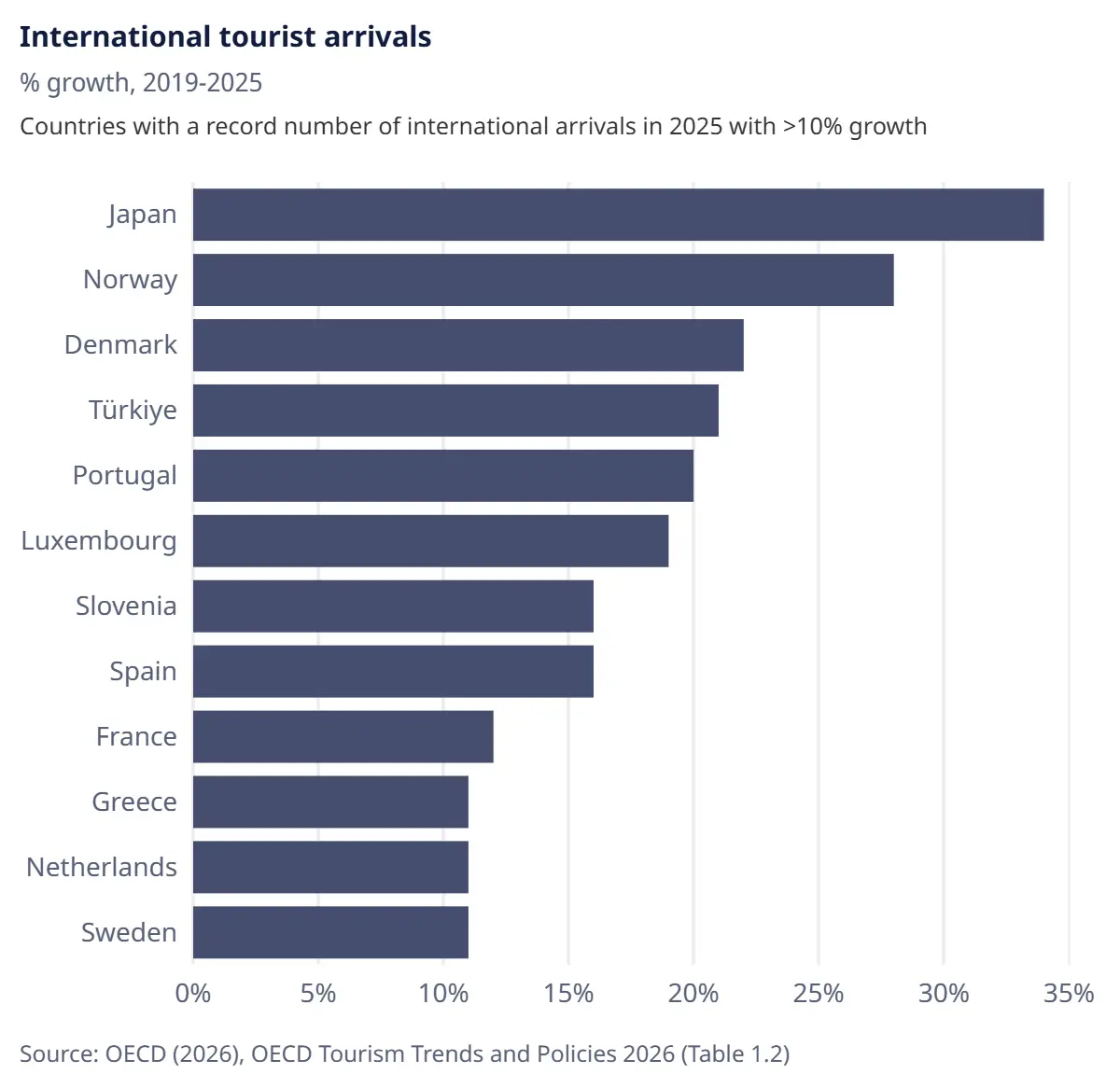
The overall record conceals sharp differences between countries. Four OECD countries recorded double-digit growth in 2025 and reached record levels of inbound arrivals: Finland, up 16.5%; Japan, up 15.8%; Korea, up 15.7%; and Norway, up 12.5%.
Japan and Korea’s growth builds on a strong recovery in 2024, when arrivals rose 47.1% and 48.4% respectively. The OECD attributes this to expanded flight connectivity and a weak yen, which made Japan more affordable for foreign visitors.
Four other OECD countries saw arrivals fall in 2025 and remain below pre-pandemic levels. Canada fell 0.6%, Germany fell 0.8%, Ireland fell 2.8% and the United States fell 5.5%. Inbound tourism to Israel has been hit hardest of all, with arrivals still 70.8% below pre-pandemic levels because of the conflicts in the Middle East.
Industry Urged to Prepare for Uncertainty
“Tourism continues to grow, generating business opportunities, jobs and tax revenues across the OECD,” said Mathias Cormann, OECD Secretary-General. “Governments and businesses need to work together to sustain this growth and build resilience. This means applying the lessons of the pandemic and the conflict in the Middle East to strengthen crisis preparedness, and managing tourism and visitor flows to ensure the sector delivers lasting benefits.”
The report says concerns about safety, affordability and cancellations may increasingly shape travel decisions. It expects travellers to favour more familiar and affordable destinations, shorter stays and lower-cost options as a result.
Airlines, tour operators and other tourism providers are already adjusting their programmes for 2027 and beyond, the OECD said. Destinations will need to anticipate changing travel patterns and adapt their strategies to evolving geopolitical, economic and weather-related risks.
A recent OECD survey found that one third of OECD countries expect tourism performance to exceed 2025 levels by the end of this year, with many forecasting new records. The OECD cautioned, however, that the picture varies significantly across member countries.