Spain’s airport operator Aena is expanding its presence in the UK after agreeing to acquire majority stakes in Leeds Bradford Airport and Newcastle Airport in a deal valued at £270 million (about €309 million).
The transaction, announced through its subsidiary Aena Desarrollo Internacional, involves the purchase of 51% of a new holding company that owns 100% of Leeds Bradford Airport and 49% of Newcastle Airport.
The deal strengthens Aena’s position in the UK market, where it already manages a 51% stake in London Luton Airport. Together, Leeds Bradford and Newcastle handled around 9.5 million passengers last year, which, combined with Luton’s 17 million, brings Aena’s UK airport footprint to roughly 26.5 million passengers annually.
A strategic push deeper into the UK market
The seller, InfraBridge, will retain the remaining 49% of the new holding company and consolidates its role as Aena’s key strategic partner in the UK. InfraBridge already owns the other 49% of London Luton Airport, reinforcing a long-term partnership structure between the two companies. The transaction remains subject to customary conditions, including regulatory approvals, with Aena expecting completion in the second quarter of 2026.
For Aena, the acquisition provides exposure to two mid-sized, unregulated airport assets in full or partial ownership. The company says the deal significantly strengthens its position in the British aviation market and complements its existing investment in London Luton Airport.
Commenting on the agreement, Maurici Lucena, Chairman and Chief Executive of Aena, described the transaction as an important step for the company in a high-potential market such as the UK, where Aena has long-standing experience. He added that the group aims to grow selectively in the geographies where it already operates in order to create value for both public and private shareholders.
The UK remains one of Europe’s most competitive aviation markets, with strong demand for outbound leisure travel, particularly from regional airports serving large population centres. By focusing on Leeds Bradford and Newcastle, Aena is targeting airports with growth potential outside London, where capacity constraints and regulatory pressures are more pronounced.
Leeds and Newcastle: regional airports with strong leisure demand
Leeds Bradford Airport is located in the centre-north of England within the Yorkshire and Humber region, serving a population of around 5.6 million people. Its catchment area is estimated at approximately 13.5 million potential passengers, underlining its strategic importance in northern England. Leeds is the UK’s fourth-largest city, with around 829,000 residents, and anchors the country’s second-largest metropolitan region outside London.
The airport handled 4.3 million passengers in the 2025 financial year, with traffic largely outbound and focused on European leisure destinations. It is also the main base for Jet2.com, which has operated at Leeds Bradford since 2003 and currently stations 16 aircraft there. The airport generated revenues of £56.5 million (around €64.3 million) in the 2025 financial year, with earnings before interest, tax, depreciation and amortisation of £20.6 million (€23.4 million), representing a margin of 36.4%.
Leeds Bradford is currently undergoing a major investment programme known as “LBA: Regen”, aimed at transforming the passenger experience and strengthening the airport’s competitive position. The first phase, which included a terminal extension, was completed last summer. The second phase, now under way, focuses on renovating the former terminal and is scheduled for completion by the end of 2026. A third phase may include the construction of additional aircraft stands, subject to future traffic demand.
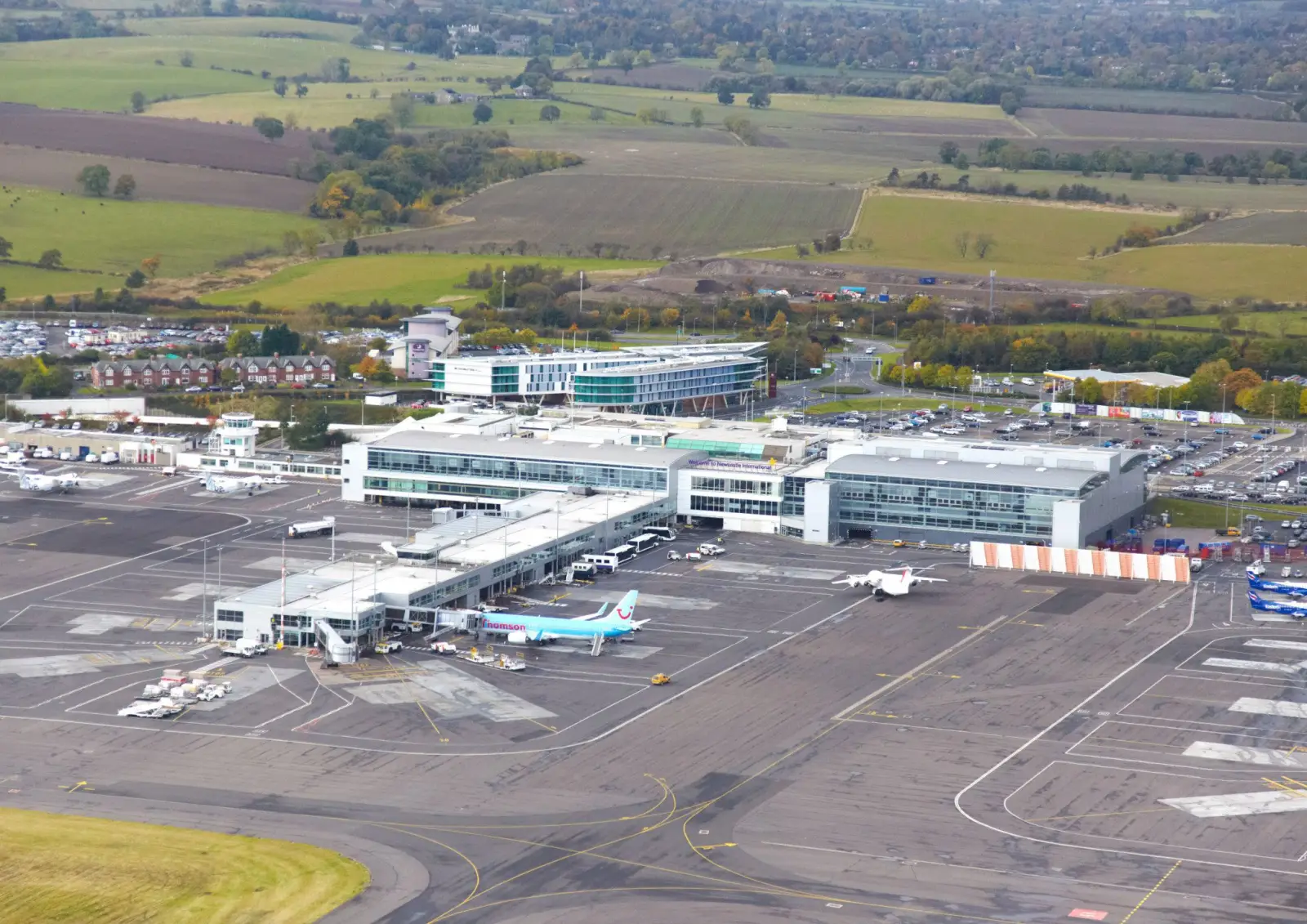
Newcastle Airport is located in northeast England on a site covering 490 hectares. Its catchment area includes around 3 million people, with no major competing airports within a 100-mile radius. The airport is currently owned by InfraBridge, which holds 49%, and LA7, a consortium representing seven local authorities, which owns the remaining 51%.
In 2024, Newcastle Airport handled 5.2 million passengers, again with traffic largely outbound and focused on European leisure travel, supported by a well-diversified airline mix. The airport reported revenues of £89.5 million (€101.8 million) and earnings before interest, tax, depreciation and amortisation of £50.2 million (€57.1 million), delivering a margin of 56%.
Environmental performance also forms part of the investment case. Leeds Bradford Airport is accredited at Level 3 of the Airport Carbon Accreditation scheme and has committed to achieving net zero emissions by 2030. Newcastle Airport operates a 3 MW solar photovoltaic plant, holds Level 4 accreditation, and has set a net zero target for 2035.
For passengers, Aena’s expansion could lead to improved facilities and enhanced airport services over time as investment programmes progress. More broadly, the deal highlights continued international interest in the UK’s regional airports, particularly those serving strong leisure markets and offering room for long-term growth.
As Aena deepens its footprint in northern England, the group further extends its influence beyond Spain, reinforcing its status as one of the world’s largest airport operators in a highly competitive European travel market.