Ryanair launches a viral “Great Idiots” seat sale on 20 January following a public social media row with Elon Musk over the airline’s decision not to adopt Starlink satellite Wi-Fi, offering 100,000 one-way seats from £16.99 for travel in February, March, and April 2026.
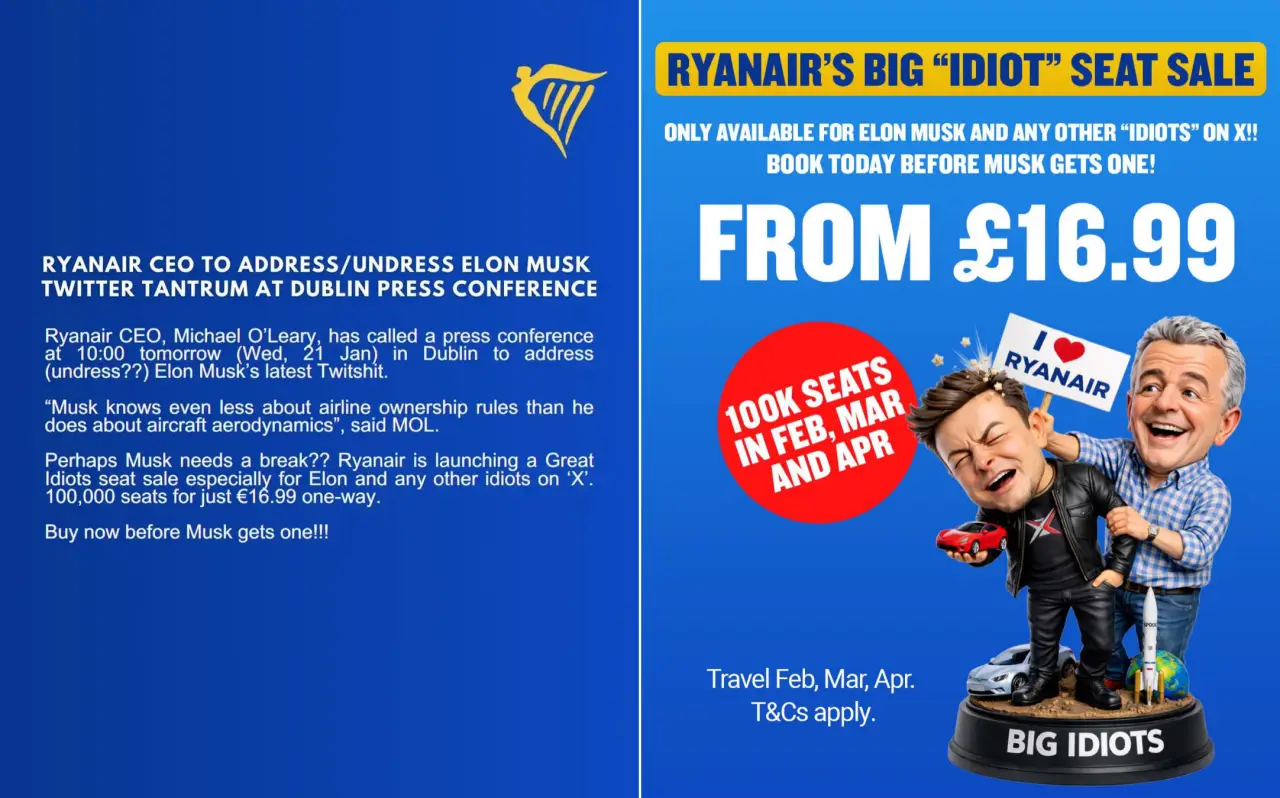
The promotion appears across Ryanair’s social channels and marketing graphics, while the airline confirms that its chief executive will address the dispute at a press conference in Dublin at 10:00 on 21 Jan. The exchange escalates after Musk publicly speculates online about buying the airline during the argument.
The dispute originates from Ryanair’s rejection of Starlink connectivity for its aircraft, prompting online criticism from Musk and a sharp rebuttal from the airline. Ryanair turns the clash into a consumer-facing campaign, using provocative branding and price-led messaging to drive attention and bookings. The episode illustrates how technology debates, executive personalities and airline marketing increasingly intersect in shaping travel narratives.
Starlink dispute sparks marketing campaign and press conference
Ryanair’s promotional material directly references the online exchange, presenting the sale as a satirical response to Musk’s comments about airline ownership and technology. One graphic announces that the airline’s chief executive will hold a press conference in Dublin to address Musk’s latest online remarks, while another advertises the “Big ‘Idiot’ Seat Sale” with fares from £16.99 and availability across Feb, Mar and Apr.
The airline attributes pointed criticism of Musk’s aviation knowledge to its chief executive. “Musk knows even less about airline ownership rules than he does about aircraft aerodynamics,” said Michael O’Leary, Chief Executive Officer. The remark reflects Ryanair’s confrontational communication style and reinforces the personal tone of the exchange.
The sale advertises 100,000 seats and positions the offer as time-limited, encouraging immediate bookings. Ryanair confirms that standard terms and conditions apply, with fares available on selected routes subject to availability. While the messaging centres on the feud, the commercial structure mirrors previous flash sales used by the carrier to stimulate demand outside peak travel periods.
Satellite connectivity has become an increasingly competitive differentiator for airlines seeking to improve onboard internet reliability and speed. Starlink, operated by Musk’s space technology business, has secured partnerships with several airlines globally, though installation involves certification, cost considerations and operational integration. Ryanair’s decision not to proceed reflects its cost-focused model and its cautious approach to onboard product enhancements that could affect fares or turnaround times.
Implications for travellers and the wider airline market
Musk’s online suggestion that he could buy Ryanair draws significant attention but remains rhetorical, with no indication of a formal bid or engagement with shareholders or regulators. European airline ownership rules impose strict limits on non-EU ownership and voting rights, creating structural barriers to any potential acquisition by overseas investors. Market analysts view the comments primarily as part of the online dispute rather than a credible transaction proposal.
For travellers, the immediate impact lies in access to discounted fares rather than any imminent changes to onboard connectivity or fleet strategy. Low headline prices may appeal to price-sensitive passengers planning short-haul trips in late winter and early spring, though ancillary charges for baggage, seat selection and priority boarding can materially increase total travel costs. Availability is expected to vary by route and booking window as inventory sells through.
The scheduled press conference in Dublin signals that Ryanair intends to continue engaging publicly on the issue rather than allowing the exchange to dissipate online. Past campaigns suggest the airline frequently leverages controversy to sustain brand visibility and reinforce its low-cost positioning. In this case, the blend of technology debate, executive rivalry and aggressive pricing amplifies the story beyond aviation media into mainstream consumer coverage.
The episode also highlights how airline strategy debates increasingly unfold in public digital spaces rather than through traditional corporate channels. Social media platforms allow executives to shape narratives instantly, while airlines can convert attention into sales through rapid promotional deployment. As connectivity technology, regulatory frameworks and brand positioning continue to evolve, similar clashes are likely to remain a feature of the travel landscape rather than an exception.
Photo credit: facebook.com/ryanair