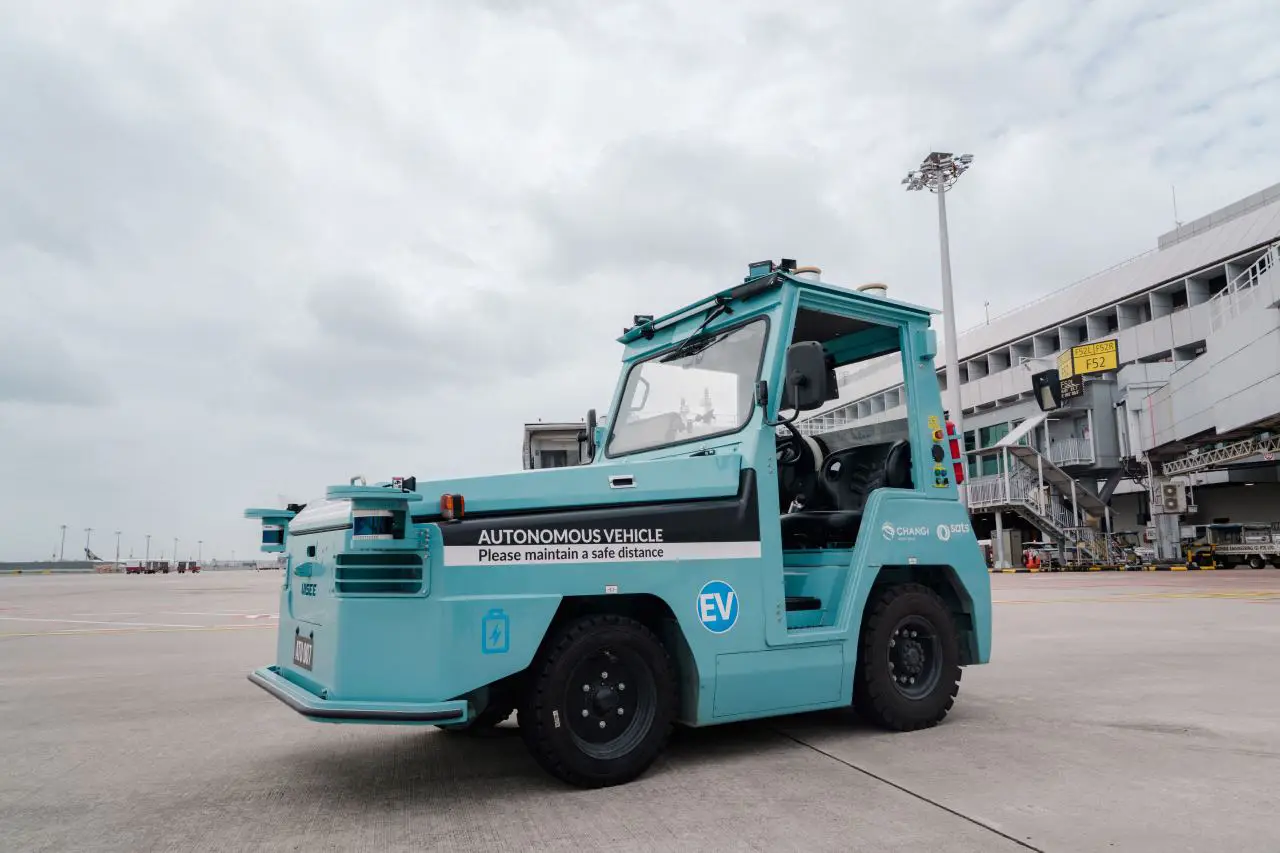
After nearly a year of rigorous trials covering more than 5,000 test trips, Changi Airport has deployed its first fleet of fully driverless autonomous tractors on 20 January to transport baggage at Changi’s airside, with remote supervision ensuring safe and efficient operations.
It was the first time such vehicles were used in live airport operations without a safety driver.
Changi Airport Group said that the fully autonomous tractors, which had been on a trial since November 2024, and had a safety driver on board as an emergency measure up until November 2025. To date, the tractors have amassed some 20,000km in mileage, with no safety incidents.
The launch signals Singapore’s commitment to pioneering smart airport technologies that set new benchmarks for operations. The milestone marks a significant leap in Changi Airport’s push for innovation and operational efficiency, raising manpower productivity while enhancing safety and reliability.
Autonomous tractors equipped with sensors and cameras

Capable of towing up to four containers of baggage that weigh up to 25 tonnes in total, two autonomous tractors now ply the 7km route between Terminal 1 and Terminal 4 and will carry a typical load of about 10 tonnes.
More than 10 sensors and cameras on each of these tractors work together to enable the vehicles to safely navigate the complex airside environment in all conditions – day, night and rain. The autonomous tractors are also monitored in a control centre during operations, where a remote operator can step in immediately, should human intervention be required.
To ensure that the autonomous tractors operate safely alongside workers, clear autonomous vehicle (AV) zone markings have been painted on the airside. Clear labels have also been attached to all AVs.
Future expansion of autonomous fleet

Another six autonomous tractors will be deployed to a different route at Terminal 2 later in 2026, to support baggage operations between the terminal’s baggage-handling area and its 35 aircraft stands.
The driverless tractor fleet will be expanded to 24 by year 2027 servicing the airside. Eventually, the airport will expand the vehicles’ operations to other terminals. Besides towing baggage, they will be capable of towing cargo and equipment.
Once the AVs go live, there will be 75 conventional tractors, operating at the airport for every driverless model. At present, there are about 600 conventional tractors in use at Changi Airport.
The AVs in use today are manufactured by the Chinese autonomous driving company Uisee, which already has a range of driverless vehicles employed at Hong Kong International Airport, including shuttle buses and patrol cars.
Changi’s ‘airside of the future’ vision
This project, co-funded by the Civil Aviation Authority of Singapore (CAAS), aligns with Changi Airport’s broader innovation strategy, which includes the integration of autonomous technology into airside operations, the use of AI in initiatives such as “Aircraft 360”, as well as automation and robotics to increase manpower productivity.
The move is part of Changi’s wider innovation strategy, which allows staff to be deployed to higher-skilled roles. Autonomous tractors free up airside workers from driving tasks, enabling them to focus on last-amile operations, which are more difficult to automate.
Photo credit : Changi Airport Group.