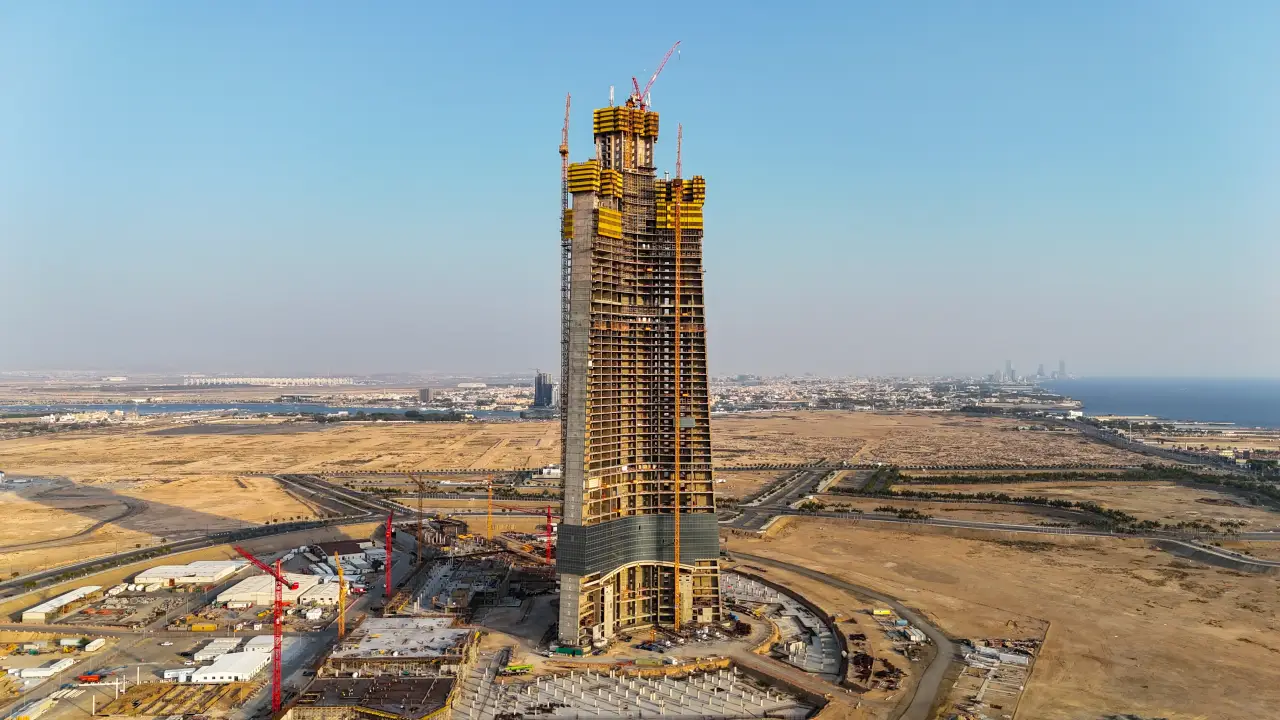
Jeddah Tower’s developer and regional media reports say construction is advancing on the more-than-1 km skyscraper in Jeddah, Saudi Arabia, as the project targets completion in 2028 and positions the city for a future rise in landmark-driven travel demand along the Red Sea coast.
In the past week, Gulf and regional outlets have renewed attention on the tower as part of a wider “tallest building” contest in the region, while the most specific recent progress detail remains a late-January statement from Kingdom Holding’s chief executive that the structure has reached the 85th floor and is rising at roughly one floor every 5 days.
Jeddah Tower is being built on the north side of Jeddah as the centerpiece of the Jeddah Economic City development, a planned mixed-use district that aims to add residential, hospitality and commercial inventory near the Red Sea waterfront. The project is designed to exceed 1,000 metres, which would make it the world’s first kilometre-high building once completed and put it ahead of Dubai’s Burj Khalifa in height rankings.
A widely cited project update published in late January said the tower’s structural work has reached the 85th floor and remains scheduled for completion in 2028, with construction having restarted in January 2025 after a long pause. The report linked the timeline and pace of work to comments made at the World Economic Forum and framed the tower as a priority investment for its backers. In that update, “The project is a major investment for the company this year,” said Talal Almaiman, CEO of Kingdom Holding.
Over the last 7 days, recent coverage has focused less on new engineering milestones and more on what the tower represents in the region’s broader pipeline of record-setting developments. A Dubai-based publication noted that Jeddah Tower is “officially under construction” and reiterated expectations that it will rise beyond 1,000 metres, adding that by the end of 2025 it had passed the 80th floor and that work was underway on the glass exterior. The same report said the completed tower is expected to include luxury residences, commercial space, a five-star Four Seasons hotel and a public viewing deck overlooking the Red Sea.
The renewed attention comes as competing proposals elsewhere in Saudi Arabia generate fresh discussion about how long existing record holders will retain their titles. Recent reporting has highlighted concept-stage plans for other megatowers in the region, though those proposals carry longer and less-defined timelines than Jeddah Tower’s 2028 target and do not yet provide the same level of construction progress detail.
For travelers and travel sellers, the most immediate takeaway is that Jeddah Tower is again being marketed and discussed as a future signature attraction tied to Saudi Arabia’s destination development agenda. While the tower is not open to visitors and remains an active construction site, the steady cadence of progress updates has helped position it as a watch item for future trip planning, particularly for travelers who build itineraries around skyline attractions, observation decks and branded luxury hotels.
Industry watchers also point to the project’s planned mix of uses as a signal that the tower is intended to anchor more than a single “must-see” viewpoint. The inclusion of a luxury hotel component, residences and commercial areas typically supports longer dwell times in the surrounding district and can drive demand for supporting services such as tour operations, transport links, F&B, events, and premium retail.
Role of Jeddah Tower in Red Sea tourism strategy
In travel terms, the tower’s significance is tied to three factors: scale, location and packaging. The scale provides a clear global hook—“world’s tallest”—that can support international marketing campaigns and media-driven travel interest. The location places the attraction in a city that serves as a major gateway to western Saudi Arabia and is within reach of other emerging Red Sea tourism initiatives the Kingdom is promoting to broaden its visitor base.
Packaging will determine the pace at which Jeddah Tower converts curiosity into bookings once the surrounding district begins to operate. Observation decks, branded hotels and mixed-use clusters typically create a “day and night” appeal: daytime viewing and guided experiences, followed by dining, shopping and nightlife that can be bundled into stopovers or long weekends. If the tower opens on schedule in 2028, it could become a centerpiece for short-break itineraries as well as a premium add-on for business travel and major events hosted in Jeddah.
For airlines and tour operators, the tower is also a future planning variable. Landmark openings can influence route marketing, seasonal demand shaping and stopover products, especially when paired with major hotel inventory and high-profile viewing experiences. Regional press reports emphasizing the glass façade work and the planned hotel and viewing deck suggest that stakeholders want to sustain momentum and keep the project visible to consumers while construction continues.
At the same time, the project’s history underscores why travel companies generally avoid hard selling until opening timelines are firm. Jeddah Tower’s construction began in 2013 and later stalled for several years before work restarted, making schedule risk a persistent consideration for forward-looking travel packaging. The most recent statements continue to point to 2028, but operators typically wait for confirmed opening windows, ticketing details, safety certifications and access plans before committing inventory to retail channels.
For now, the near-term travel relevance is informational: travelers are tracking the build as it rises toward a widely discussed milestone of 100 floors, and destination marketers are using the tower’s progress to reinforce the narrative of a rapidly changing Saudi visitor economy. If the current pace holds and the project stays aligned with its stated 2028 completion target, Jeddah is positioned to add one of the world’s most recognizable skyline attractions to its tourism offering within the next two years.
Photo Credit: Ayman Zaid / Shutterstock.com