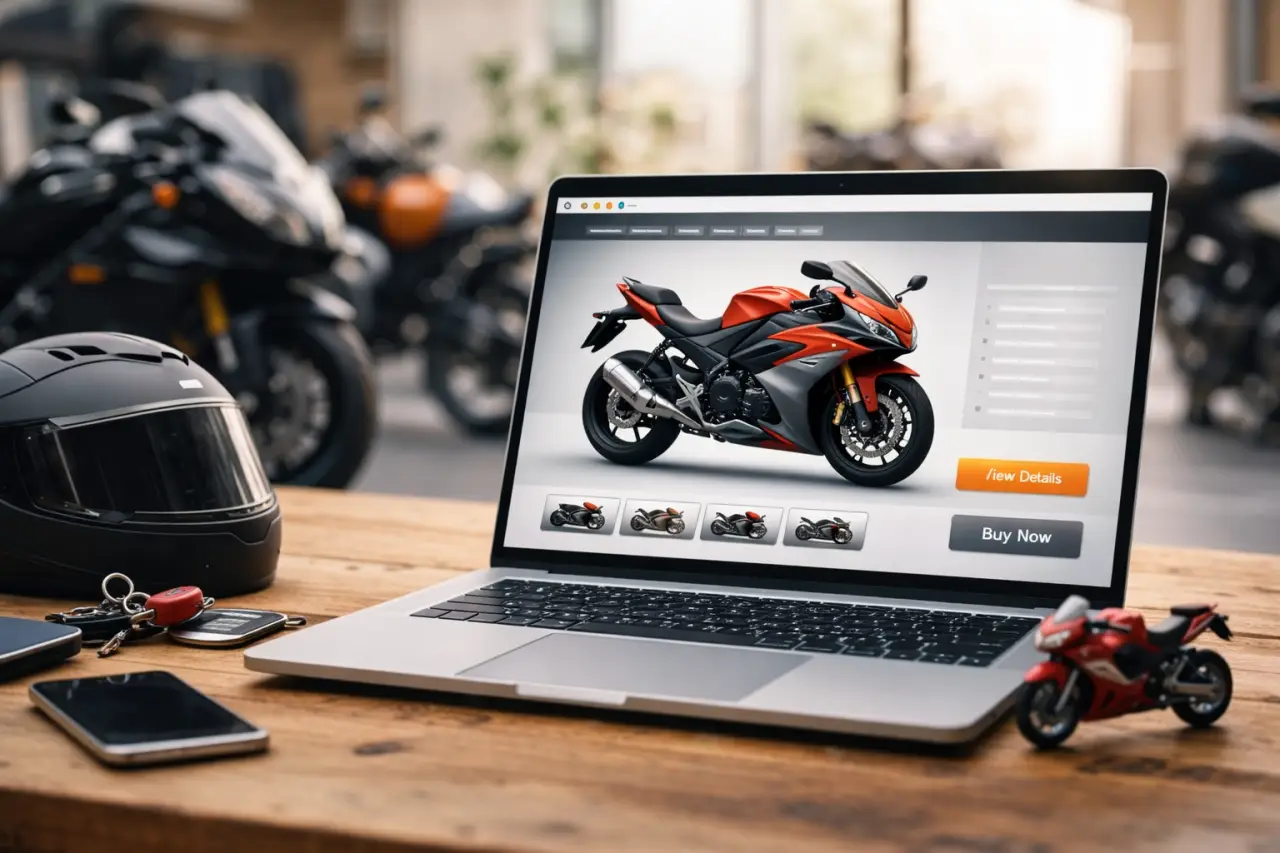
The shift toward online motorcycle buying is driven by three core factors: total price transparency, access to a nationwide inventory that local dealerships cannot match, and the maturation of specialized door-to-door logistics.
Modern riders are bypassing the traditional “dealership shuffle” to utilize digital verification tools, virtual walk-arounds, and professional shipping services that deliver a vetted machine directly to their driveway.
The End of the “Dealership Shuffle”
For decades, buying a motorcycle was a physical ritual. You’d walk into a local showroom, breathe in the scent of new tires and chain lube, and eventually find yourself in a small back office haggling over “documentation fees” and “setup charges.” While the tactile experience of sitting on a bike is great, the sales process often wasn’t.
Today’s riders, particularly those in the 25–45 demographic, are “digitally native.” They value time and transparency over the traditional handshake deal. Online platforms allow buyers to see the out-of-the-door price immediately, bypassing the emotional pressure of a sales floor. When you shop online, you aren’t limited by what a single franchise owner decided to stock three months ago; you’re looking at the entire market.
Inventory: From Local Limits to Nationwide Choice
If you live in a mid-sized city, your local dealer might have three adventure bikes in stock. If you want a specific color, a specific luggage rack, or a low-mileage version of a discontinued model like the Yamaha FJR1300, you could be waiting months for one to “pop up” locally.
The internet turned the motorcycle market into one giant, interconnected showroom.
- The Rare Find: Collectors looking for vintage 70s Hondas or specific Italian exotics like a Moto Guzzi can find them in a different time zone and have them in their garage by next week.
- The Price Gap: Market values fluctuate by region. A dual-sport bike might be cheaper in a flat, urban state than in a mountainous one. Savvy riders realize they can save $1,500 by buying from a seller three states away, even after factoring in the cost to ship a motorcycle across the country.
The Trust Factor: Better Data Than a Handshake
One of the biggest hurdles to buying online used to be the fear of the “lemon.” How do you know the engine isn’t knocking if you can’t hear it?
Modern digital marketplaces have solved this through hyper-documentation. A reputable online seller today provides:
- High-Definition Video Startups: Watching a cold start on a 4K video is often more revealing than a 30-second idle in a noisy dealership.
- VIN Reports: Services like Carfax for motorcycles are now standard, showing accidents, title liens, and service history.
- Third-Party Inspections: Many buyers now hire local mechanics in the seller’s city to perform a “Pre-Purchase Inspection” (PPI) for a small fee, ensuring an expert’s eyes are on the frame and forks.
If you are ready to start your search but aren’t sure which platforms offer the most protection and best inventory, here are the best places to buy motorcycles online where you can find everything from factory-fresh sportbikes to custom cafe racers.
The Logistics Revolution: Why Distance is No Longer a Barrier
In the past, the logistical nightmare of getting a bike from point A to point B killed most out-of-state deals. You either had to own a truck and a ramp (and take two days off work) or trust a random freight company that might treat your Triumph like a pallet of bricks.
The rise of specialized motorcycle transport has changed the math. Professional carriers now use “motorcycle skids” and soft-tie systems designed specifically for two wheels. They understand that a bike’s kickstand isn’t meant to hold it steady during a 1,000-mile haul.
| Feature | Traditional DIY Moving | Professional Online Delivery |
| Effort | High (Driving, loading, fuel) | Zero (Door-to-door) |
| Equipment | Ramps, straps, open truck | Enclosed trailers, specialized skids |
| Risk | High (Tipping, weather) | Low (Insured, climate-controlled) |
| Time | 1–3 days of travel | 0 days (You stay home) |
Price Transparency: No More “Hidden” Fees
Dealerships often rely on “back-end” profit. You see a sticker price of $8,000, but by the time you reach the finish line, it’s $10,500. Online sellers, especially private ones and digital-first dealers tend to be more upfront. They know that if their price isn’t competitive, the buyer will simply click the next tab in their browser. This “forced honesty” of the internet has made the market more efficient. You can compare five different bikes of the same year and mileage in under ten minutes, something that would take a week of physical driving to accomplish.
Peer-to-Peer Marketplaces vs. Digital Dealers
We are seeing two distinct paths for the online buyer:
- The “Bring a Trailer” Model: High-end auctions where the community “vets” the bike in the comments. If a seller tries to hide a leaky gasket, five enthusiasts will point it out in the photos within an hour.
- The “Carvana for Bikes” Model: Larger retailers that offer a 7-day return policy. You buy the bike, they ship it, and if it isn’t what you expected, they pick it up. This eliminates the “sight-unseen” risk entirely.
The “Senses” Problem: How to Sit on a Bike You Can’t Touch
The biggest argument against online buying is: “I need to know if I fit.”
Riders are solving this through “ergonomic simulators” like Cycle-Ergo, where you can input your height and inseam to see exactly how your knees will bend on a specific model. Combine that with a quick trip to a local showroom just to “sit” on a similar model, and the need to actually buy from that local showroom vanishes.
The Safety Net: Escrow, Financing, and the “Wire Transfer” Anxiety
To buy a motorcycle online safely, you must use a verified escrow service or a secure dealership portal to hold funds until the vehicle is picked up by a professional carrier. This “neutral territory” for your money prevents common scams where sellers vanish after a direct bank wire. Additionally, securing pre-approved financing from a credit union allows you to act as a “cash buyer,” giving you more leverage in negotiations with out-of-state dealers.
Financing the Invisible Bike: How it Actually Works
One of the most common questions riders ask is: “How do I get a loan for a bike that’s 2,000 miles away?” Most people think you have to use the dealer’s in-house financing. In reality, you have far more power than that.
Credit Unions are Your Best Friend
National credit unions and even some local banks are well-versed in out-of-state vehicle purchases. Once you have a Bill of Sale from the seller, the bank will often cut a “direct-to-dealer” check or wire the funds into an escrow account. This takes the “trust” issue out of your hands and puts it into the hands of a financial institution with a legal department.
The Danger of the Direct Wire
If you are buying from a private individual on a forum or a marketplace, never just “send the money.” Even if they have a 5-star rating, use an escrow service. These platforms charge a small percentage (usually 1-2%) to hold the money. They only release it to the seller once the shipping company scans the VIN and confirms the bike is actually on the truck. It’s the $100 “insurance policy” that keeps you from losing $10,000.
The Paperwork Maze: Titles, Taxes, and “The Notary”
Dealing with a title from a different state can feel like doing your taxes in a foreign language. But here is the good news: the “interstate” part is mostly handled by your local DMV, not the seller’s.
1. The Title Transfer
The seller must sign the title over to you and, in many states, they need to get it notarized. This is a critical step. If the title arrives without a notary stamp (and the state requires it), you’re stuck with a very expensive paperweight in your garage. Always ask the seller for a photo of the signed, notarized title before the bike is loaded onto the trailer.
2. The Sales Tax Illusion
A common myth is that you can avoid sales tax by buying from a state that doesn’t have it (like Oregon or New Hampshire). Unfortunately, you pay sales tax to the state where you register the bike, not where you bought it. When you walk into your local DMV with that out-of-state title, be prepared to pay your local tax rate on the purchase price.
3. VIN Verification
Some states (like California or Florida) require a physical VIN verification for out-of-state bikes. Sometimes this means a police officer or a DMV clerk needs to physically look at the frame and engine numbers. If your bike has a “custom” frame or an engine swap, this is where things can get tricky. Make sure the numbers on the bike match the title exactly.
The Delivery Ritual: What to Do When the Truck Arrives
The moment the transport truck pulls up to your curb is a high-adrenaline event. You finally get to see the machine you’ve been staring at on a screen for weeks. But before you fire it up and ride off, you have a job to do.
The “Wet Spot” Check
As soon as the bike is rolled off the ramp, look at the ground. Check for:
- Fork Seal Leaks: Often, bikes are strapped down too tightly by inexperienced drivers, blowing out the fork seals. Look for oil running down the chrome stanchions.
- Case Leaks: Check the bottom of the engine for any fresh oil or coolant that might have shaken loose during the vibrations of a long haul.
The “Five-Minute” Inspection
Don’t let the driver rush you. They have a schedule, but you have a legal right to inspect the vehicle before signing the Bill of Lading (BOL).
- Check the “Glass”: Mirrors, blinkers, and the instrument cluster. These are the most fragile parts and the most likely to get bumped in a crowded trailer.
- Verify the VIN (Again): Make sure the bike on the trailer is the bike on your paperwork.
- The “Hidden” Damage: Look at the bar ends and the footpegs. If the bike leaned against another crate or the side of the truck, these will show the first signs of a “rash.”
Note on Insurance: If you find damage, note it clearly on the BOL. Take pictures while the bike is still next to the truck. This is your only chance to file a claim with the carrier’s cargo insurance. Once you sign a “clean” BOL, the driver’s liability ends.
Why the “Digital Garage” is the Future
The motorcycle industry is traditionally slow to change, but the “digital garage” is now inevitable. We are seeing a shift where the “buying” part of the hobby is becoming as streamlined as ordering a pizza, allowing the “riding” part to take center stage.
Better Access for Rural Riders
For a rider in a small town, the “local dealer” might be two hours away and only carry two brands. Online buying has democratized access. Now, a rider in rural Nebraska has the same access to a rare Ducati as someone living in downtown Manhattan.
The “Vetted” Community
We are also seeing the rise of community-vetted auctions. When a bike is listed on a high-end auction site, the “comments section” acts as a collective mechanical inspection. If a seller says a bike is “original paint” but an expert in the comments notices the pinstriping is 2mm off, the whole world knows. This level of peer-review is something you will never get at a traditional dealership.
Conclusion: Trusting the Process
Buying a motorcycle online isn’t about being lazy; it’s about being smart. It’s about using data, logistics, and digital tools to find the exact machine that makes you want to wake up at 5:00 AM on a Sunday.
Yes, there is a “human” element of anxiety when you click “buy” on a $15,000 object you haven’t touched. But if you use an escrow service, hire a professional carrier, and do your homework on the title laws, that anxiety is replaced by a much better feeling: the sound of a new engine echoing through your driveway.