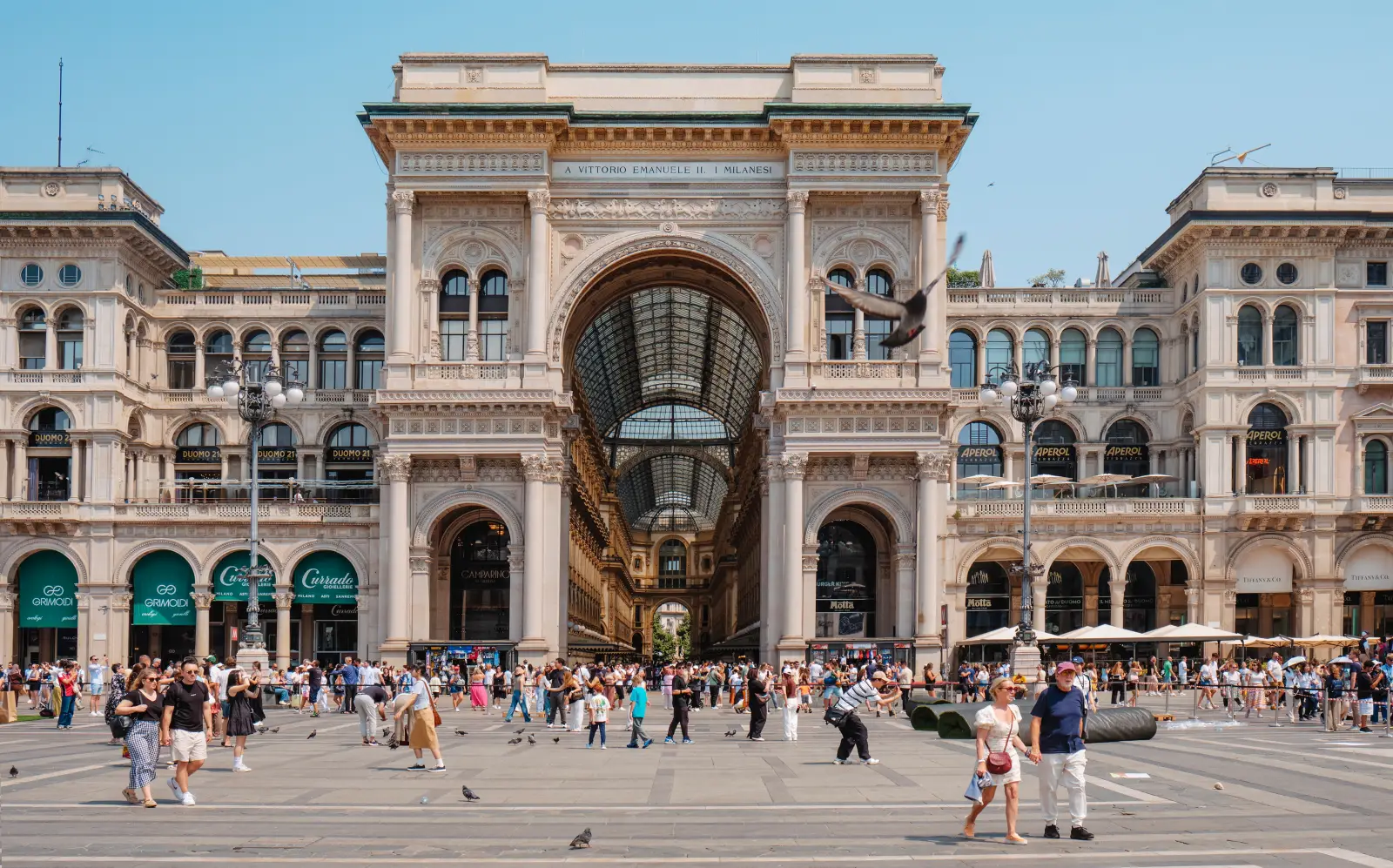
Milan’s famous bull mosaic inside the Galleria Vittorio Emanuele II has been restored once again, just nine years after the previous intervention, as decades of tourist footfall continue to wear down one of the city’s most beloved and quirky landmarks.
The restoration was carried out between 27 and 30 May 2026 by craftsman Gianluca Galli, who worked by hand in the heart of the grand 19th-century shopping arcade, kneeling between luxury storefronts and clusters of raised smartphones to piece together the mosaic’s worn sections. This time, the work used epoxy resins rather than traditional lime to better withstand the relentless pressure of spinning heels and slow future deterioration.
The damaged section is not the bull itself but its testicles, which form part of a floor mosaic representing the coat of arms of Turin. The word Torino translates to “little bull” in Italian, giving the symbol its place among the four coats of arms laid into the gallery floor, alongside the she-wolf of Rome, the lily of Florence, and the red cross of Milan.
For decades, visitors have followed a popular ritual: placing their right heel on the bull’s genitals and spinning clockwise three times to bring good fortune and, according to legend, guarantee a return trip to the city. Thousands of tourists perform the ritual every day, and the accumulated effect on the pale mosaic tiles has been severe. The area around the bull’s testicles has repeatedly become flattened, faded and worn through.
“A fascinating gesture, but a damaging one,” said restorer Galli, who described the Galleria as a living heritage site that wears down precisely because it is loved and experienced.
City councillors Emmanuel Conte, responsible for State Property, and Marco Granelli, responsible for Public Works, praised the outcome. “As expected, the bull mosaic returned to the Galleria Vittorio Emanuele, fully restored,” Granelli wrote on social media. “Congratulations to our craftsman for his work restoring the mosaic.”
View this post on Instagram
However, the restoration quickly attracted public criticism. Several commenters questioned the quality of the work, with one noting that the tiles appeared to be different colours and sizes and that the joins were messy. Others questioned the project’s anatomical accuracy, with one observer suggesting the restored section resembled “a faucet” and another describing the result as “crushed.” The project is believed to have cost around 30,000 euros.
Built between 1865 and 1877 and designed by architect Giuseppe Mengoni, the Galleria Vittorio Emanuele II is one of the world’s oldest active shopping arcades and is considered a national treasure. Mengoni tragically fell from the roof and died just before the arcade was inaugurated. The gallery is home to some of Milan‘s oldest businesses and hosts flagship stores for luxury brands including Gucci and Prada, whose original store is located inside.
This is not the first time the bull has needed attention. The mosaic was previously restored in 2007 and again in 2017, marking three major interventions in under 20 years. Heritage workers say the challenge is a familiar one across Europe: how to protect fragile historic sites while keeping them open and accessible to the public.
The latest restoration highlights how small-scale visitor habits can generate long-term and recurring conservation costs at major cultural attractions. What began as a local superstition has become a global tourist ritual, and with it a permanent conservation headache for one of Milan‘s most iconic public spaces.
Photo Credit: nito / Shutterstock.com