The International Air Transport Association (IATA) has criticised European Union and United Kingdom targets for electro-sustainable aviation fuel (e-SAF), describing the 2030 mandates as detached from reality.
The EU and the UK have mandated e-SAF production of around 0.6 million tonnes by 2030. IATA says global production capacity currently operating and under construction stands at just 0.02 million tonnes, with only one production site in operation.
To meet the mandated volume, the industry body estimates it would take approximately 20 commercial-scale refineries. No new final investment decisions for e-SAF facilities have been made over the past year.
Marie Owens Thomsen, IATA’s Senior Vice President Sustainability and Chief Economist, said the targets were unworkable in current conditions.
“The 2030 e-SAF targets by the UK and the EU are beyond unrealistic, they are utterly detached from reality. It is a reckless energy market creation strategy to impose mandates before production is enabled. Such a strategy will only drive up the price,” she said.
She added that the approach was difficult to justify given regional energy costs. “The strategy is also bewildering given that Europe has the highest renewable energy prices in the world. A serious strategy would first scale renewable energy production to drive its price down and build the e-SAF production capacity on sound economics. Only at that point can mandates achieve the desired results,” she said.
What is e-SAF?
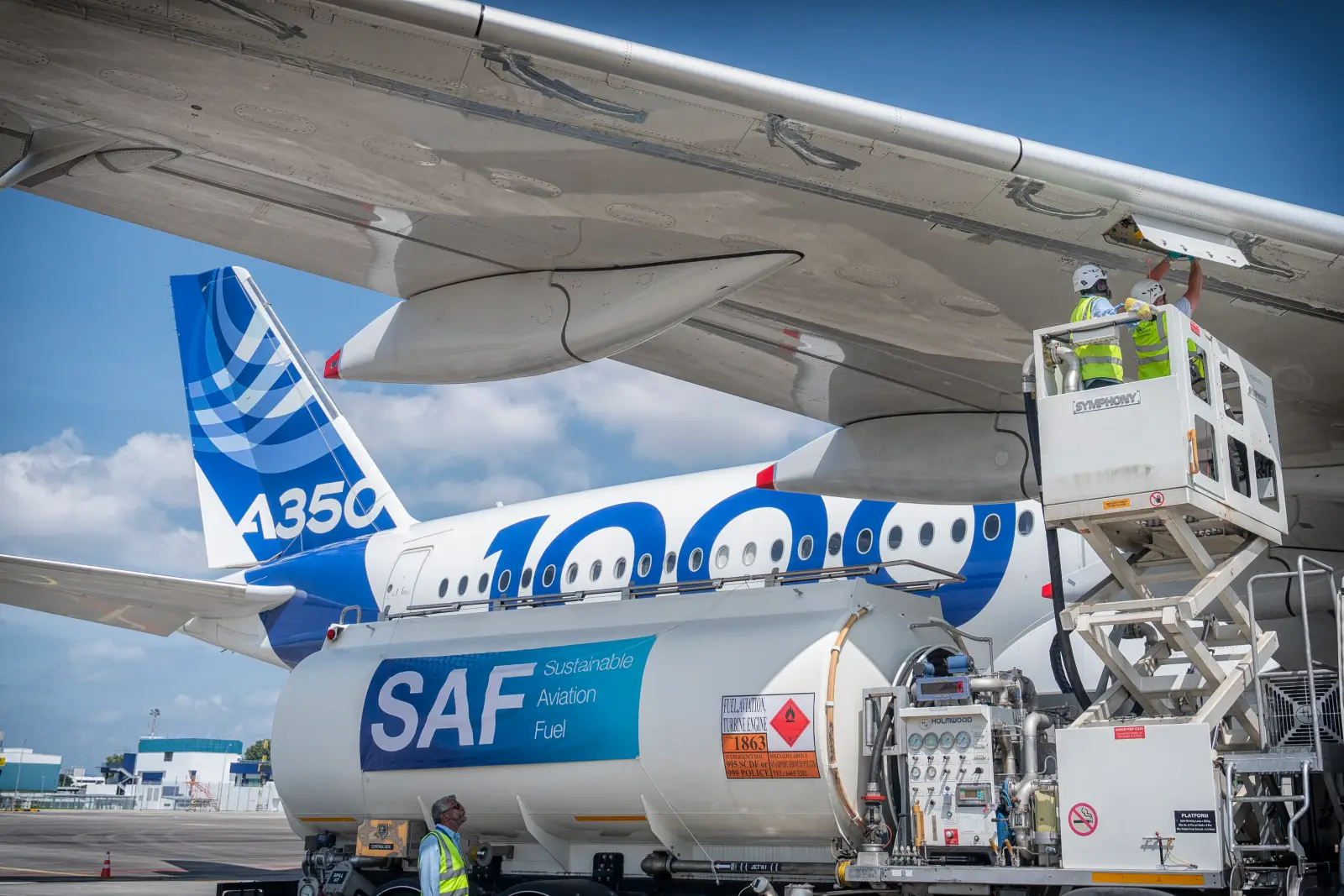
e-SAF is a synthetic fuel derived from renewable energy that is compatible with jet engines and offers similar performance to fossil fuels. Unlike conventional sustainable aviation fuel made from biofuel sources, it does not require biomass or waste oils.
It is produced using a power-to-liquid process. Renewable electricity from solar, hydro or wind is used to split water into hydrogen and oxygen, which is then combined with captured carbon dioxide and processed into a synthetic crude that can be upgraded into fuel.
e-SAF can be used as a drop-in fuel and stored, transported and distributed through existing infrastructure. Its carbon neutrality comes from the fact that it emits only as much carbon when burnt as was captured during production.
Why does e-SAF matter for aviation?
The fuel is seen as central to aviation’s long-term decarbonisation because it sidesteps a key limitation of current supply. Most SAF today comes from a pathway known as HEFA, which uses waste oils and fats, but quantities of these feedstocks are limited.
Reaching the industry’s low-carbon goals will require a mix of pathways, including the growth of e-SAF. Battery-powered flight is expected to remain viable only for short-haul journeys for the foreseeable future, leaving synthetic fuels as the main route to decarbonising long-haul travel.
What is stopping e-SAF from being produced at scale today?
The central barrier is cost. e-SAF remains in the development stage and can currently be up to eight times the price of conventional jet fuel and two to three times the cost of SAF made from HEFA or municipal solid waste.
The price of renewable electricity for hydrogen production, alongside the high cost and logistics of rolling out electrolysers, are key challenges. To be commercially viable, e-SAF needs to be produced at low cost, and current economics make that difficult.
This wider picture frames IATA’s broader concern about the pace of SAF development. The association estimates that global SAF production will reach around 2.4 million tonnes in 2026, representing just 0.8% of aviation fuel use, at a cost to airlines of $4.3 billion.
Willie Walsh, IATA’s Director General, said the outlook was disappointing five years after the industry committed to net zero by 2050.
“It looks to be another disappointing year for SAF production. Five years after committing to achieve net zero by 2050, SAF production will only account for 0.8% of airline fuel use this year,” he said.
Can costs come down?
Supporters of e-SAF argue that mandates are precisely what will bring costs down over time. The aim is to create demand for renewable energy and push the industry to scale faster, with e-SAF expected to be commercialised after 2030 and more widely available beyond 2040.
There are some encouraging signals. Renewable energy costs have fallen 90% over the past decade, and innovations in carbon sourcing, such as securing carbon monoxide from existing industrial sources, could cut energy costs by around 30%. Further investment in refineries would also help scale production and reduce prices.
What is IATA calling for?
To accelerate the scale-up of SAF, IATA is calling for coordinated action across four priorities. These include expanding renewable energy supply to underpin production, ensuring open access to fuel infrastructure such as pipelines and airport systems, and strengthening policy support through effective sequencing of incentives before mandates are imposed.
The association is also pushing to enable a global SAF market with sufficient volumes at commercially viable prices. It argues that a book-and-claim system is essential to transform the market from local to global, making it accessible to airlines and producers regardless of their location, supported by harmonised standards.
What do passengers think?
IATA’s position is set against strong passenger backing for decarbonisation. Its latest survey, conducted in April 2026, found that 89% of passengers believe the industry should keep reducing emissions even if governments scale back their efforts.
Around two-thirds of passengers, 66%, say they are willing to pay more to compensate for emissions, while nearly 88% expect ticket prices to rise as a result of sustainability investments. Passengers favour direct solutions, with 25% prioritising funds for SAF and 23% for emissions-reduction technologies, far ahead of taxes at 10%.
Sustainability is also shaping behaviour. Nearly half of travellers, 48%, look at carbon emissions when choosing flights, and among those who do, over 85% say it affects their decision.