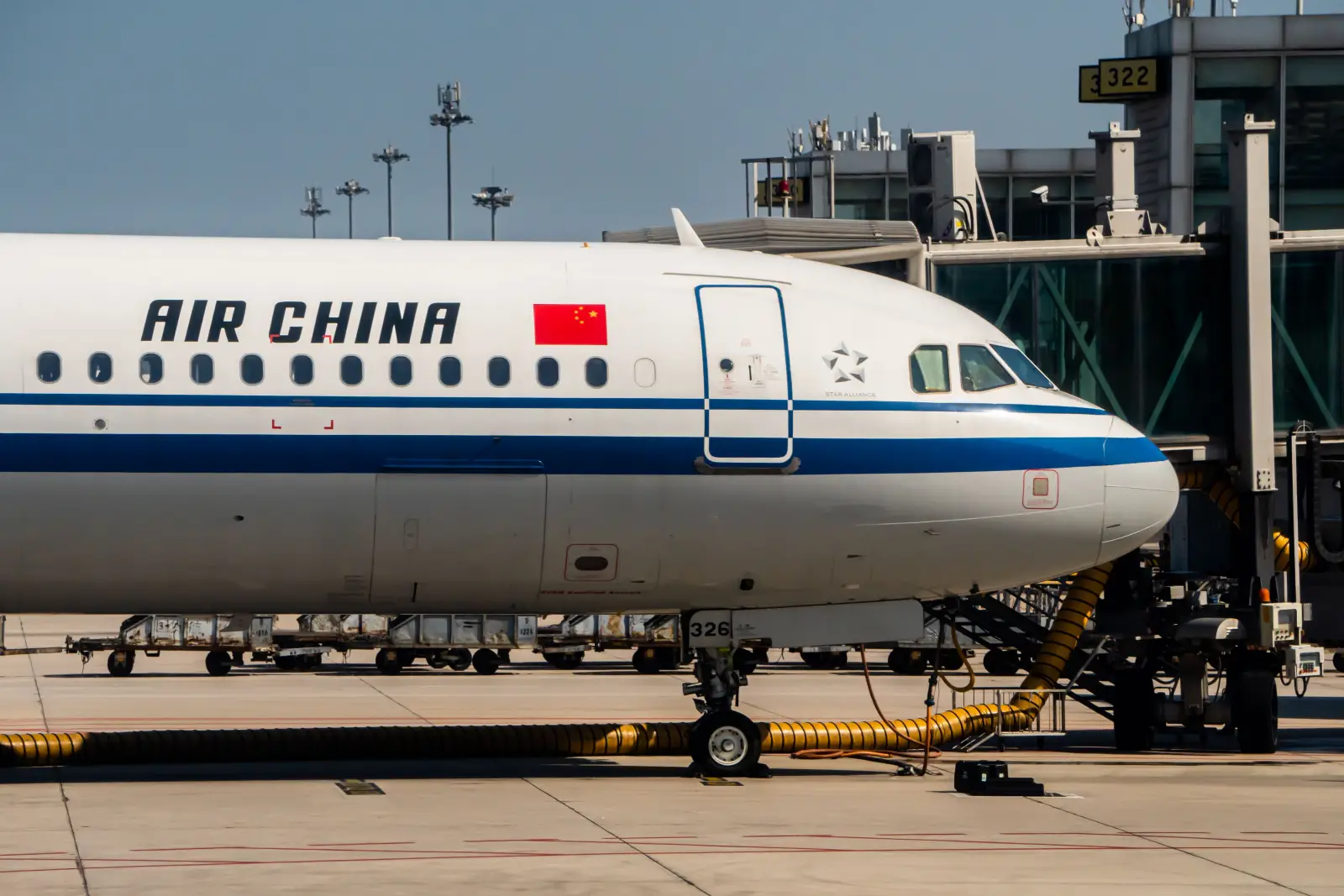
Air China has launched direct flights between Italy and Beijing on two routes, giving travellers in Milan and Venice non-stop access to the Chinese capital. The new links began in June and July 2026, adding to the carrier’s existing services from Milan to Beijing Capital, Chengdu and Shanghai.
The Milan route started on June 18, 2026, connecting Malpensa with Beijing Daxing, one of China’s newest and most advanced airports. The Venice service begins on July 2, 2026, with four weekly flights operating on Tuesday, Thursday, Saturday and Sunday.
The Milan-Beijing Daxing service operates daily using an Airbus A330-300, bringing Air China’s total network from Malpensa to four Chinese destinations. The inaugural ceremony took place at Terminal 1 of Milan Malpensa Airport, attended by Li Duo, General Manager of Air China, Cheng Xuan, President of CCCIT, and Zhang Chenggang, Consul General of the People’s Republic of China in Milan.
Malpensa is the first Italian airport to connect to Beijing Daxing. Air China said the new route reflects the airport’s growing importance in its network and gives passengers another direct option to the Chinese capital.
The Venice service will be the first direct link between the Venetian airport and Beijing. It follows the success of Air China’s existing Shanghai-Venice service and was announced at the 16th session of the Italy-China Joint Economic Commission in Beijing, chaired by Italian Minister of Foreign Affairs and International Cooperation Antonio Tajani and Chinese Minister of Commerce Wang Wentao.
The new Venice flight will use an Airbus A330-200 with 267 seats. It arrives at Marco Polo at 19:15 and departs for Beijing at 21:30 on the same day. With the launch, Air China becomes the only airline operating direct flights between Beijing and Venice, alongside China Eastern, which also serves the city via Shanghai.
The expansion forms part of a wider push by Air China across Europe, where the airline is scheduled to serve 22 destinations during peak summer 2026 across 42 nonstop routes. The growth will lift Air China’s two-way seat capacity between Europe and mainland China to 4.53 million seats in summer 2026, up from 3.63 million in summer 2025.
Italy remains one of the strongest growth markets for Chinese carriers at present. Data from OAG shows China-Italy capacity rising 13% year on year in summer 2026, supported by the Venice launch and growth across Milan and Rome. Other new European routes for Air China this season include Brussels-Beijing Capital, Brussels-Chengdu, Frankfurt-Beijing Daxing and London Gatwick-Chengdu.
Beijing has become one of Asia’s most appealing city-break destinations, offering a mix of historic landmarks, imperial architecture and ultramodern skylines. The city has invested heavily in tourism infrastructure in recent years, improving transport links and access to major attractions.
Among the city’s best-known sights is the Forbidden City, also known as the Palace Museum, the world’s largest ancient palace complex and for centuries the centre of imperial power in China. Visitors also often make time for the Great Wall of China, with the Mutianyu section a popular choice for its accessibility and wide views, including cable cars for the descent.
Other major attractions include the Summer Palace, a vast imperial garden complex built around Kunming Lake, and the Temple of Heaven, or Tiantan, whose circular main building remains a symbol of the capital. Tiananmen Square connects directly to the Forbidden City, while Jingshan Park just to the north offers panoramic views over Beijing’s historic central axis.
Beyond the major monuments, Beijing’s hutong lanes in areas such as Nanluoguxiang and Gulou offer a more traditional side of the capital, popular for cycling and rickshaw tours. The 798 District, once an industrial area, now showcases the city’s contemporary art scene through galleries, design studios and cafes. The Lama Temple, or Yonghe Gong, remains one of the best-preserved Tibetan Buddhist monasteries in China.
With the new direct flights, Italy-based travellers now have more options to reach Beijing without stopovers. The expansion underlines the Chinese capital’s continued push to attract international visitors as demand for long-haul travel between Europe and China continues to recover.
Photo Credit: Wirestock Creators / Shutterstock.com