The International Air Transport Association (IATA) has launched a global safety campaign titled Travel Smart with Lithium Batteries to educate travelers on how to carry lithium-powered devices safely when flying.
The initiative provides seven practical rules for handling mobile phones, laptops, cameras, and power banks, aiming to reduce fire and safety risks caused by damaged or improperly packed batteries. The campaign is available worldwide across IATA’s website, social media channels, and as white-label assets for airlines, airports, and travel partners.
According to IATA, the campaign responds to the growing number of passengers carrying electronic devices and the persistence of misinformation regarding airline battery policies. It also reflects the industry’s ongoing efforts to strengthen aviation safety standards amid rising passenger volumes and increasing device use during air travel.
Campaign Targets Common Safety Misconceptions
IATA data shows that most air travelers carry multiple lithium-powered devices but often misunderstand the rules for transporting them. In a recent passenger survey, 83% of respondents said they travel with a mobile phone, 60% with a laptop, and 44% with a power bank. While 93% of travelers consider themselves familiar with the rules, many hold incorrect assumptions about safe packing practices.
Half of the travelers surveyed incorrectly believe that small lithium-powered devices can be packed in checked baggage. In addition, 45% mistakenly think power banks are allowed in checked luggage, and 33% are unaware that limits exist on the power capacity of batteries. These findings underscore the need for clearer communication and better awareness campaigns across the global travel ecosystem.
“Lithium-powered devices are safe when handled properly, but they can pose a risk if damaged or packed incorrectly. As more travelers fly with these devices, our Travel Smart with Lithium Batteries campaign will help airlines educate their passengers on the simple rules they must keep in mind when traveling with the electronic devices that have become an essential part of their daily lives,” said Nick Careen, Senior Vice President, Operations, Safety and Security at IATA.
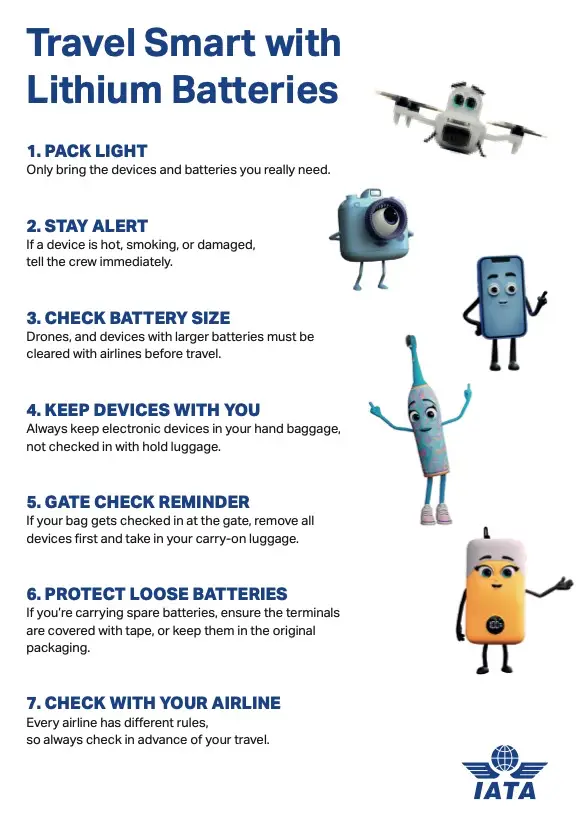
Seven Safety Rules for Travelers
The campaign highlights seven simple safety practices for passengers to follow when carrying lithium batteries or electronic devices on flights. These include packing only essential devices, keeping all lithium-powered items in hand baggage, and protecting spare batteries from short-circuiting by keeping them in their original packaging or covering terminals with tape.
Other recommendations advise travelers to immediately alert crew members or airport staff if a device becomes hot, smokes, or shows signs of damage. Passengers are also urged to remove all lithium-powered items from their baggage if asked to gate-check their hand luggage. For batteries exceeding 100 watt-hours, such as those used in larger cameras or drones, passengers should consult their airline for approval before flying.
The campaign also reminds passengers to check each airline’s individual battery policies, as local regulations and carrier-specific rules may differ. This is particularly relevant for travelers connecting through multiple regions with differing aviation safety standards.
Industry Collaboration and Safety Outreach
IATA’s campaign provides freely available materials to airlines, airports, and industry partners, encouraging them to integrate safety messaging into customer communications. These assets include digital banners, social media templates, and in-flight information materials to ensure consistent safety education across touchpoints.
The initiative supports IATA’s broader mandate to enhance passenger safety and operational standards across the aviation sector. The association continues to work with regulators, airlines, and manufacturers to improve compliance frameworks related to the transport of lithium batteries and other potentially hazardous materials. IATA also maintains technical guidance for airlines on battery handling procedures, training, and labeling requirements.
Lithium batteries are widely used in modern electronics due to their energy efficiency and lightweight design, but they can ignite or overheat when damaged or exposed to extreme temperatures. Incidents of battery-related fires, though rare, have prompted global regulators to issue stricter packaging and transportation rules in recent years. IATA’s campaign reinforces the shared responsibility among travelers, airlines, and regulators to minimize these risks.
The Travel Smart with Lithium Batteries campaign is part of IATA’s long-term safety education strategy and aligns with international efforts to standardize lithium battery transport rules under the International Civil Aviation Organization (ICAO). The association encourages all stakeholders in the travel sector to adopt and share the materials to promote consistent traveler awareness and reduce the likelihood of battery-related incidents in flight.
As the number of devices per traveler continues to rise, IATA’s initiative aims to make battery safety a familiar part of travel preparation. By following a few simple rules and ensuring compliance with airline policies, passengers can help maintain high safety standards and support the aviation industry’s ongoing commitment to secure and reliable air transport.