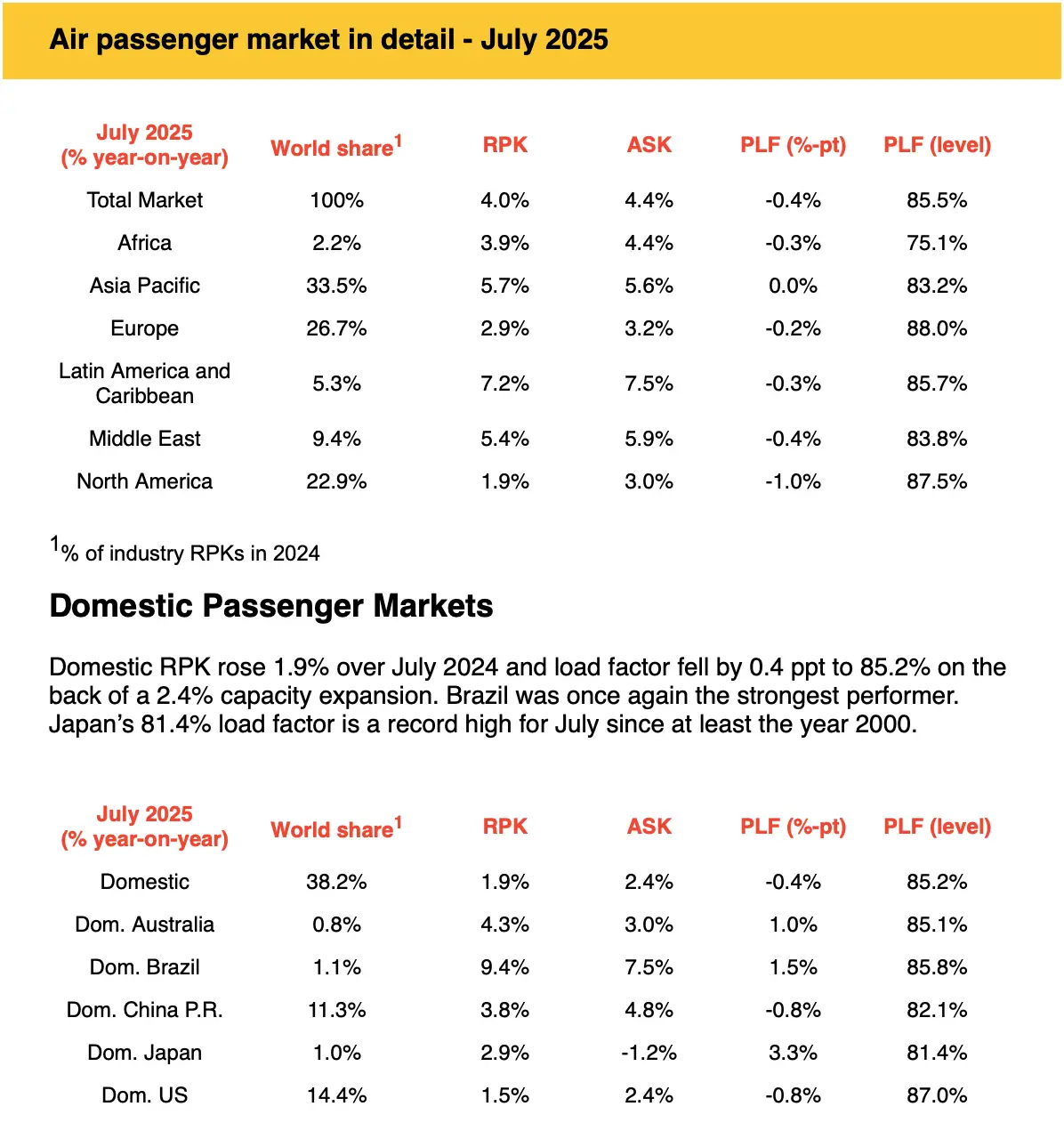
The International Air Transport Association (IATA) reported a 4.0% year-on-year increase in global passenger demand for July 2025, measured in revenue passenger kilometers (RPK).
Total capacity, measured in available seat kilometers (ASK), rose 4.4% compared to July 2024, while the global load factor slipped 0.4 percentage points to 85.5%.
International traffic led the growth with a 5.3% rise in demand compared to the previous year, while domestic travel increased 1.9%. Capacity expanded 5.8% on international routes and 2.4% in domestic markets, with load factors easing slightly across most regions.
Momentum in International Travel
“It’s been a good northern summer season for airlines. Momentum has grown over the peak season with July demand reaching 4% growth. That trend appears across all regions and is particularly evident for international travel, which strengthened from 3.9% growth in June to 5.3% in July. Moreover, with flight volumes showing a 2% year-on-year increase for September after five months of decelerating growth, airlines are positioned to take advantage of this market momentum into the coming months,” said Willie Walsh, IATA’s Director General.
Asia-Pacific airlines recorded the strongest international growth, with an 8.7% increase in demand. Capacity rose 9.0% year-on-year, and the load factor slipped marginally by 0.2 points to 83.8%. European carriers saw a 4.0% demand rise, with a load factor of 87.3%.
Regional Performance
North American carriers posted a 2.4% increase in international demand, alongside a 3.6% rise in capacity. Their load factor was the highest among global regions at 88.4%, despite a 1.0 point decline. Traffic on routes between North and South America declined 0.8%, marking the only negative performance among international corridors.
Middle Eastern airlines achieved a 5.3% demand increase, with capacity up 5.6%. Their load factor reached 84.1%, down 0.2 points year-on-year. The rebound came after disruptions from military conflict in June. Latin American carriers saw the fastest international expansion at 9.3%, although capacity growth of 11.3% outpaced demand, reducing the load factor to 85.8%.
African airlines reported a 2.8% rise in demand, with capacity up 2.3%. The region’s load factor improved by 0.4 points to 74.9%, making Africa the only region to post a year-on-year gain in load factor. Traffic between Africa and Asia recorded a notable surge.
Domestic Markets Remain Stable
Domestic travel demand rose 1.9% compared with July 2024. Brazil led domestic growth with a 9.4% increase in RPK and a 1.5-point improvement in load factor to 85.8%. China’s domestic market grew 3.8% in demand, while the United States posted a 1.5% increase, with its carriers maintaining the world’s highest domestic load factor at 87.0%.
Japan recorded a 2.9% rise in domestic demand, coupled with a 3.3-point increase in load factor to 81.4%, the highest July figure since at least 2000. Australia also saw gains, with demand up 4.3% and load factor at 85.1%.
IATA’s July data underscores resilience in global air travel, with growth evident across most regions despite slight declines in efficiency. Airlines continue to benefit from strong international demand and stable domestic performance, setting the stage for sustained momentum in the latter part of 2025.