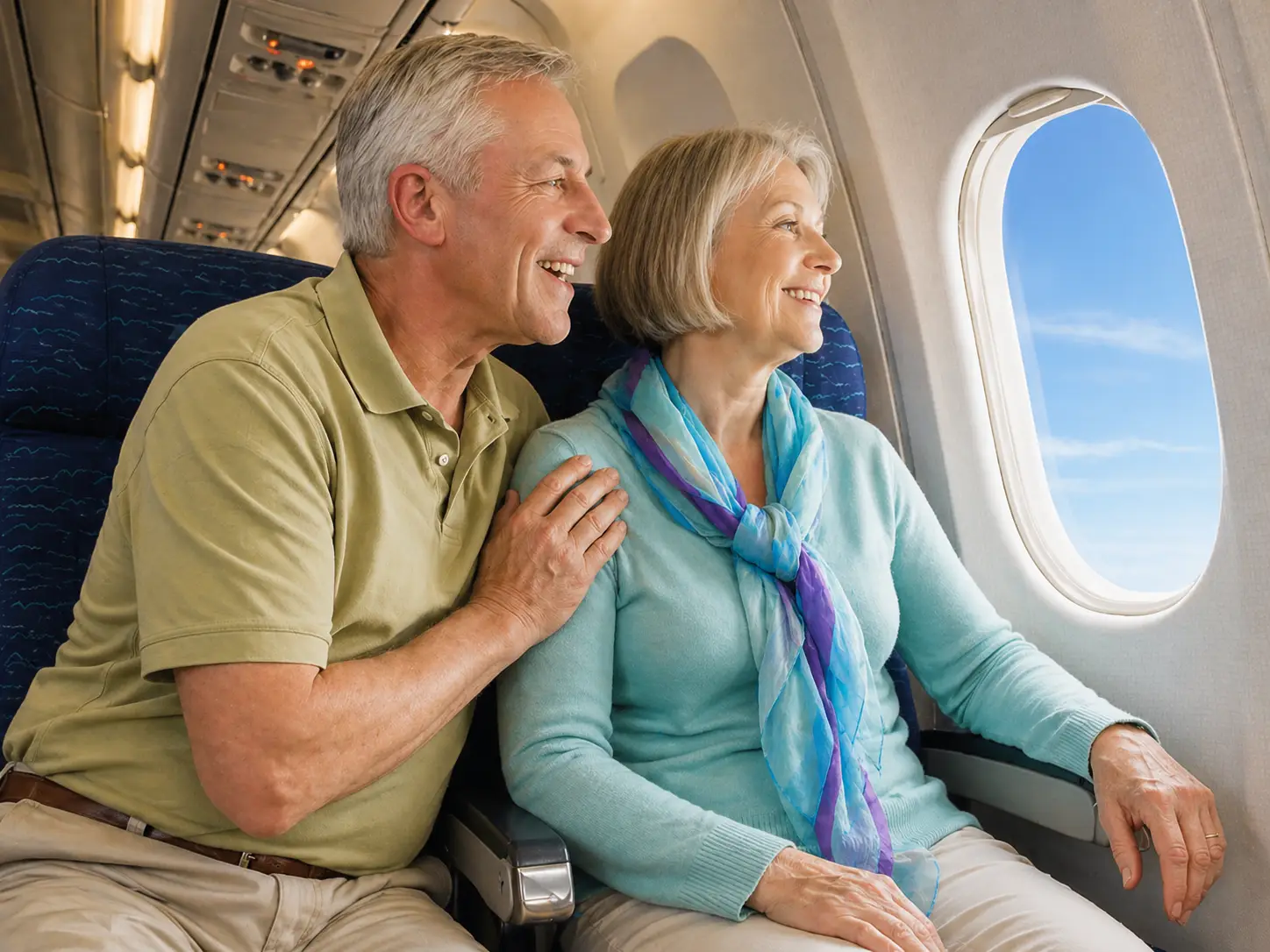
A new study has found that the way older passengers are distributed across an aircraft cabin can significantly affect evacuation times, raising fresh questions about whether current aviation safety standards reflect the realities of an ageing travelling public.
The research, published in the journal AIP Advances, found that in every simulated evacuation scenario tested, aircraft could not be cleared within the internationally required 90-second limit when older passengers were on board.
What the study found
A research team comprising neuroscientists, logistics experts, and engineers simulated an engine fire on an Airbus A320 in which the emergency exits over the wings were unusable. The team ran 27 scenarios using specialised simulation software, varying the seating arrangement, the ratio of older to younger passengers, and the distribution of elderly travellers within the cabin.
The study defined “older” as passengers aged over 60. Age-related factors including walking speed and limited mobility were built into the calculations.
Even in the most favourable scenario modelled, evacuation took 141 seconds. When the proportion of elderly passengers was higher, waiting times climbed to over 200 seconds in some cases.
Why clustering is the problem
The study identified uneven distribution as a particular hazard. When elderly passengers were concentrated in one section of the cabin, bottlenecks formed that delayed the entire evacuation process.
Beyond physical limitations such as reduced mobility or difficulty rising quickly from a seat, the researchers also identified possible cognitive factors. In high-stress situations, these could contribute to slower reactions or difficulties with spatial orientation.
The findings carry a direct implication for a common travel habit: older passengers who fly with family or friends tend to book seats together, which can inadvertently create exactly the kind of concentration the study warns against.
A call to update safety assumptions
The researchers stopped well short of suggesting any restrictions on older passengers flying. Instead, they called for an even distribution of elderly travellers across aircraft cabins, arguing that seating concentrations, whether deliberate or accidental, should be avoided.
The study also challenged the assumptions underpinning many existing evacuation models, which have typically been built around idealised conditions in which passengers react quickly and move without difficulty.
“In view of an aging society, it may therefore be necessary to adapt safety concepts and align them more closely with real-world conditions,” the research team concluded.
The 90-second evacuation standard is a core requirement in international aviation safety regulation, designed to ensure all passengers can exit a commercial aircraft within that window in an emergency. The study suggests that standard may need to be revisited as passenger demographics shift.