Layovers have become an unavoidable part of modern travel, and a new global study reveals that where you wait can matter as much as where you are going.
Research by travel eSIM provider TripSIM has ranked 50 of the world’s busiest international airports to identify which deliver the best layover experience, based on food, shopping, entertainment, rest facilities, connectivity and technology.
The analysis places Singapore Changi Airport at the top overall, with airports in the Middle East and Asia dominating the top 10. The findings highlight how airports are increasingly competing on comfort, dining and fast Wi-Fi as millions of travellers spend hours in transit during long-haul journeys.
Why some airports stand out during long layovers
TripSIM’s study evaluated airports using six equally weighted categories: restaurants and cafés, shops, entertainment amenities, showers and on-site hotels, connectivity and tech amenities, and rest zones. The results suggest that the best-performing airports are those that treat layovers not as dead time, but as an extension of the travel experience.
Singapore Changi Airport claims first place thanks to consistently strong performance across nearly every category. It ranks first for entertainment amenities, connectivity and tech amenities, and rest zones, while placing second for both restaurants and cafés and retail. Features such as indoor gardens, movie theatres, quiet lounges and fast, reliable Wi-Fi underpin its reputation as the gold standard for transit passengers.
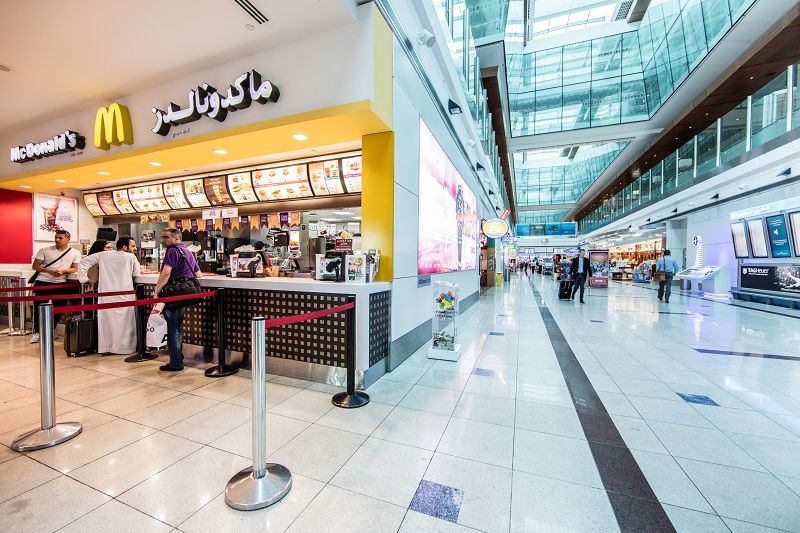
Dubai International Airport ranks second overall and excels in comfort and retail. It places first globally for shops and for showers and on-site hotels, making it particularly attractive for long international connections. The airport also ranks second for entertainment amenities and rest zones, reinforcing its focus on keeping travellers comfortable regardless of how long they are waiting between flights.
Food plays an increasingly central role in how travellers judge layovers, and New Delhi’s Indira Gandhi Airport demonstrates just how influential dining can be. Ranking third overall, it finishes first in the study for restaurants and cafés, offering more than 200 dining options. While its rest zones and hotel facilities are more modest compared with the very top hubs, its strength in food helps push it high up the rankings.
Food, Wi-Fi and rest now define the layover experience
Several airports score highly not because they dominate a single category, but because they avoid major weaknesses. Hong Kong International Airport ranks fourth overall with balanced results across food, entertainment, connectivity and rest facilities, making it a dependable choice for longer connections. Doha International Airport follows closely, ranking fifth overall by combining strong retail, high-quality showers and hotels, and robust connectivity, even though it offers fewer restaurants than some competitors.
South Korea’s Incheon International Airport, in sixth place, stands out for its emphasis on entertainment, connectivity and rest zones. It ranks third globally in all three of those categories, appealing to travellers who value quiet spaces, cultural exhibits and digital convenience over sheer volume of shops or dining outlets.
London Heathrow Airport appears in seventh place, driven largely by its food offering. It ranks third globally for restaurants and cafés, reflecting the breadth of dining across its terminals. However, lower scores for shops and rest zones illustrate the challenges faced by space-constrained, high-traffic European hubs, particularly during peak travel periods.
Tokyo’s Haneda Airport appears twice in the top 10, reflecting variation across terminals and amenities. Overall, it delivers a solid all-round experience, with strong scores for entertainment and connectivity, efficient operations and a reputation for cleanliness helping to smooth the layover experience even where facilities are more limited.

According to Arber Abdullahu, travel expert at TripSIM, the results reflect a broader shift in how travellers perceive time spent between flights. “Layovers used to be something travelers just tolerated,” he said. “Now, people actively notice whether an airport makes those hours easier or harder. Good food, fast internet, and somewhere to sit or rest quietly can completely change how a trip feels.”
Connectivity, in particular, has become non-negotiable for many passengers. “For many travelers, a layover is a chance to catch up on work, message family, or rebook plans,” Abdullahu said. “Airports that invest in strong Wi-Fi and charging infrastructure immediately stand out.”
The dominance of Asian and Middle Eastern airports in the rankings reflects long-term investment rather than passenger volume alone. Abdullahu pointed to hubs such as Singapore and Dubai as examples of airports designed specifically around transit passengers. “They’re building spaces where people can actually reset between flights,” he said. “That’s why these airports consistently rank at the top, year after year.”
For travellers facing layovers of three hours or more, the study suggests that choosing the right connecting airport can significantly affect how a journey feels. As airlines continue to streamline routes and rely on hub-and-spoke networks, the airports that succeed will be those that turn waiting time into something closer to a pause than a penalty.