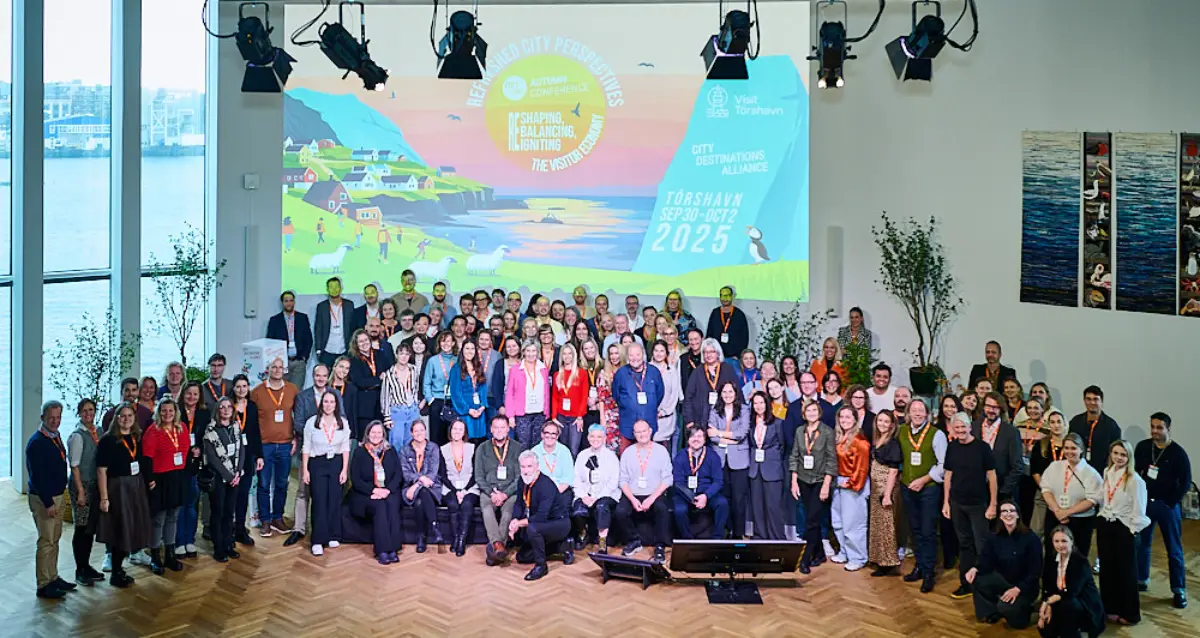
More than 130 tourism leaders from across Europe gathered in Tórshavn, Faroe Islands, for the City Destinations Alliance (CityDNA) Autumn Conference 2025, held from September 30 to October 3. Hosted by Visit Tórshavn under the theme “Refreshed City Perspectives,” the event focused on collaboration, creativity, and purpose in redefining the future of the urban visitor economy.
The conference marked a milestone for CityDNA as it initiated the process toward the Tórshavn Declaration — a shared commitment to reframe the role of Destination Marketing and Management Organisations (DMOs) in a rapidly changing tourism landscape. Through workshops structured around political, economic, social, and technological dimensions, participants identified key priorities for European cities, including stronger EU advocacy, sustainable funding models, inclusion, AI integration, and data ethics.
The Tórshavn Declaration: A New Framework for Urban Tourism
The Tórshavn Declaration is designed as a living document that will evolve through continued collaboration among CityDNA members over the next 18 months. Barbara Jamison-Woods, President of City Destinations Alliance, described it as “the start of a movement.” She said, “Our members are co-authoring a shared vision for European cities for the next 18 months: one that balances growth with care, innovation with integrity, and visitors with residents.”
The outcomes of the Declaration will be refined and published later this autumn, adding a strategic layer to CityDNA’s long-term framework. Rather than replacing the organization’s strategy, the Declaration aims to make it more relevant in what Jamison-Woods described as a “VUCA world” — one defined by volatility, uncertainty, complexity, and ambiguity.
Speakers throughout the conference emphasized that the future of tourism depends on a human-centered approach, where innovation and empathy coexist. Jesse Palmer from the House of Beautiful Business highlighted the importance of intentional community-building in the digital age, while Dr. Caitlin Morrissey from The DNA of Cities urged destinations to “decode their city’s DNA” — its identity, story, and culture — as a compass for future growth. Her examples from Sydney, Manchester, Kyiv, and Tórshavn underscored how storytelling and governance can help cities retain authenticity amid global competition.
Innovation, Inclusion, and Responsible Growth
Technology and data featured prominently at the conference as participants examined how artificial intelligence and automation can enhance operations, marketing, and visitor experiences. Presentations by Bastian Hiller and Friedemann Schütz of Teejit showcased how AI tools can streamline workflows, while Cédric Lopez and Luca Romozzi from Sojern discussed digital-first strategies for personalizing storytelling and measuring impact. Speakers emphasized the need for transparency, accountability, and ethical use of data to ensure that innovation remains people-driven.
Insights from the City Travel Report 2024–2025, presented by Bozana Zekan of Modul University Vienna, revealed that European city tourism is entering a phase of strategic stabilization. Long-haul travel is rebounding, and urban destinations are performing strongly. However, the report also noted that rising carbon emissions highlight the urgency for sustainable transformation across the sector.
Speakers including Łukasz Wysocki of Visit Gdańsk and representatives from Madrid Destino, London & Partners, and Visit Faroe Islands shared case studies showing how inclusion, accessibility, and resident engagement are now central to destination success. Discussions emphasized that cities must evolve from marketing destinations to stewarding entire visitor ecosystems, ensuring that local communities play an active role in shaping tourism development.
David Peacock (Simpleview, VivaCITY), Henna Siltanen and Kaisa Kosonen (City of Helsinki), and Reinhard Lanner (Saint Elmo’s) explored how data, co-creation, and collaboration can support regenerative tourism models that prioritize community well-being and environmental stewardship. Examples demonstrated that when residents and local partners are empowered, tourism can become a force for sustainability and civic pride.
Carolin Giarra (ETFI) and Claire Mertens (City of Antwerp) led climate-focused workshops presenting strategic foresight methodologies developed with 19 European destinations. Their research illustrated how scenario planning can help DMOs anticipate and adapt to multiple futures, reinforcing the need for evidence-based policy and collective action in response to climate change and technological disruption.
Across parallel sessions, topics such as wellness tourism, climate adaptation, and the €1.6 trillion meetings industry added depth to the agenda. These discussions reaffirmed CityDNA’s position as a central forum for knowledge-sharing and collaboration among European cities.
“Across every theme, from accessibility to AI, one message stood out,” said Jamison-Woods. “Building the visitor economy of tomorrow requires co-creation — not top-down management, but shared responsibility and purpose.”
Cultural Legacy and Local Engagement
The conference’s social program highlighted the Faroese spirit of connection and environmental care. Delegates joined local NGO Rudda Føroyar for a beach clean-up to protect the islands’ fragile ecosystem and took part in a guided hike to the historic village of Kirkjubøur, experiencing the Faroe Islands’ natural and cultural heritage firsthand.
Learning extended beyond the conference venue through “walkshops,” interactive sessions encouraging discussions on voluntourism and city identity in real settings. The networking dinner featured a surprise performance by local musician Marius Ziska, encapsulating the creativity and warmth of the Tórshavn community. CityDNA thanked Visit Tórshavn for their partnership and hospitality, noting the event’s strong local impact and global reach.
As CityDNA prepares to release the finalized Tórshavn Declaration later this autumn, it continues to advance its mission through upcoming gatherings, including the Visitor Experience Expert Meeting in Vilnius (November 2025), the CVB Expert Meeting in Graz (January 2026), the CEO Meeting in Barcelona (February 2026), and the International Conference and General Assembly in Helsinki (April 2026).
The Tórshavn conference reaffirmed CityDNA’s commitment to collaboration and purpose-driven leadership in shaping resilient, inclusive, and sustainable urban tourism for the years ahead.