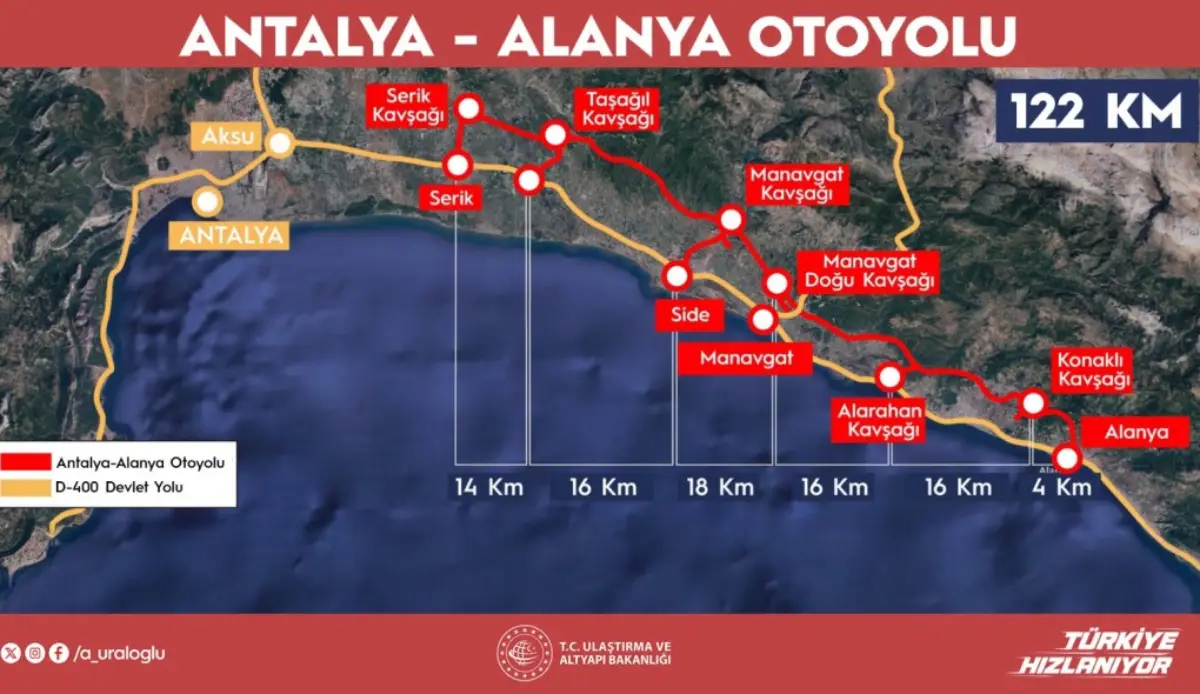
Turkey has launched construction of a 122-kilometer highway linking Antalya and Alanya, two of the country’s busiest Mediterranean destinations. Officials say the road will cut travel time from two and a half hours to just 36 minutes, reshaping the region’s transportation landscape and providing a critical boost to tourism, agriculture, and the broader economy.
At a groundbreaking ceremony earlier this month, Transport and Infrastructure Minister Abdulkadir Uraloğlu described the project as a “path of tourism, trade, production, and life.” The route is expected to alleviate chronic congestion during peak travel seasons while offering significant financial and environmental gains.
Strategic Roadwork on the Mediterranean Coast
The highway will stretch from the town of Serik near Antalya and extend to the Alanya West Junction, cutting across the Taurus Mountains via a modern infrastructure system. The plan includes 84 kilometers of main road and 38 kilometers of connector routes. Five tunnels totaling 4,365 meters and 16 viaducts measuring nearly six kilometers will support the network, along with seven junctions and four service stations.
Engineers have designed the route for high-speed travel, allowing for speeds of up to 140 km/h on the main route and 110 km/h on connecting roads. Officials say this speed will reduce delays and give tourists and locals faster access to coastal resorts, airports, and trade routes.
Minister Uraloğlu framed the initiative as part of Turkey’s long-term infrastructure strategy. “We are connecting Antalya and Alanya not just with concrete,” he said, “but with vision, confidence, and engineering.”
Economic Case for Connectivity
The project carries a price tag of 235 billion lira, part of a broader 235.1 billion lira investment in Antalya’s transportation infrastructure since 2002. The highway is expected to generate annual savings of 16.9 billion lira in travel time and 800 million lira in fuel, officials say.
But the government is also touting environmental benefits. According to the Ministry of Transport and Infrastructure, the road could eliminate more than 47,000 tons of carbon emissions each year. That figure reflects both the reduction in fuel consumption and the improved traffic flow anticipated once the highway opens.
Local industries also stand to benefit. Regional farmers will have quicker access to markets, helping reduce spoilage and transportation costs. The government says the highway will support new jobs, improve access to ports, and help spread the economic benefits of tourism more evenly across the region.
| Benefit | Estimated Annual Impact |
|---|---|
| Time savings | 16.9 billion TL |
| Fuel savings | 800 million TL |
| Carbon reduction | 47,000 tons |
| Travel time reduction | 2.5 hours to 36 minutes |
From Regional Shortcut to National Network
The highway project is also viewed as a building block in Turkey’s broader national infrastructure agenda. It will eventually integrate with routes connecting Antalya to İzmir, Istanbul, and European transport corridors. Upcoming projects like the Denizli-Burdur-Antalya Highway will add new arteries to the expanding system.
“This highway is a concrete demonstration of the vision of the Turkish Century,” Uraloğlu said during his remarks, echoing the government’s emphasis on modernization through large-scale infrastructure projects.
The construction comes amid heightened government focus on building up logistics, energy, and digital infrastructure ahead of Turkey’s 2028 economic goals. Officials say improved road systems will help facilitate the movement of goods and reduce supply chain inefficiencies throughout southern Turkey.
Local Identity and Global Reach
The road’s significance is as much cultural as it is technical. In a symbolic flourish, Uraloğlu said the highway “connects the orange blossoms of Antalya to the banana groves of Alanya.” The message underscores a broader theme: investing in local identity while scaling toward national and international relevance.
As tourism rebounds and domestic travel demand continues to climb, the new highway offers a physical route through which Turkey hopes to carry its economic and strategic ambitions forward. Whether it becomes a new artery of commerce or merely a faster route to the beach, the project marks a defining shift in how the region moves.