Pope Leo XIV concluded his three-day visit to Turkey (Türkiye) on November 30, 2025, having toured Ankara, Istanbul and İznik to commemorate the 1,700th anniversary of the First Council of Nicaea and to promote interfaith dialogue and religious reconciliation.
The Türkiye trip, as expected before, becomes his first overseas journey since his election in May 2025 — included meetings with Turkish political and religious leaders, visits to Muslim and Christian sites, and a landmark joint declaration with the head of the Orthodox Church.
The visit comes at a time of renewed openness, according to minority-community representatives who said the presence of the Pope brought heightened visibility and a sense of restored confidence for long-standing Christian populations in a predominantly Muslim country. Turkish government officials appeared receptive, making the trip as much diplomatic as spiritual.
Ambitious itinerary: Ankara, İznik, Istanbul
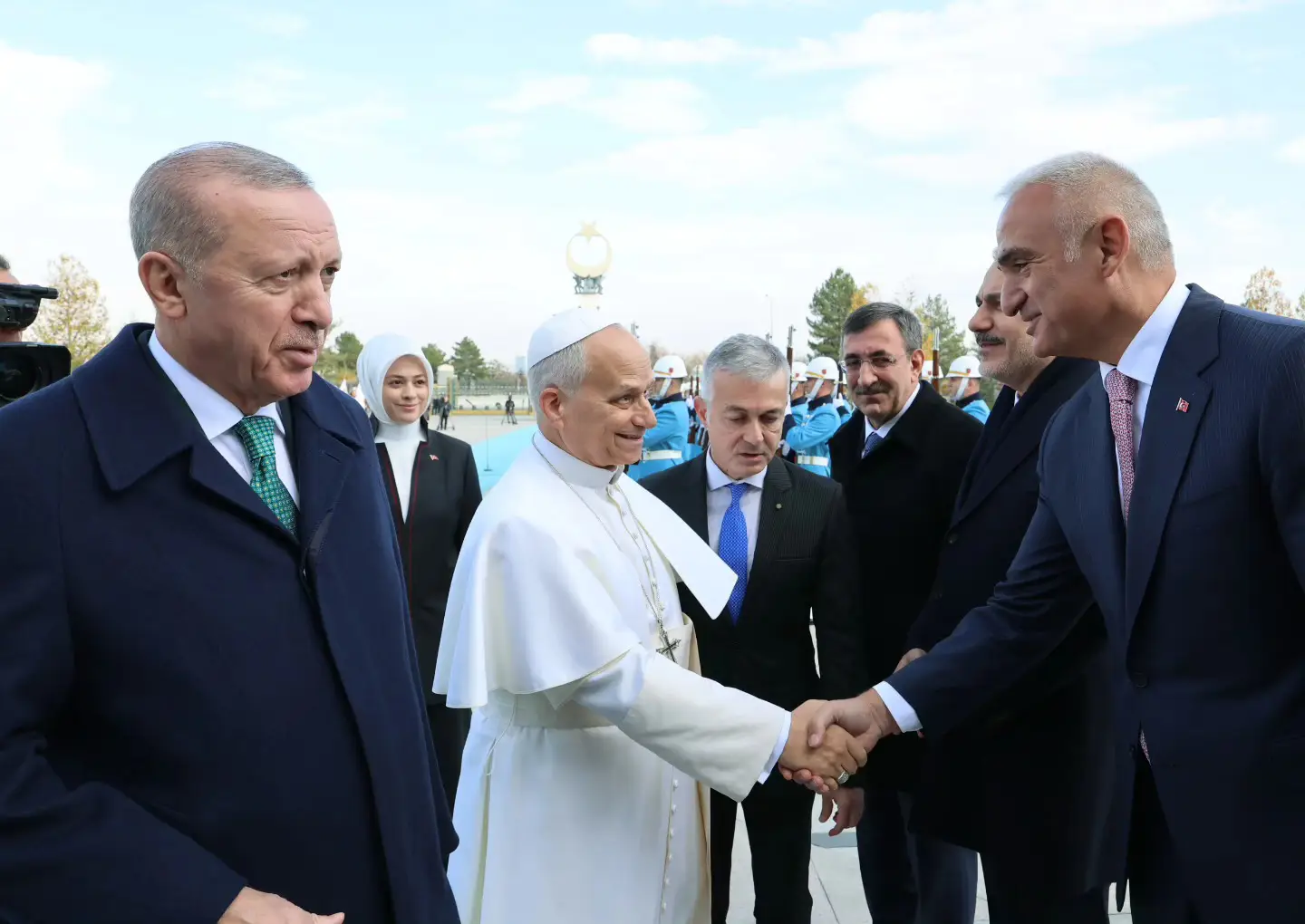
Arriving in Ankara on November 27, Pope Leo began his journey at the Atatürk Mausoleum before visiting the Presidential Palace for a formal welcome. He addressed civil authorities, diplomatic corps and civil society at the National Library, where he described Türkiye as “a land inextricably linked to the origins of Christianity,” while stressing its vocation as a bridge between cultures, faiths and continents. He urged societies to reject division and embrace dialogue and fraternity.
On November 28, the Pope visited the Cathedral of the Holy Spirit in Istanbul to meet Catholic faithful, and later travelled by helicopter to İznik — the site of Nicaea — to attend an ecumenical prayer service near the ruins of the ancient basilica of Saint Neophytos. That event marked the 1,700th anniversary of the First Council of Nicaea, a milestone for Christianity worldwide.

Interfaith gestures and Christian-Orthodox unity efforts
On November 29, Pope Leo entered Istanbul’s Blue Mosque walking in white socks, a sign of respect, but declined to pray. He spent roughly 20 minutes inside the mosque, during which he engaged in silent reflection and a moment of shared respect with Muslim leaders. Local religious officials reported that a muezzin’s offer to pray with him was politely declined; the Pope later joked with him over a “No exit” sign at the door he was guided toward. The Vatican said the visit was undertaken “in a spirit of contemplation and listening, with deep respect for the place and for the faith of those who gather there in prayer.”

Earlier the same day, he visited the Ecumenical Patriarchate of Constantinople at the Patriarchal Church of St. George, where he signed a joint declaration with Bartholomew I, the head of the Orthodox Church. The declaration committed Rome and Constantinople to unity efforts among Christians, including exploring a common date for Easter. The gesture was described as historic and symbolic.
Minorities welcome visit; broader implications for religious coexistence
Representatives of Greece’s, Armenia’s and Syriac orthodox and other long-established Christian minorities in Turkey welcomed the Pope’s visit. Many voiced that the trip offered renewed visibility and, for some, a sense of restitution or recovery of confidence after decades of demographic decline, political tensions, and loss of religious and communal rights. One leader described it as “a great honour for Türkiye,” noting that the presence of the Pope and the government’s cooperation signalled a strengthened role for minority foundations.
Despite Christians now representing only a small fraction of a country of over 80 million people, the visit underscored that ancient Christian communities remain part of Türkiye’s social fabric. According to community representatives, reforms in recent years have allowed restoration of religious properties, legal recognition of foundations, and renewed opportunity for religious life.
Observers said Pope Leo’s careful but deliberate diplomacy — avoiding provocative language on sensitive issues such as historical events or contemporary politics — reflects a measured approach aimed at fostering cooperation without inflaming tensions. The restrained tone contrasts with more direct-style predecessors, but may better suit the complex social and religious landscape of modern Türkiye.
For travellers and pilgrims, the Pope’s visit — traversing Ankara’s mausoleum and palace, the ancient site of Nicaea, Istanbul’s Christian churches and a historic mosque — highlights how Türkiye can serve as a living crossroads of civilizations. The itinerary serves as a reminder that Turkey’s cultural and religious heritage, from Byzantine basilicas and Orthodox cathedrals to Ottoman mosques, remains accessible and relevant, offering a unique perspective for visitors interested in history, faith and interfaith dialogue.
Photos: facebook.com/MehmetErsoyTR