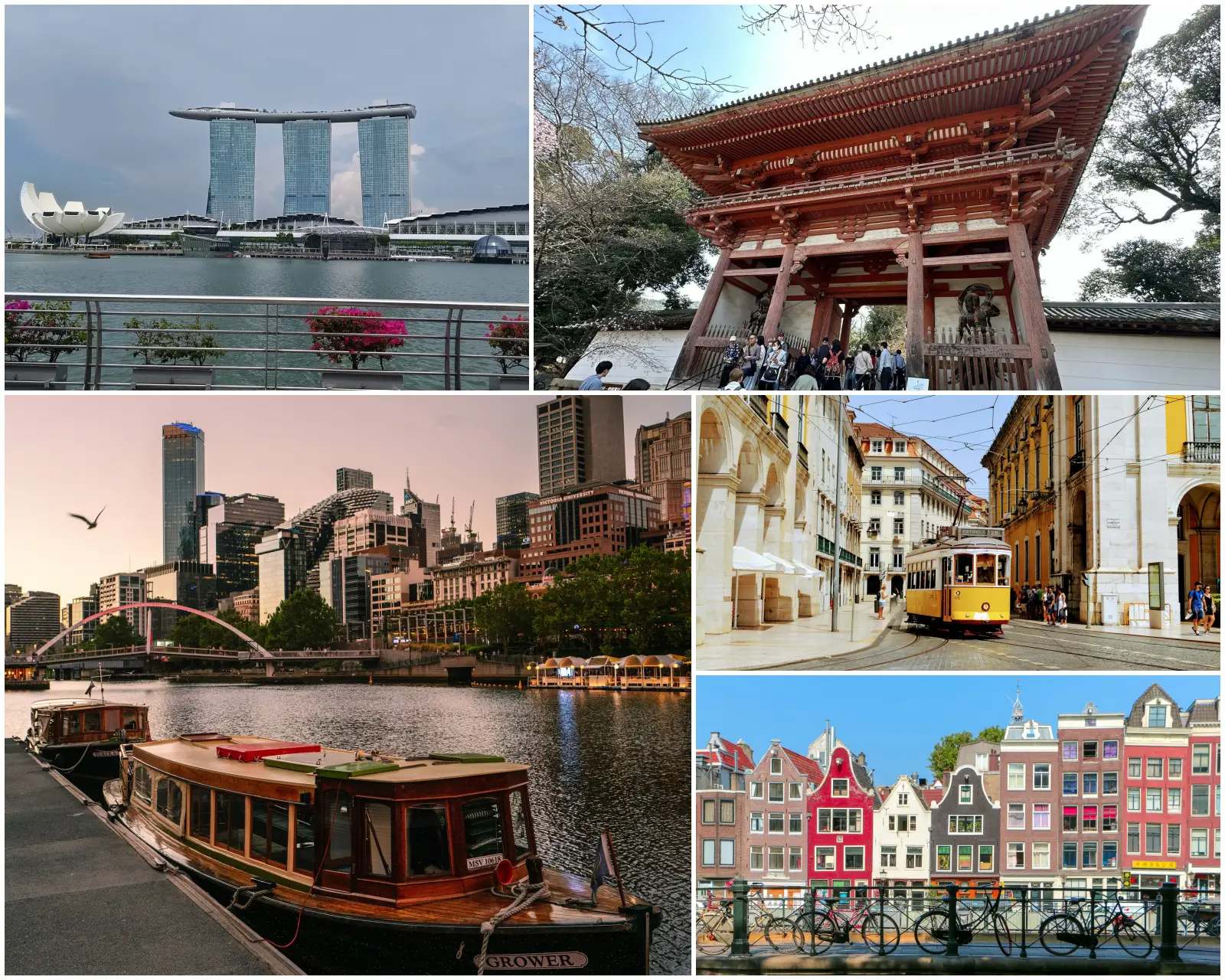
Today, more than 300 million people live outside their country of birth. The number of international migrants reached 304 million in 2024, nearly double the 154 million recorded in 1990 (UN DESA, 2025). The post-pandemic decade has accelerated this shift further, producing a more diverse group of internationally mobile individuals, including remote workers, retirees, digital entrepreneurs and location-independent families, each with distinct priorities.
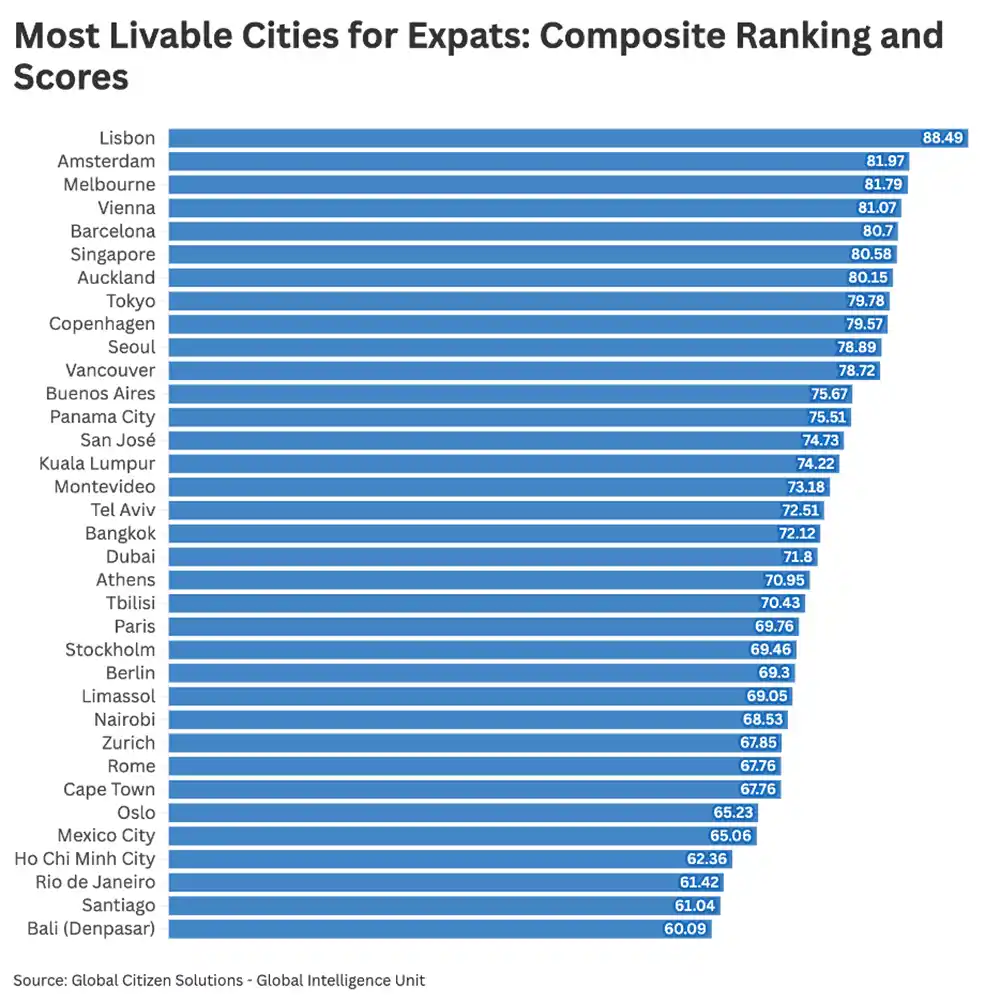
Global Citizens Solutions’ first edition of the Ranking of 35 Cities for International Relocators evaluates 35 globally diverse cities and identifies the most livable destinations for expats among them.
City selection and criteria
The 35 global cities were selected based on their relevance to active relocation decisions rather than prestige or population size. The cities are evaluated across seven indicators which are cost of living, personal safety, air quality, healthcare quality, ease of settling in, English proficiency and enhanced mobility.
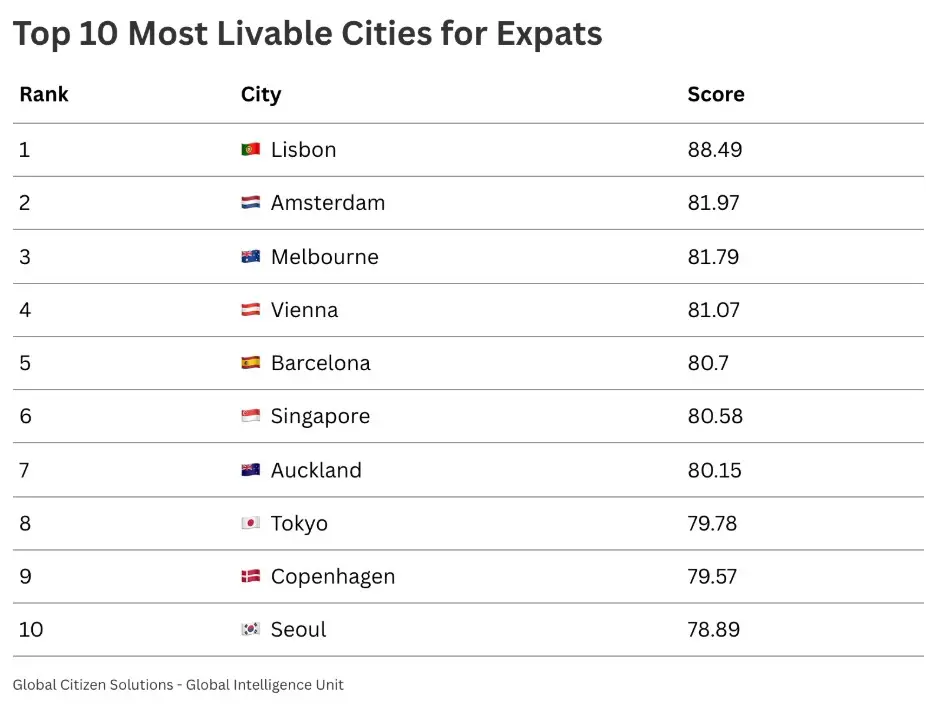
- Lisbon, Portugal
Lisbon leads the index due to its consistently strong performance across all indicators, rather than dominance in any single category. Lisbon is among the least expensive capitals in the index. It combines good air quality with comparatively low living costs and broadly strong performance across infrastructure, environmental, and mobility indicators.
For internationally mobile residents, this profile is reinforced by multiple legal pathways to residency, including residence-by-investment and digital nomad visa relative to other European jurisdictions.
- Amsterdam, Netherlands
Amsterdam ranks second, supported by high safety, high-quality healthcare, and clean air. The city also stands out for its accessibility for international residents, recording the highest English proficiency level among European cities. Amsterdam is also exceptionally easy to navigate without a car, underscoring its appeal for car-free expat living. Amsterdam offers a well-rounded and stable living environment, for those able to sustain its cost level.
- Melbourne, Australia
Melbourne ranks as the highest-performing city outside Europe, supported by high English proficiency level and ranks among the cleanest cities on air quality. High-quality healthcare, stable governance and well-developed urban systems support a reliable standard of living, particularly for residents relocating from other English-speaking countries. Its principal constraint of safety, represents the main weakness in an otherwise balanced profile.
- Vienna, Austria
Vienna stands out for its strong performance in healthcare. Beyond healthcare, Vienna combines high institutional quality with manageable living costs and high English proficiency. The city’s extensive public transport system and large share of green space further contribute to day-to-day livability. The principal limitation is ease of settling in, where Vienna records the lowest score among the top 10 cities. This indicates that social integration may take longer for newcomers, even where the underlying infrastructure and quality-of-life conditions remain strong.
- Barcelona, Spain
Barcelona ranks fifth, supported by solid healthcare, relatively clean air, and a high level of international mobility. Barcelona is one of Europe’s most internationally mixed cities: foreign nationals account for 26.4% of the city’s population. Its cost of living is also moderate relative to higher-ranked cities. Spain also offers a non-lucrative visa pathway, which permits financially independent individuals to reside in the country without employment. The primary limitation is safety, where Barcelona records the lowest score among European cities in the top ten.
- Singapore
Singapore records the highest mobility score in the index and high English proficiency level. Its safety score is also among the highest, contributing to a stable and predictable living environment. A defining feature of Singapore is its long-established role as a global hub for international business and finance. Singapore’s global connectivity is a major expat advantage, underscored by the award-winning Changi Airport. However, Singapore is the most expensive city in the top ten, which limits accessibility for lower- and middle-income residents.
- Auckland, New Zealand
Auckland is seventh, owing to its strong environmental performance and welcoming environment for foreigners. The city has some of the cleanest air in the ranking, and it also offers the advantage of broad English proficiency. Overall, it is a stable, lower-density city, lo living costs and a healthcare score that meets every day needs. Despite its principal limitation of safety, Auckland’s balance of environmental quality, accessibility, and cost positions it as a competitive option within the index.
- Tokyo, Japan
Tokyo ranks eighth, with its safety score among the highest. A defining feature of Tokyo is access to Japan’s strong healthcare system. Tokyo’s foreign resident population is growing. As of 1 January 2026, Tokyo had an increase of over 62,000 foreigners as compared to the year before. Tokyo also recorded the lowest English proficiency in the top 10. Despite this, its combination of safety, healthcare quality, and cost efficiency positions it as a distinctive option within the index.
- Copenhagen, Denmark
Copenhagen scored well in high safety, strong healthcare, clean air, high English proficiency and high mobility contribute to a well-developed and stable urban environment. Copenhagen remains one of the world’s strongest cycling cities: around 150,000 people cycle each day to work or educational institutions in the City of Copenhagen, representing a 36% modal share of all trips. However, Copenhagen is the second most expensive city in the top ten, behind only Singapore, and its ease-of-settling-in score is among the lowest in the sample.
- Seoul, South Korea
Seoul stands out for its exceptional performance in healthcare. The country received two million foreign medical visitors in 2025. The city also performed strongly on safety, while maintaining a cost of living that is moderate. However, air quality is weaker relative to other cities in the top ten, and English proficiency together with ease of settling in suggest that integration may require additional time and adjustment for international residents.
Conclusion
No city in the sample leads in every dimension, and the cities that do lead the composite – Lisbon, Amsterdam, Melbourne, Vienna – are cities without a significant weakness. Livability, as measured here, is a function of balance rather than peak performance. These patterns suggest that the question facing prospective expats is not which city is best, but which combination of strengths and trade-offs best aligns with their priorities.
For example, a digital nomad with location-independent income may prioritise affordability and expat community. A retiree may prioritise healthcare quality and safety. A family relocating with children may weigh English-language access and institutional stability,. A high-net-worth individual may prioritise mobility, personal security, and access to residence-by-investment pathways.