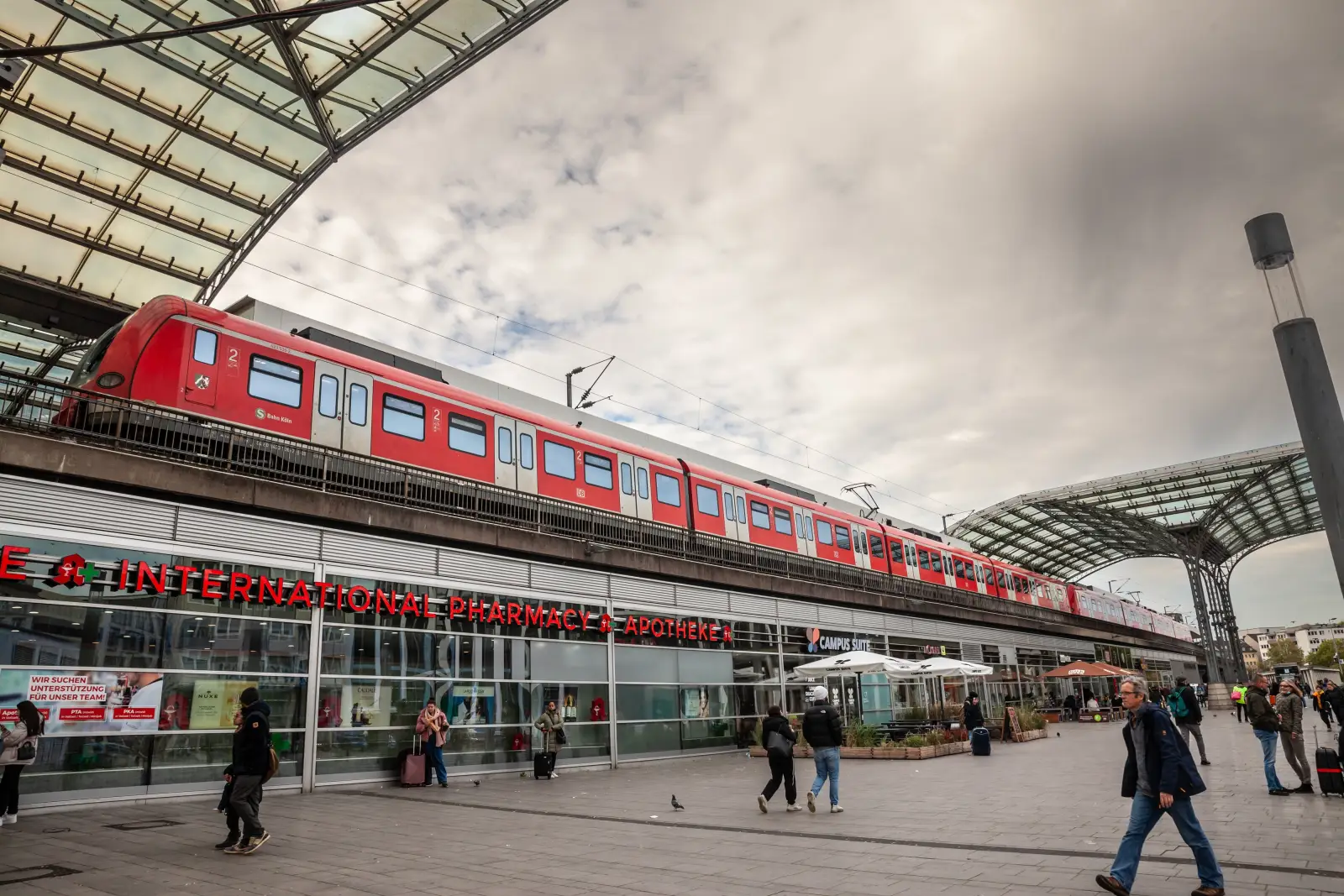
Deutsche Bahn will close one of Germany’s busiest rail corridors between Cologne and Hagen for five months in 2026 as part of a large-scale modernization project worth €800 million. The overhaul will begin on February 6, 2026, and is set to continue until July 10, 2026, affecting both local and long-distance services across North Rhine-Westphalia.
The project covers more than 80 kilometers of railway line and 12 stations between Cologne-Mülheim and Hagen Central Station. Deutsche Bahn said the work forms part of its revised infrastructure strategy, which focuses on fully renovating key rail sections instead of carrying out smaller, piecemeal repairs. The initiative is expected to cause extensive disruptions to passenger traffic along one of Germany’s most heavily used routes linking Cologne, Wuppertal, and the Ruhr region.
Five-Month Closure and Service Disruptions
Officials confirmed that the line will be completely closed to all train services during three specific periods totaling eight weeks. The full closures are scheduled between February 6 and 20, March 20 and April 3, and May 15 and June 12. During these times, Deutsche Bahn will provide replacement bus services. S-Bahn services will operate only during the intervals between closures, while all long-distance trains will remain suspended throughout the five-month period.
“This is a huge challenge,” said Arno Jaeger, head of the comprehensive renovation project between Hagen and Cologne. He added that the construction involves “a large number of companies” and noted the logistical difficulties posed by “dense urban development and limited access to the tracks.”
All Intercity (IC) and Intercity-Express (ICE) trains between Dortmund and Cologne will be rerouted via Essen and Düsseldorf or canceled for the affected section. The long-distance stops at Solingen and Wuppertal Hauptbahnhof will be closed for the duration of the project. Journey times between Cologne and Berlin will be extended by around 20 to 30 minutes due to rerouting, and the ICE Sprinter service between Cologne and Berlin will be suspended for the entire construction period.
Stations and Infrastructure Upgrades
Deutsche Bahn said the modernization will cover extensive infrastructure improvements, including the renewal of 80 kilometers of track, 28 switches, and 30 kilometers of overhead power lines. Twelve stations will undergo upgrades, with the exception of Hagen Central and Cologne-Mülheim. Planned works include new platform roofs, upgraded passenger information displays, and improved accessibility through barrier-free access at all renovated stops.
In the Cologne area, 5.6 kilometers of track between Cologne-Höhenhaus and the city boundary with Leverkusen will be replaced. Two new switches and a trapezoidal switch system will be installed to make overtaking maneuvers more efficient and reduce operational delays. The project also includes the installation of 300 meters of new noise barriers in the Höhenhaus district to minimize environmental impact for nearby residents.
The €800 million renovation is part of Deutsche Bahn’s nationwide effort to modernize aging infrastructure and reduce long-term disruptions by completing full line upgrades in concentrated timeframes. The company has adopted this “total closure and renewal” approach to increase reliability across major corridors serving Germany’s industrial regions.
While the overhaul aims to improve long-term efficiency and passenger experience, the temporary closure will significantly affect commuters and regional travelers in North Rhine-Westphalia. The Hagen–Cologne line connects key population centers and supports both domestic and international routes, making it a critical artery in Germany’s rail network.
Deutsche Bahn has stated that early communication with passengers will be prioritized, with detailed replacement schedules and routing information to be published well ahead of the closure. Regional transit authorities are expected to coordinate additional local connections and bus services during the disruption period.
When completed in July 2026, the modernized line is expected to improve punctuality, safety, and travel times across the region. Deutsche Bahn said the upgrades will form part of a broader infrastructure program designed to strengthen Germany’s rail network and support the company’s long-term sustainability goals.
Photo Credit: BalkansCat / Shutterstock.com