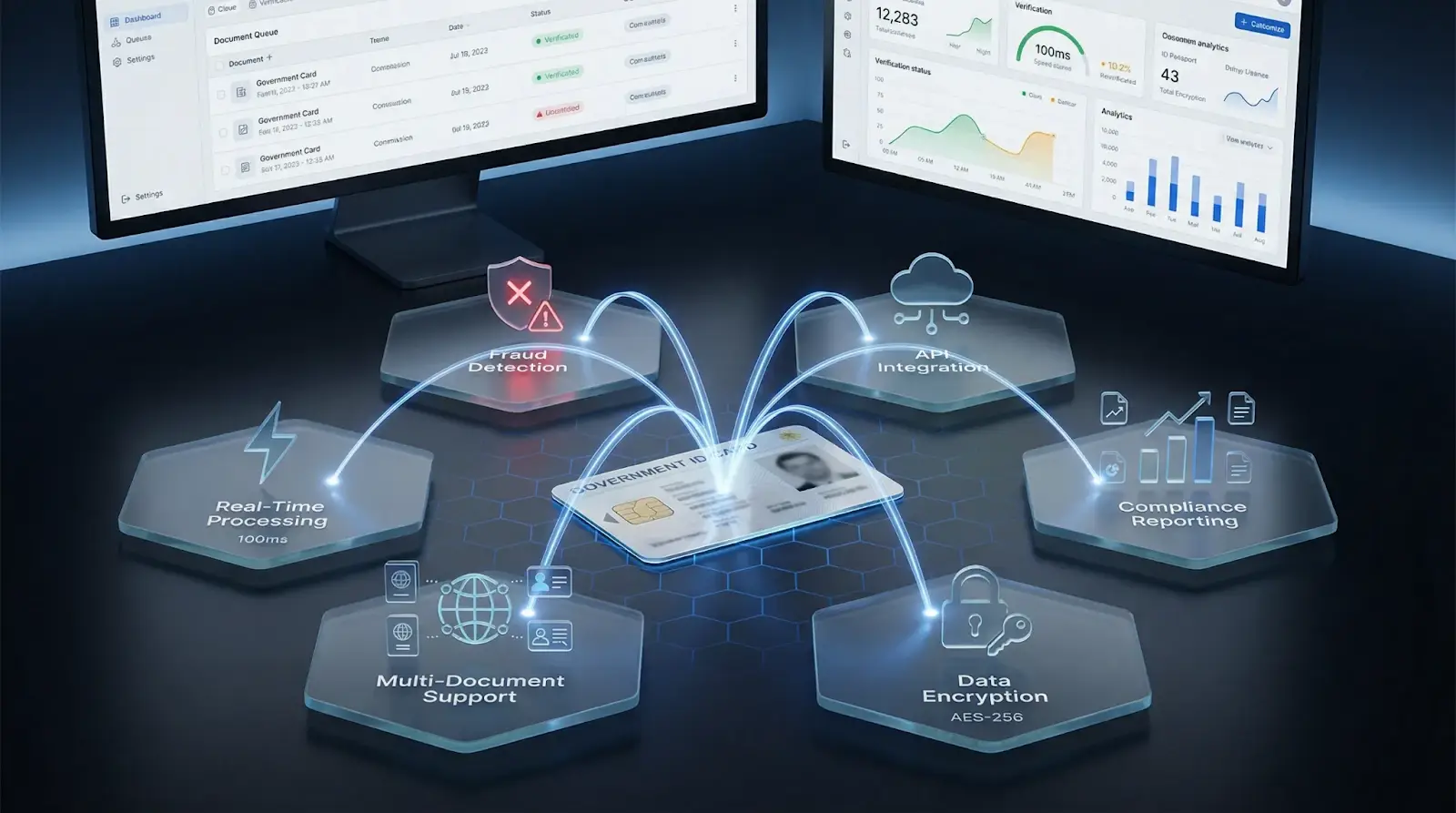
Identity verification failures are rarely caused by a lack of intent — they are caused by inadequate tooling. Businesses across financial services, healthcare, hospitality, retail, and digital platforms are under growing pressure to verify customer identities accurately, rapidly, and with a defensible audit trail. Regulatory frameworks governing KYC and AML compliance have tightened considerably in recent years, and the consequences of verification failures — ranging from regulatory fines to reputational damage and fraud losses — have grown proportionally.
Yet a significant number of organizations continue to operate with verification tools that were selected without a rigorous evaluation of their core capabilities. The result is a gap between what the business believes its verification process delivers and what it actually produces under real-world conditions — variable document types, inconsistent image quality, international customers, and escalating fraud sophistication. Here’s when the right technology selection becomes a strategic decision rather than a procurement formality.
ID scanner software is the category of tools designed to automate the capture, extraction, and validation of identity document data — transforming a raw document image into structured, verified personal data that can feed directly into compliance workflows, onboarding systems, and customer records. Given this, knowing precisely which features a production-grade solution must provide — and which omissions represent genuine operational risk — is essential for any business evaluating its options.
What Is ID Scanner Software?
ID scanner software is a technology solution that automates the process of reading identity documents — including passports, national identity cards, driver’s licenses, and residence permits — and extracting structured personal data from them. It combines optical character recognition (OCR) for text extraction, machine-readable zone (MRZ) parsing for standardized document fields, and algorithm-based validation to confirm data integrity and flag potential fraud indicators.
In other words, the software replicates and substantially improves upon what a trained human document reviewer does — reading visible fields, checking machine-readable data, comparing the two for consistency, and identifying signs of tampering or forgery — while doing so faster, more consistently, and at a scale that human review cannot match. ID scanner software is typically delivered as an API, a mobile SDK, or a cloud-based platform that integrates with existing onboarding, CRM, or compliance management systems.
What is also important here is that not all tools marketed under this category deliver the same depth of functionality. The gap between a basic document scanning tool and a compliance-grade identity verification solution can be substantial — and that gap has direct consequences for fraud exposure, regulatory posture, and customer experience. That’s why evaluating core features with precision is not optional for businesses with meaningful verification requirements.
When Does It Make Sense to Deploy ID Scanner Software?
The business case for deploying dedicated ID scanner software is strongest in environments where identity verification is a mandatory step in the customer journey and where volume, accuracy, and compliance documentation must be managed simultaneously. The most highly demanded options are found in contexts including, but not limited to:
- Digital banking and fintech: Remote account opening and payment platform onboarding requiring KYC-compliant identity verification before activation.
- Insurance: Policyholder identity confirmation during online application and claims processing.
- Healthcare and telehealth: Patient registration and prescription verification requiring confirmed personal identity.
- Online gaming and gambling: Age and identity verification mandated by gaming license conditions prior to account activation.
- HR and recruitment platforms: Candidate identity validation during remote hiring and pre-employment screening.
- Hospitality and car rental: Guest or driver identity confirmation at digital check-in or booking confirmation.
- Government and public services: Citizen identity verification for e-government portal access and benefit applications.
Apart from this, businesses expanding into new geographic markets — particularly those serving international customers — will find that software-based scanning significantly reduces the operational complexity of processing identity documents from multiple issuing countries without building dedicated internal expertise for each.
Core Features Every Business Should Require
Understanding what a production-grade solution must deliver requires evaluating capabilities across several distinct dimensions. The following feature set represents the minimum viable standard for any business deploying ID scanner software in a compliance-sensitive context.
Document Coverage and Library Maintenance
A reliable solution should support a broad range of document types — including passports, national identity cards, driver’s licenses, and residence permits — from a comprehensive set of issuing countries. Equally important is how actively the document library is maintained. Document formats change as national authorities issue new versions, introduce new security features, and retire older designs. A solution with a stale document library will misread newer formats, creating false rejections that frustrate legitimate users and undermine verification reliability. You should look for vendors that provide documented update schedules and transparent coverage lists.
MRZ Parsing with Checksum Validation
The machine-readable zone is a standardized data field present on passports and many national identity cards, defined by ICAO Document 9303. It encodes key personal data — including document number, date of birth, and expiration date — along with checksum digits that allow the extracted data to be mathematically validated. A production-grade solution must parse the MRZ and validate all checksums, not merely extract the visible text. When MRZ data fails checksum validation, it is a strong indicator of document tampering or data corruption that requires escalation.
Cross-Field Consistency Verification
Identity documents contain the same personal data in multiple locations — in the visual inspection zone visible to the human eye, and in the machine-readable zone or barcode readable by machines. A reliable solution automatically compares data extracted from both zones and flags discrepancies. This cross-field consistency check is one of the most effective first-line fraud detection mechanisms available, catching alterations that affect one zone but not the other. Pay attention to whether candidate solutions perform this check automatically or require custom configuration to enable it.
Fraud and Tampering Detection
Beyond data consistency checking, a compliance-grade solution should include dedicated fraud detection capabilities. Features are equipped with algorithms that analyze document images for anomalies including, but not limited to: inconsistent font styles or sizes within the same field, missing or misaligned security features such as holograms and microprint, color profile irregularities indicative of digital alteration, and structural inconsistencies in document layout. These mechanics boost the system’s ability to catch sophisticated fraud attempts that pass basic OCR extraction without triggering data-level alerts.
Biometric Matching and Liveness Detection
Biometric matching compares the facial photograph on the identity document against a selfie or live image captured from the user at the point of verification. Liveness detection confirms that the image being submitted is of a live person rather than a photograph, printed image, or screen replay. Together, these capabilities close the gap between document authenticity and identity confirmation — verifying not just that a document is valid, but that the person presenting it is its legitimate holder. For remote verification workflows, this combination is it crucial for preventing identity substitution fraud.
Field-Level Confidence Scoring and Review Routing
Not every verification will produce high-confidence extraction results across all fields. A reliable solution should assign individual confidence scores to each extracted data point and provide mechanisms for routing low-confidence results to human review automatically. This enables businesses to define clear thresholds — auto-approving high-confidence verifications and escalating borderline cases — without applying uniform manual review to all submissions, which is neither efficient nor scalable.
Compliance Audit Logging
Every verification event should generate a structured, timestamped audit record that captures the document type processed, fields extracted, confidence scores assigned, fraud flags triggered, and the final verification outcome. This audit trail is the documentary evidence that regulators require during KYC and AML compliance audits. A solution that does not generate this record by default places the burden of audit trail construction on the business’s own development team — a significant and avoidable operational risk.
How to Evaluate and Select the Right Solution
We recommend a structured evaluation process that tests real-world performance rather than relying solely on vendor-provided specifications:
- Define your document mix before issuing an RFP. You should attentively analyze which document types and issuing countries are most common among your users, and use this as the primary filter for evaluating document library coverage.
- Request a benchmark test on your actual documents. It will be helpful to provide candidate vendors with a representative sample of real document images — including challenging cases such as worn cards, low-light captures, and international formats — and compare extraction accuracy and fraud detection performance.
- Evaluate compliance documentation outputs against your regulatory requirements. If you want audit logs that satisfy your specific regulatory framework, you need to confirm that the solution’s output format and data retention capabilities align with those requirements before committing.
- Assess API documentation quality as a proxy for vendor maturity. Typical integrations with well-maintained, clearly documented APIs take a fraction of the time of integrations with poorly documented ones — and integration quality directly affects time-to-deployment.
- Confirm ongoing maintenance commitments contractually. You should look for vendors that provide documented SLAs for document library updates, fraud model refreshes, and security patches — not just at the point of sale, but as a contractual obligation.
Conclusion
Selecting ID scanner software without a rigorous feature evaluation is a risk that businesses in regulated industries cannot afford. The core capabilities — broad document coverage, MRZ parsing with checksum validation, cross-field consistency checking, fraud detection, biometric matching, confidence scoring, and compliance audit logging — are not advanced features reserved for enterprise deployments. They are the minimum standard that any production verification workflow should meet.
The majority of businesses that have experienced verification-related compliance issues or fraud losses can trace the root cause to a capability gap in their scanning tooling that was not identified at the point of selection. If your current solution does not deliver all of the features outlined above, you should evaluate whether that gap is creating exposure that a more capable alternative could close — before that exposure becomes a measurable business problem.