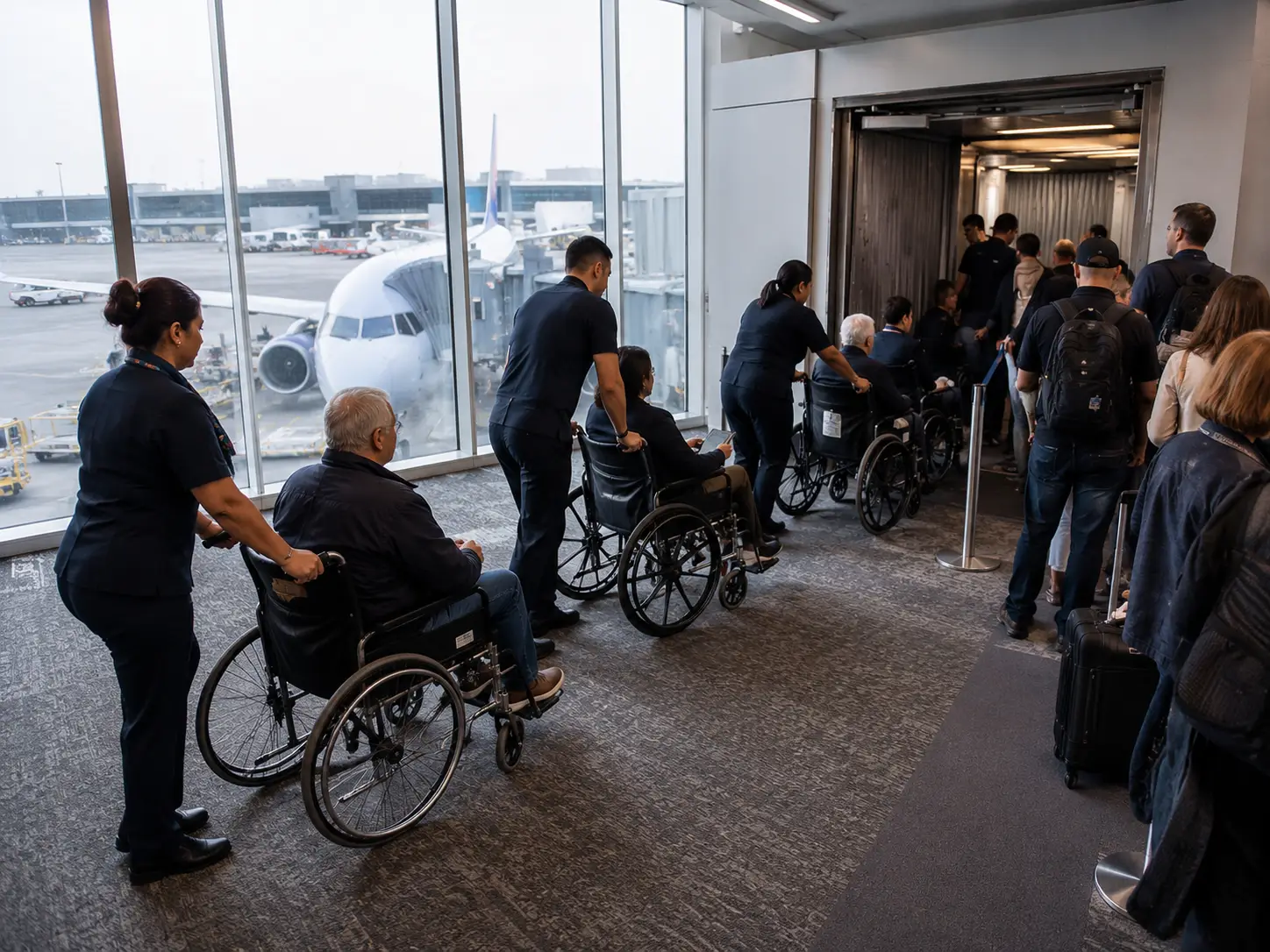
Airlines and disability advocates are clashing over a growing practice at airports across the United States and beyond, where some passengers request wheelchair assistance to skip queues at the gate and board aircraft early, then walk off the plane unaided upon arrival. The phenomenon has been given a sardonic nickname online: the “miracle flight.”
What Is a Miracle Flight?
The term, popularised on social media platforms including TikTok and Reddit, refers to a pattern in which travellers claim a mobility impairment to obtain wheelchair assistance at the departure gate, only to show no signs of difficulty once they disembark. On some platforms the person providing this apparent mid-flight healing has been dubbed “Jetway Jesus.” One Reddit user described the practice as passengers who “fake mobility issues, arrive at the boarding gate in wheelchairs, secure better treatment and better seats” before leaving “the plane unassisted and not needing wheelchairs” at their destination.
The practice exploits rules designed to protect passengers with genuine disabilities. Under US law, airlines are required to provide wheelchair assistance to any passenger who requests it. Crucially, carriers are generally prohibited from asking for proof of disability or posing most questions about the nature of a passenger’s condition.
Airlines Sound the Alarm
JetBlue chief executive Joanna Geraghty recently drew fresh attention to the issue during an interview with WBUR’s Breakfast Club programme in Boston. Geraghty said that while the law compels airlines to honour wheelchair requests, some passengers are using the service “to get to the front of the line, and not for legitimate reasons.” She noted that certain JetBlue flights see as many as 23 to 25 passengers requesting wheelchairs, describing the situation as “a very tough situation to navigate, both politically, but also just heart.”
Geraghty also acknowledged that the industry itself has not done enough for passengers who genuinely need help. “In general, I don’t think the airline industry does a great job with our customers with disabilities,” she said.
Her comments echoed those made by former Frontier Airlines chief executive Barry Biffle, who said in 2024 that his airline was experiencing “massive, rampant abuse” of special services. Biffle noted that each wheelchair assistance request costs an airline approximately $30 to $35 to fulfil.
The problem is not limited to the United States. Former Heathrow Airport chief executive John Holland-Kaye raised the same alarm in 2022, warning that some travellers were using wheelchair assistance to fast-track through the airport after seeing the tactic promoted on TikTok.
A 30 Per Cent Rise in Requests
Industry data underscores the scale of the trend. The International Air Transport Association has reported a 30 per cent year-on-year increase in wheelchair assistance requests at larger airports around the world. In a recent memo the organisation described the surge as “a key issue for the aviation industry.” Airlines are struggling to reconcile this increase with the persistent shortfall in assistance for passengers who genuinely require it.
US Transportation Department figures show there were approximately 43,500 disability-related complaints filed against US airlines in 2024. More than half related to failures in wheelchair provision, including insufficient staff or passengers being left behind.
Why the System Is So Difficult to Police
Michele Erwin, founder and president of the disability advocacy nonprofit All Wheels Up, said there is “virtually no way to verify who does or does not have a disability without asking for legally protected information.” She told Business Insider that airlines discuss the abuse privately but are attempting to respond within the boundaries of the law.
Disability campaigners stress that not all impairments are visible. Some passengers who use a wheelchair in a large terminal may still be capable of walking once on board, having needed assistance only to navigate a long concourse or after enduring an exhausting journey. Retired Delta captain Mark Stephens warned against any policy that would involve questioning passengers who might be telling the truth.
Erwin emphasised that abuse of the system creates costs for airlines and erodes support for travellers who genuinely need help. “It’s not great for either side; we’re all living in a gray area,” she said. She also pointed out that part of the pressure on assistance systems stems from passengers failing to notify airlines in advance that they need help, leaving staff overwhelmed by last-minute requests.
Southwest Airlines and the Seat Incentive
Travel observers have long linked the surge in wheelchair requests to airline boarding structures that reward early access to the cabin. Southwest Airlines, which operated an open-seating model for decades, was particularly susceptible: whoever boarded first had the widest choice of seats and overhead-bin space. Under that system, requesting wheelchair assistance became a reliable shortcut to a preferred seat, and the airline consistently recorded more wheelchair pre-boards than any other US carrier.
That incentive has now been removed. Beginning 26 January 2026, Southwest introduced assigned seating for the first time in its history, eliminating the advantage that made pre-boarding so attractive. Industry observers expect wheelchair pre-board numbers on Southwest to fall sharply as a result, though experts caution that the broader problem of line-skipping at airports is unlikely to disappear entirely, as passengers can still use wheelchair assistance to bypass security and other queues unrelated to seating.
Innovations and Possible Solutions
Some airports have begun experimenting with new approaches to ease pressure on assistance teams. Detroit Metropolitan Airport has introduced autonomous wheelchairs that can transport passengers to their gates without a human attendant. Erwin has encouraged travellers to use the service where it is available.
One frequently cited proposal from passengers and commentators is a rule requiring that anyone who boards with wheelchair assistance must also deplane in a wheelchair. Supporters argue this would remove the practical benefit of gaming the system, since the person who pre-boarded first would then be among the last to leave the aircraft. Critics, however, warn that such a policy could humiliate passengers with invisible disabilities who may walk off a short flight without difficulty but genuinely needed help navigating a busy terminal.
Another suggestion that has circulated on social media is a pre-boarding fee charged retroactively to passengers who disembark without wheelchair assistance after having pre-boarded with it. Legal experts note that implementing such a policy without demanding proof of disability would almost certainly face challenges under the Americans with Disabilities Act.
A System Under Strain on Both Sides
The debate highlights a broader tension within airport accessibility. On one side, airlines and genuine wheelchair users are losing out to a minority of travellers willing to exploit a system designed for people in need. On the other, any crackdown carries the risk of deterring or humiliating passengers with hidden conditions who have every right to request assistance.
Adding to the complexity, the aviation industry is simultaneously facing legal challenges from a different direction. A coalition of major US carriers, including American Airlines, Delta Air Lines, JetBlue, Southwest, and United Airlines, has filed an appeal against a Department of Transportation rule introduced under the Biden administration that strengthens protections for wheelchair users and mandates annual training for staff who interact with disabled passengers. The airlines argue the rule represents regulatory overreach, a stance that disability advocates say sends a troubling signal about industry priorities.
For now, airlines remain caught between their legal obligation to provide assistance without question and growing pressure to prevent a practice that is placing real strain on staff, costs, and the passengers who need wheelchair help the most.