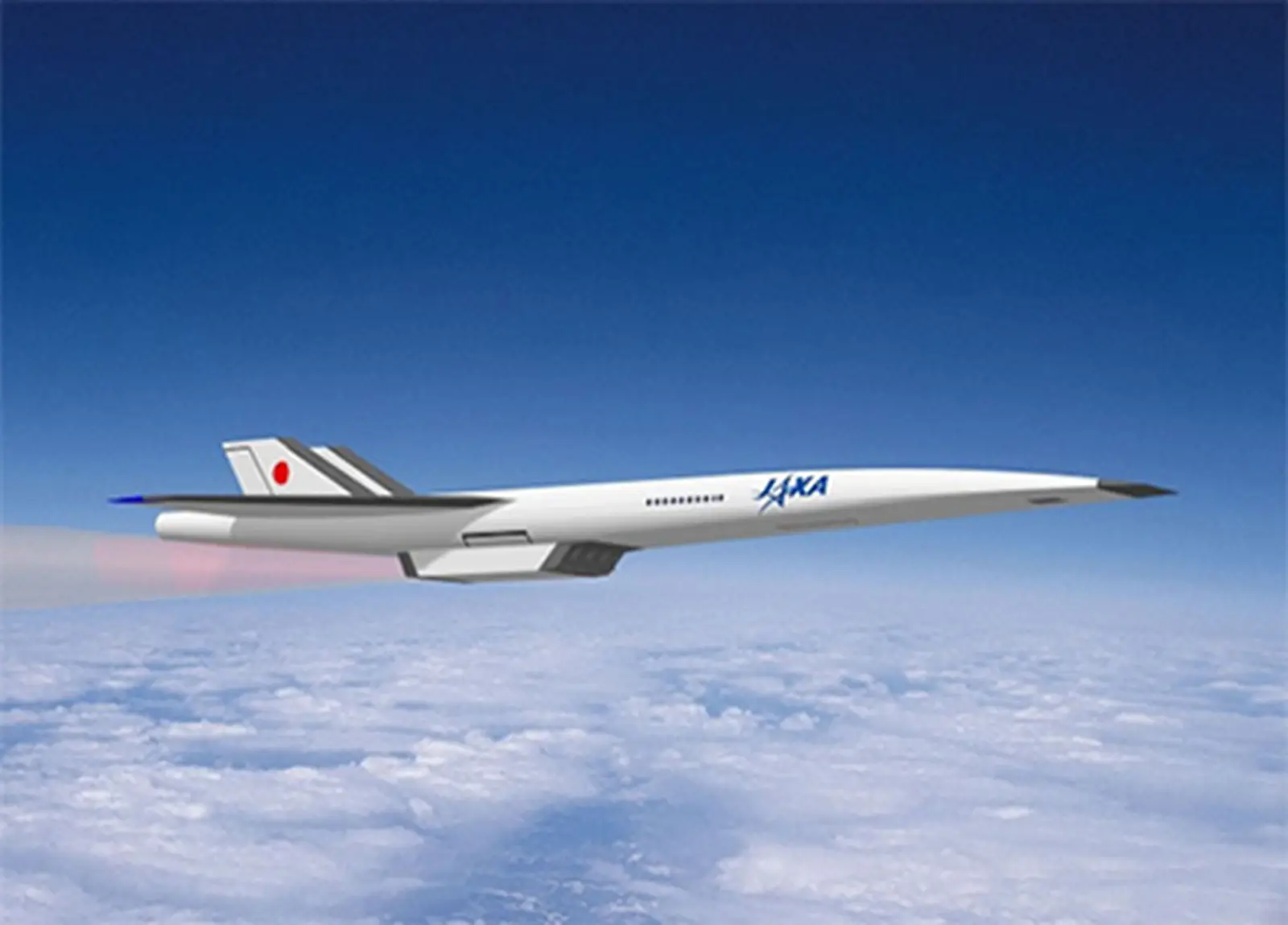
Japan’s Japan Aerospace Exploration Agency (JAXA) has completed a landmark ground test of a Mach 5 ramjet engine for a hypersonic experimental aircraft, marking a significant milestone in the country’s long-running effort to develop ultra-high-speed aviation. The test was announced on April 16, 2026, by a collaborative research team including JAXA, Waseda University, the University of Tokyo, and Keio University.
The test was carried out as part of a collaborative research programme focused on integrated airframe and propulsion control for hypersonic vehicles. Researchers installed the experimental aircraft inside a ramjet engine testing facility at JAXA‘s Kakuda Space Center in Miyagi Prefecture, where they simulated flight conditions at Mach 5, roughly five times the speed of sound.
The experiment involved a two-metre-long experimental vehicle subjected to a simulated Mach 5 environment. Importantly, this was a propulsion and thermal-management result, not a free-flying aircraft demonstration. Compression heating in this flight regime can push air temperatures around the vehicle to roughly 1,000 degrees Celsius.
The wind-tunnel test demonstrated the aircraft’s heat-shielding structure, control-surface operation and ramjet combustion under hypersonic conditions. JAXA said the aircraft was designed and built by the university and agency research team under a Japan Society for the Promotion of Science-funded project, which focuses on building a hypersonic flight testbed using sounding rockets and demonstrating integrated airframe-propulsion control.
Waseda University, the University of Tokyo, and Keio University were all involved in the research programme. The scientists simulated flight conditions that can occur during Mach 5 flight, at which high temperatures of up to approximately 1,000 degrees Celsius develop around the airframe. JAXA reportedly succeeded in developing an airframe in which internal temperatures could be maintained at almost normal levels, with the heat shield ensuring that all onboard avionics functioned without disruption.
Hypersonic aircraft require a fundamentally different design approach from conventional aircraft, because the airframe and propulsion system interact closely at high speeds. Shock waves generated around the aircraft affect airflow entering the engine, while engine thrust directly affects aircraft motion, making the aircraft and engine a single coupled system rather than separate design problems.
A ramjet engine works differently from conventional jet engines. It has no rotating parts and relies entirely on the aircraft’s forward speed to compress incoming air, which means it only functions properly once the vehicle is already travelling extremely fast. This milestone builds upon years of quieter research by JAXA, which previously focused on mastering Mach 4 combustion. Hydrogen was used as fuel, as it burns incredibly hot and fast, making it ideal for sustaining combustion in a simulated Mach 5 setting.
At Mach 5, the aircraft would theoretically travel at roughly 3,800 miles per hour, fast enough to fly from Tokyo to New York City in just under two hours. JAXA says future hypersonic aircraft could potentially reduce flights between Japan and the United States to around two hours, dramatically reducing current trans-Pacific flight times.
The next phase of the programme could involve mounting the experimental aircraft onto a sounding rocket or similar launch vehicle for a real-world Mach 5 flight demonstration. JAXA also envisions the technology contributing to spaceplanes capable of reaching altitudes approaching 100 kilometres, near the boundary of space.
Researchers from JAXA, Waseda University, the University of Tokyo, and Keio University hope to commercialise the technology in the 2040s. The test adds momentum to a global race involving private firms such as Hermeus and Boom Supersonic in the United States, as well as parallel military-grade hypersonic programmes in China. For now, the successful combustion and thermal-management results represent a technical milestone rather than an imminent passenger service, but they confirm that Japan’s hypersonic ambitions are advancing on a credible engineering path.