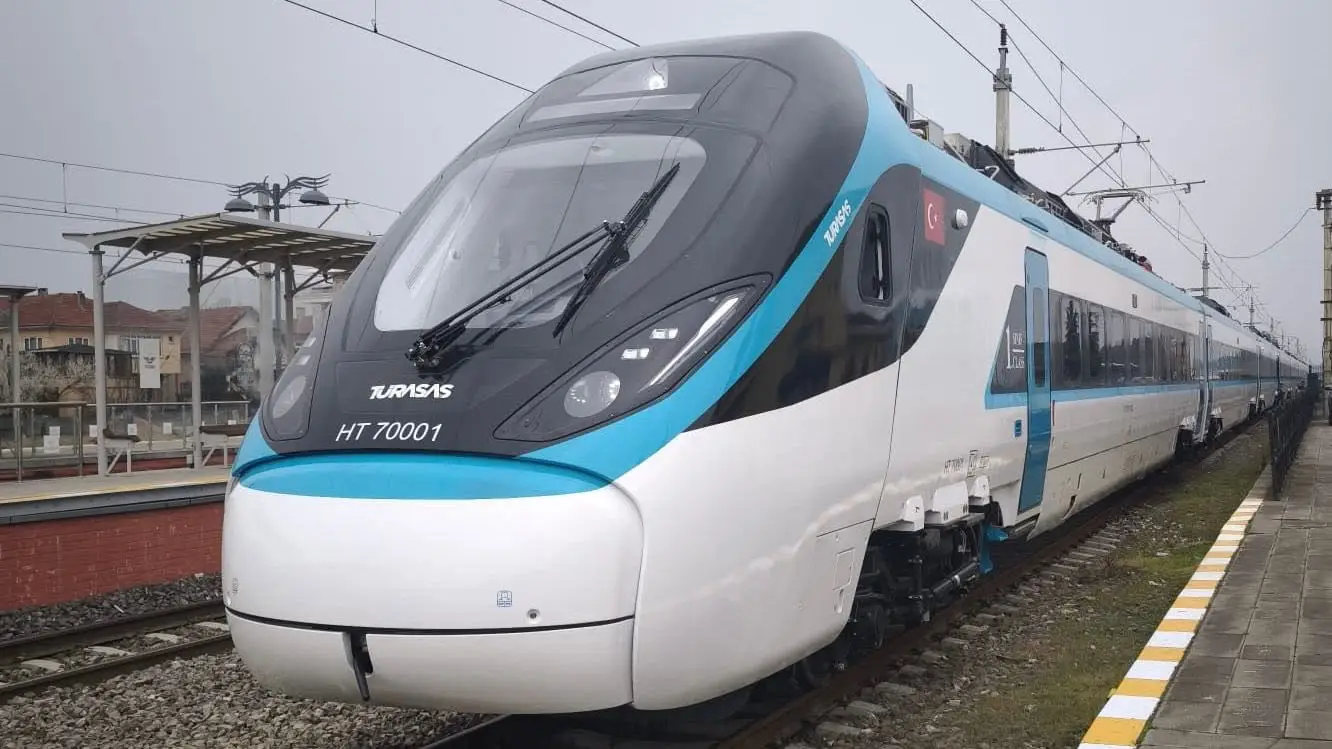
Turkey’s Ankara-Istanbul high-speed rail journey is set to fall by 30 minutes once two major infrastructure projects are completed, Transport and Infrastructure Minister Abdulkadir Uraloglu has announced.
In a written statement, Uraloglu said the trip between Turkey’s capital and its commercial centre would drop from 4 hours 7 minutes to 3 hours 37 minutes after the completion of the T26 Tunnel and the Dogancay Diversion 2 project on the Eskisehir-Istanbul section of the route.
The Ankara-Istanbul high-speed line is operated by Turkish State Railways, known as TCDD, and is one of the country’s most heavily used rail corridors, connecting the political and financial capitals of Turkey on a daily basis. Both cities generate high volumes of business, leisure and commuter traffic, making journey time reductions significant for passengers and for rail’s competitiveness against road travel on the same corridor.
Uraloglu said the Eskisehir-Istanbul section of the line currently has three critical bottleneck points where high-speed trains are forced to slow down or divert onto conventional track. The first of those, the 12-kilometre Dogancay Diversion 1 section, opened in 2022. The two projects now under construction are designed to eliminate the remaining weak points and bring the entire route up to full high-speed standard.
The T26 Tunnel, measuring 5,587 metres in length, will resolve a 9.2-kilometre stretch of conventional track on the Alifuatpasa-Arifiye section where high-speed trains currently run at an average of 55 kilometres per hour. Once operational, the tunnel will allow trains to pass through that section at 250 kilometres per hour, cutting the Bozuyuk-Bilecik journey from 20 minutes to 9 minutes, a saving of 11 minutes. The tunnel will also remove single-track operating restrictions and ease constraints on freight services using the same corridor.
Underground works on the T26 Tunnel have been completed. Superstructure, electrification and signalling work continue. The ministry plans to complete superstructure manufacturing in the third quarter of 2026 and electrification and signalling work by the end of 2026 or early 2027, with the aim of opening the line before mid-2027.
The Dogancay Diversion 2 project is described by the ministry as one of the most critical sections of the entire route. The works include 7,544 metres of tunnel, 3,795 metres of safety tunnel and around 795 metres of viaduct. Upon completion, travel time through that section will fall from 23 minutes to 4 minutes, delivering a further 19-minute saving on the overall journey. Physical progress on the Sapanca-Geyve section stands at 65 percent, with the ministry targeting completion in the first half of 2028.
Uraloglu did not announce a single completion date for both projects in his statement, but said the government’s objective was to eliminate all remaining bottlenecks and achieve uninterrupted 250 kilometres per hour operation across the full Ankara-Istanbul line.
The upgrades sit within a broader programme of high-speed rail expansion in Turkey. The country is targeting a high-speed network of 2,843 kilometres by 2026 and 4,122 kilometres by 2027, with a longer-term Ankara-Istanbul super high-speed project designed to operate at 350 kilometres per hour and reduce the journey to 80 minutes, targeted for 2034.
The promised 30-minute reduction on the existing route is expected to make the high-speed train more competitive with domestic flights and intercity road coaches on the Ankara-Istanbul corridor, where travel demand remains among the highest in the country.