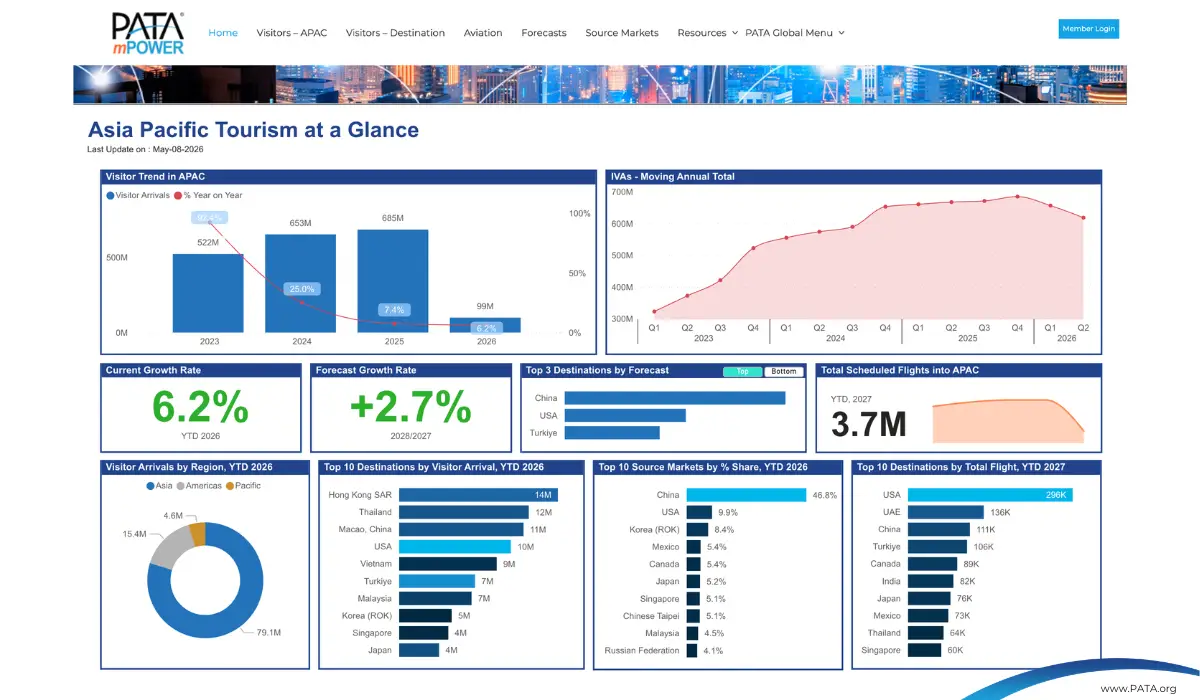
The Pacific Asia Travel Association (PATA), in partnership with the Research Centre for Digital Transformation of Tourism (RCDTT) at The Hong Kong Polytechnic University (PolyU), has released its Asia Pacific Visitor Forecasts 2026-2028: Mid-Year Update, projecting international visitor arrivals across 39 destinations in the region will reach 789.2 million by 2028. The report confirms that Asia Pacific tourism has moved beyond post-pandemic recovery and entered a new phase of sustained expansion.
Arrivals across the region are forecast to reach 714.9 million in 2026, rising to 758.8 million in 2027 before reaching 789.2 million in 2028. By the end of the forecast period, visitor volumes are expected to stand at 115.6% of 2019 pre-pandemic levels, marking a definitive break from the recovery narrative that has defined the sector since 2020.
“Change is no longer an occasional disruption; it is the new constant,” said Noor Ahmad Hamid, CEO, PATA. “The destinations and organisations that thrive will be those that can adapt quickly, innovate continuously, and respond with agility to an increasingly complex and fast-changing world.”
“The latest forecasts demonstrate the remarkable resilience of Asia Pacific tourism,” Hamid added. “While the region continues to grow and recover, success will increasingly depend on destinations’ ability to navigate geopolitical uncertainty, evolving traveller behaviour, connectivity challenges, and rising operational costs. This is precisely why timely, data-driven insights have become essential for strategic decision-making.”
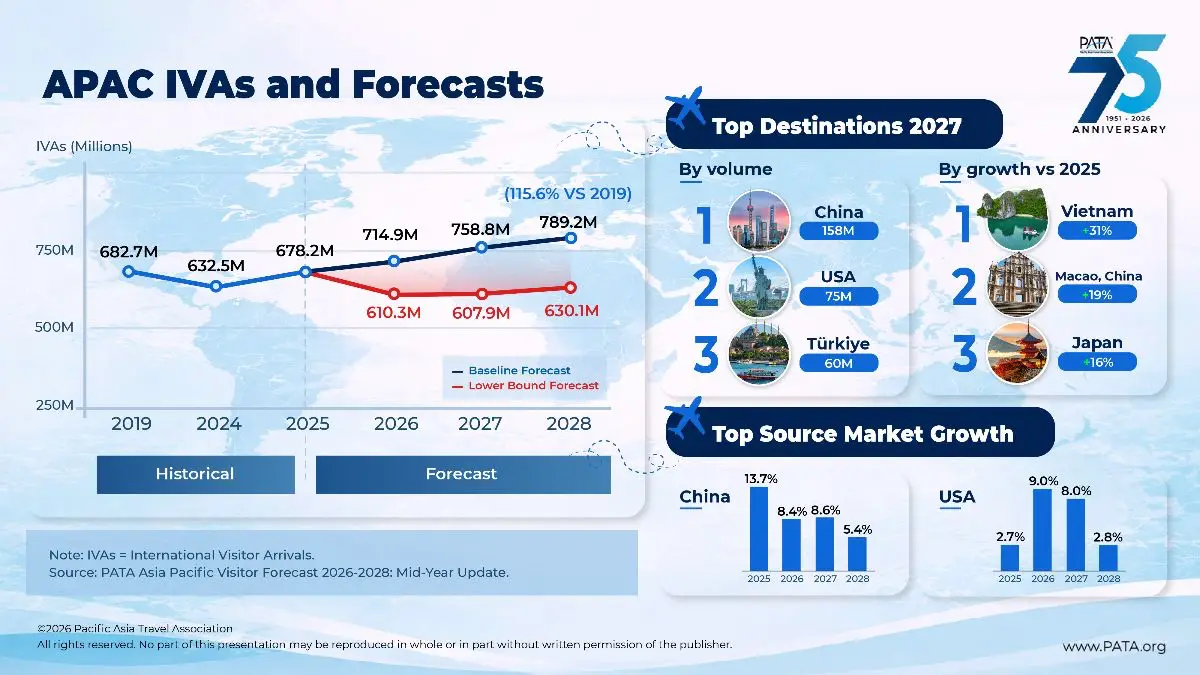
Among the region’s 10 largest destinations, Vietnam is forecast to record the strongest growth between 2025 and 2027, with international visitor arrivals rising 31.2% to reach 27.8 million. Macao, China follows with projected growth of 19.4%, ahead of Japan at 15.8%, Hong Kong SAR at 13.9%, Türkiye at 12.7% and Malaysia at 11.6%. The report attributes this performance to strong demand, enhanced air connectivity and continued investment in tourism infrastructure.
By contrast, several of the region’s largest and most established destinations are entering a more mature growth phase. China remains Asia Pacific’s single largest destination, with 157.8 million arrivals projected in 2027, but is forecast to grow by just 2.2% over 2025 levels. Thailand and the United States are similarly expected to record more modest gains of 5.2% and 9.0% respectively over the same period.
Looking further ahead to 2028, Mongolia is forecast to achieve the highest recovery rate in the region, reaching 177.8% of its 2019 arrival levels. Japan, the Maldives, Vietnam and Sri Lanka are also projected to significantly outperform their pre-pandemic benchmarks. Of the 39 destinations covered in the report, around 27 are projected to exceed pre-pandemic arrival volumes in 2027, rising to 30 by 2028.
Thailand is expected to return to its 2019 levels only by 2028, while the United States, Chinese Taipei, the Philippines, Myanmar and several Pacific Island destinations are projected to remain below pre-pandemic volumes through to the end of the forecast period.
On the outbound side, China is projected to remain the Asia Pacific region’s largest source market in 2027, generating nearly 127 million visitor arrivals across the region. The United States follows with 65.2 million outbound arrivals. Both markets are expected to record growth of approximately 18% compared to 2025 levels. Korea, Canada and Mexico are also forecast to generate substantial outbound travel volumes, though growth rates are expected to vary.
The report also identifies a number of risks that could weigh on the outlook. Escalating geopolitical tensions and energy market volatility have raised concerns over fuel prices, aviation costs and air connectivity. Continued inflationary pressures and higher living costs in key source markets may also reduce discretionary travel spending, particularly among middle-income households and long-haul travellers. At the same time, expanding airline networks, new airport developments, improved visa facilitation and strengthening intra-regional demand are expected to support growth across many destinations.
“While the recovery trajectory remains positive, destinations must remain agile in responding to evolving market conditions,” said Professor Haiyan Song, Director, RCDTT, PolyU. “The forecasts provide an important evidence base for tourism organisations, governments, and industry stakeholders seeking to make informed strategic decisions in a rapidly changing environment.”
The PATA Asia Pacific Visitor Forecasts 2026-2028: Mid-Year Update provides annual and quarterly projections for 39 destinations across Asia Pacific, alongside analysis of major source markets, destination performance trends and the macroeconomic and geopolitical factors shaping the future of regional tourism.