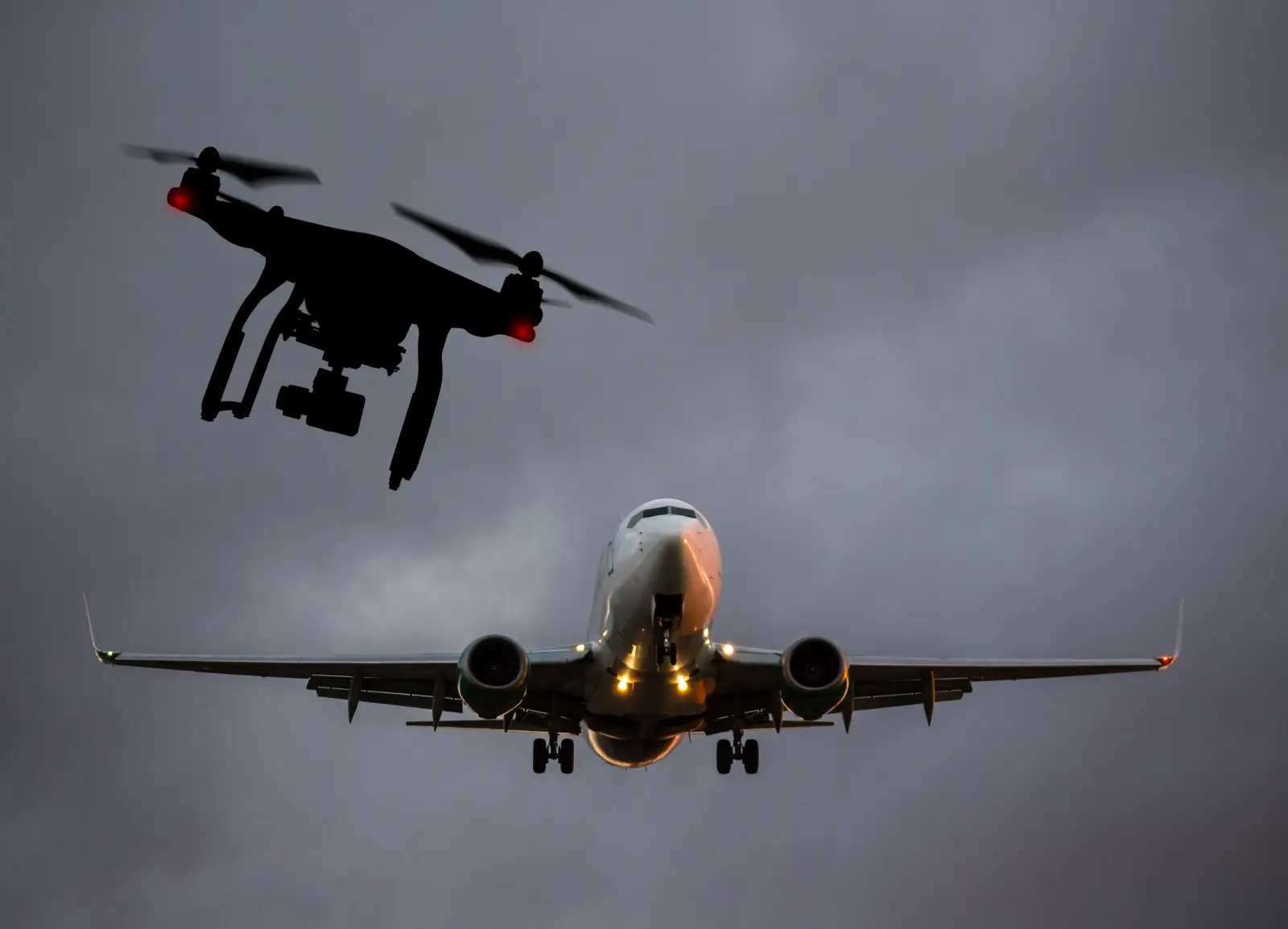
Copenhagen and Oslo airports were forced to close on Monday evening after multiple sightings of unidentified drones in their airspace, disrupting flights and triggering heightened security measures. Authorities in Denmark and Norway confirmed the temporary shutdowns and said investigations are underway to determine the origin of the incursions.
Danish Prime Minister Mette Frederiksen described the incident at Copenhagen Airport as the most serious attack on Denmark’s critical infrastructure to date. In Norway, Oslo Airport suspended operations following two separate drone sightings before reopening at 3:15 a.m. local time on Tuesday. Both airports warned that delays and cancellations would continue as traffic gradually returned to normal.
Copenhagen Airport was closed for several hours on Tuesday night after drones were detected over its secure area, disrupting flights and triggering heightened security measures.
Danish Prime Minister Mette Frederiksen described the incident as the most serious attack on Denmark’s critical infrastructure to date.
Authorities said it remains unknown who launched the drones, but Frederiksen suggested Russia could be behind the incident, noting recent drone activity in Eastern Europe and cyberattacks targeting airports. The prime minister stressed that such operations aimed to destabilize the situation and incite unrest.
Serious Threat to Infrastructure
Frederiksen, in an interview with Danish broadcaster TV2, underscored the severity of the attack. “I consider this a serious attack on Denmark’s critical infrastructure… There should be no doubt that the use of drones at the airport can have very serious consequences,” she said. She emphasized that the incident marks the gravest assault on the nation’s transport and aviation facilities in recent history.
When asked directly whether Russia was suspected of orchestrating the disruption, Frederiksen replied: “In any case, I cannot deny in any way that it was Russia.” She pointed to a pattern of hostile activities in the region, including drone flights in Poland and Romania, violations of Estonian airspace, and hacker attacks on European airports.
Danish police said “three or four large drones” were observed near the airport’s secure area around 8:30 p.m. local time. “The airspace above Copenhagen Airport has been closed since 8:30 p.m. due to the presence of two or three unidentified drones. No aircraft can take off or land at the airport,” said airport spokesperson Lise Agerley Kurstein. The closure forced several flights to be diverted, while departing services faced long delays and cancellations.
In Norway, operations at Oslo Airport were halted after two separate drone sightings. “We have made two separate drone sightings,” said Monica Fasting, a spokeswoman for Oslo Airport, adding that the airport reopened at 3:15 a.m. local time. Airport authorities cautioned that residual disruptions would continue through Tuesday as schedules normalized.
Jakob Hansen, a senior Danish police official, said security forces, the military, and intelligence services were working jointly with Norwegian authorities to determine the origin of the drones. “At this stage, we do not know” if the drones could be linked to Russia, Hansen said.
Regional Security Concerns
Neighboring Sweden also addressed the wider implications of drone activity. Swedish Defense Minister Paul Jönsson reiterated that airspace violations could not be tolerated. “The government has given the Armed Forces instructions on how to deal with intruding aircraft. This includes the right to use weapons if necessary – with or without warning,” said Jönsson, according to Swedish tabloid Aftonbladet. He added that Sweden would defend its airspace against any incursions.
The Danish government has not disclosed whether military assets were deployed in response to the drones at Copenhagen Airport. Police confirmed they are investigating the incident and that no group or state actor has been identified as responsible at this stage. European authorities have raised concerns in recent months about the growing use of drones near airports and other strategic sites. Officials argue that drones pose both safety and security risks, given their potential to interfere with aircraft operations and their use in hybrid warfare tactics.
The incident comes amid heightened geopolitical tensions in Europe, with several countries reporting drone-related activity near critical infrastructure. Poland and Romania have previously documented unauthorized flights along their borders, while Estonia has registered repeated violations of its airspace. Cyberattacks against airport systems across the continent have also increased, further fueling fears of coordinated attempts to destabilize transport networks.
While no injuries or physical damage were reported at Copenhagen Airport, the temporary closure highlighted vulnerabilities in aviation security. Analysts note that airports are particularly susceptible to drone interference, given the difficulty in detecting small unmanned aircraft and the limited countermeasures available without risking passenger safety. Copenhagen Airport is the largest air hub in Scandinavia, serving tens of millions of passengers annually, and Oslo Airport is Norway’s primary international gateway—making the simultaneous disruptions significant for the region’s travel network.
Frederiksen emphasized that Denmark would not downplay the gravity of the event. “There should be no doubt that the use of drones at the airport can have very serious consequences,” she said. Authorities in Denmark and Norway continue to investigate and have warned of possible ongoing disruptions as enhanced monitoring remains in place.
The disruption is expected to renew debate within the European Union on counter-drone strategies and joint defense measures for aviation hubs. Policymakers are considering both technological solutions, such as detection and neutralization systems, and legal frameworks that would permit quicker intervention against unauthorized drone operators. For now, Copenhagen and Oslo airports have resumed operations, but the cases remain open, with police urging witnesses or passengers with information to come forward.