Airline passengers departing from Singapore will have to pay a sustainable aviation fuel (SAF) levy ranging from S$1 (US$0.77) to S$41.60 per ticket (US$32.04), depending on their travel destination and travel class.
In imposing this levy, Singapore will become the first country in the world to introduce a SAF tax on outbound flights.
The levy will apply to tickets sold from 1 April 2026, for flights departing from Singapore on or after 1 October 2026, the Civil Aviation Authority of Singapore (CAAS) announced.
This means that if a ticket is bought before 1 April for a flight departing after 1 October, the levy will not apply. Likewise, if a ticket is bought after 1 April for a flight before 1 October, there will be no levy.
Geographical bands
All destinations from Singapore will be grouped into four geographical bands:
- Band 1: Southeast Asia
- Band 2: Northeast Asia, South Asia, Australia and Papua New Guinea
- Band 3: Africa, Central and West Asia, Europe, the Middle East, the Pacific Islands and New Zealand
- Band 4: the Americas.
Travellers who fly farther will pay more because longer flights consume more fuel, CAAS said. Passengers in business or first class are set to pay up to four times more than those in economy class, based on industry norms for calculating the carbon emissions of passengers in different cabin classes.
Passengers travelling to Band 1 destinations will pay S$1 (US$0.77) if travelling in an economy cabin, which includes economy class and premium economy, and S$4 (US$3.08) for a premium cabin, which includes business class and first class.
Band 2 passengers will pay S$2.80 (US$2.16) and S$11.20 (US$8.62) for an economy cabin and a premium cabin, respectively.
Band 3 passengers will pay S$6.40 (US$4.93) and S$25.60 (US$19.71), and Band 4 passengers will pay S$10.40 (US$8.01) and S$41.60 (US$32.02) for an economy cabin and a premium cabin respectively.
The levy will not apply to passengers transiting through Singapore. For flights with multiple stops, the levy will be based on the immediate next destination after departing Singapore.
The levy will also apply to cargo shipments, and general and business aviation flights – such as private jets and chartered services – departing Singapore.
New entity to procure SAF
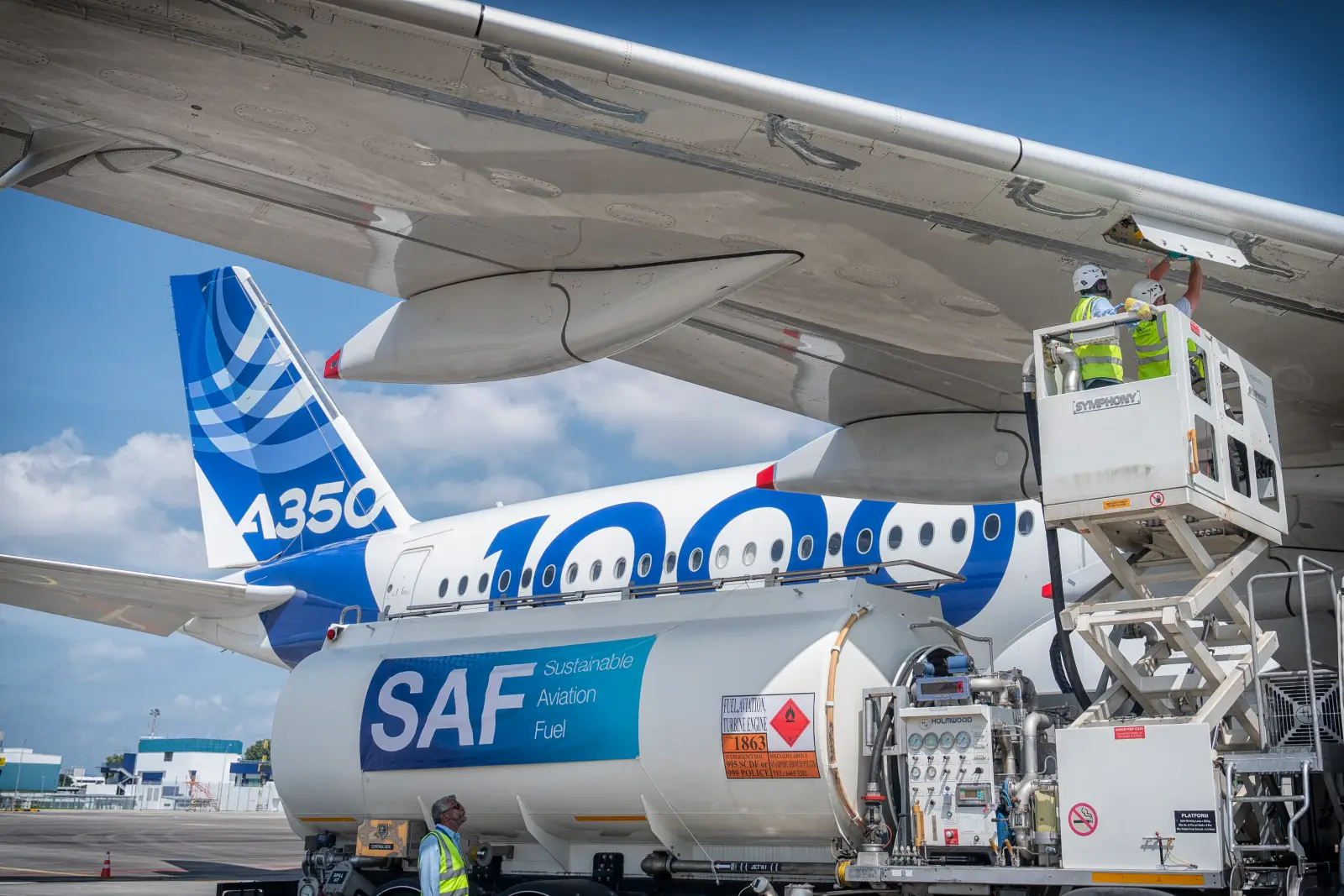
The announcement of the levy amounts comes after CAAS said last month that it had set up a new entity to centrally procure sustainable aviation fuel and secure a more affordable and stable supply for Singapore and the region.
Levies collected from passengers will go into a fund used to purchase sustainable aviation fuel. The airline will collect the levy and must display it as a distinct line item on the air ticket sold.
All the funds collected through the imposition of the SAF levy will go into a statutory SAF fund to be managed by CAAS. In turn, the fund will subsequently be used solely for the purchase of SAF and/or SAF environmental attributes, said CAAS, and would cover the associated administrative costs.
One percent target
The levy amounts, said CAAS, were calculated based on the volume of fuel needed to meet Singapore’s one per cent target for 2026, and the projected price of the fuel.
Singapore’s target is for sustainable aviation fuel to form one per cent of all jet fuel used at Changi and Seletar airports in 2026.
The goal is to raise this target to three per cent to five per cent by 2030, depending on global developments and the availability of the green jet fuel, which is mostly made from waste materials such as used cooking oil.
CAAS said the levy amount will be fixed for as long as the target remains at one per cent. The amount will be relooked only when the current one per cent target is adjusted in future.
The levy will be applied on top of a total of $65.20 (US$50.21) in fees that departing passengers who start their trips at Changi Airport already pay. These fees will go up in stages from April 2027, reaching $79.20 (US$61) in April 2030 – a 21 per cent rise.
Passengers may not pay the whole levy
However, operating airlines may likely swallow some of the impact of the new levy being charged, to ensure that their flights from Singapore remain competitive.
Instead, airlines may well adjust their base fares to keep the overall cost of tickets competitive, thereby absorbing some, if not all, of the levy. It is also worth noting that in the case of frequent flyer award tickets and other complimentary ticket types, the SAF levy will still apply and is likely to be picked up in full by the passenger, as with any other tax or surcharge.