Venezuela’s civil aviation authority has given several international airlines, including Spain’s Iberia, Air Europa and Plus Ultra, 48 hours to resume flights to Caracas or face the loss of their traffic rights, escalating a safety-driven wave of suspensions into an open regulatory confrontation.
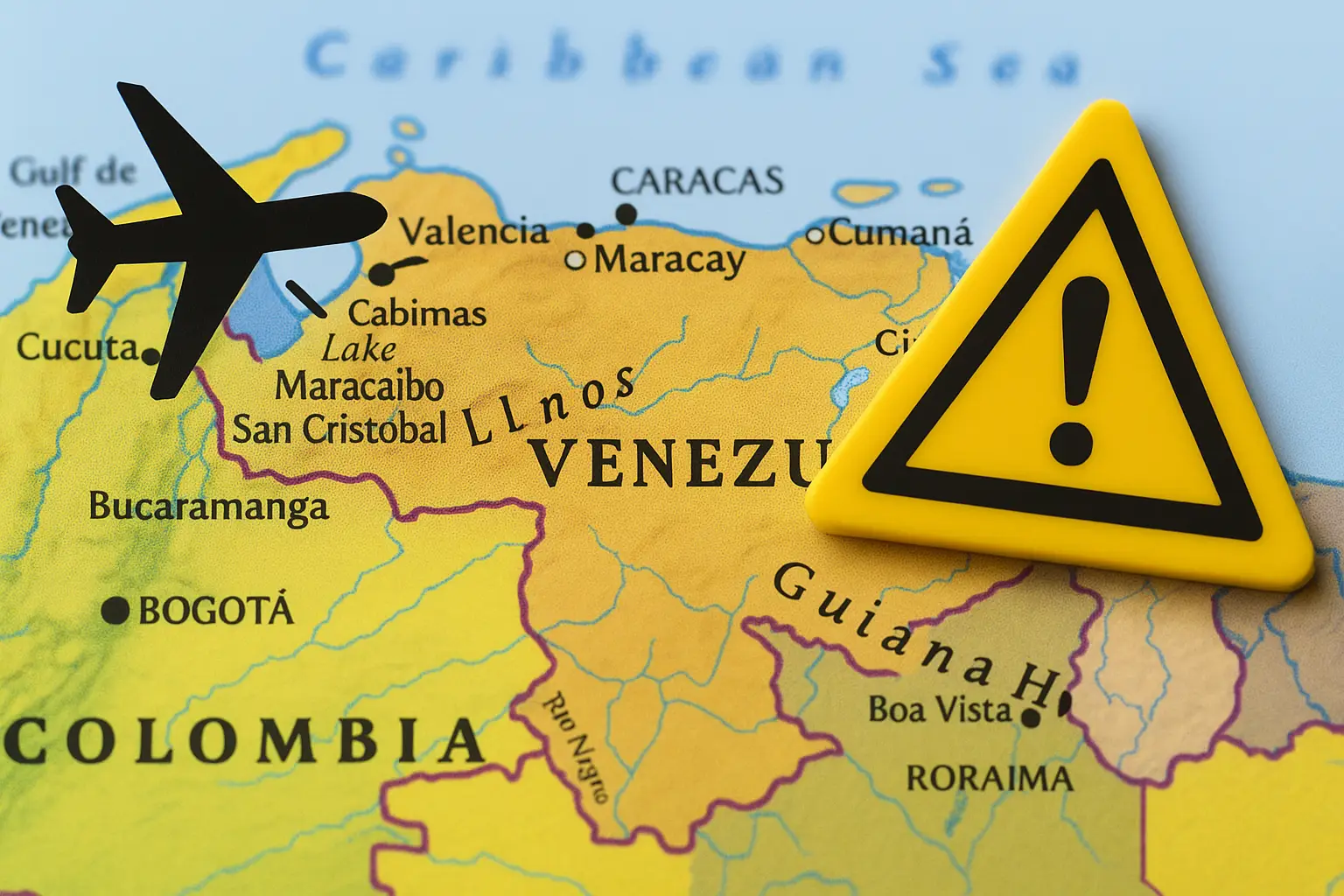
The ultimatum follows the cancellation of at least 22 international departures from Simón Bolívar International Airport in recent days, after the US Federal Aviation Administration issued a warning urging extreme caution when flying over Venezuelan airspace and the southern Caribbean.
The standoff now threatens to further reduce what was already one of the least-connected aviation markets in Latin America, with implications for travellers, airlines and Venezuela’s tourism sector.
The International Air Transport Association (IATA), which represents some 300 airlines worldwide, disclosed the demand from Venezuela’s Instituto Nacional de Aeronáutica Civil (INAC) and urged authorities and carriers to engage in closer dialogue. IATA warned that forcing airlines to resume services under current conditions risks weakening safety and could cut connectivity even further if carriers decide not to return. European and Latin American airlines that have temporarily halted flights say they will only restore services when they judge conditions to be suitable, while Venezuelan carriers continue to operate most domestic routes and a limited set of international services.
European airlines under pressure to return
The latest tensions centre on flights between Caracas and Madrid, historically one of Venezuela’s key long-haul links. According to Spanish media, Iberia suspended its Caracas operations shortly after the FAA notice and has extended the measure at least until 1 December. The airline typically operates five weekly flights between Caracas and Madrid, excluding Fridays and Sundays. Its decision has left many passengers reliant on rebooking, refunds or rerouting via third countries at a time of heightened uncertainty.
Air Europa, which also connects Caracas and Madrid, confirmed the cancellation of its scheduled service for Tuesday, 25 November, indicating that operations will resume only when conditions are deemed appropriate. Plus Ultra, a smaller Spanish long-haul carrier that likewise links Madrid and Caracas, has also cancelled its next scheduled service on the route. Together, the three airlines represent the bulk of non-stop connectivity between Venezuela and Spain, affecting both point-to-point traffic and onward connections to Europe and beyond.
European carriers are not the only ones to pull back. TAP Air Portugal has cancelled flights between Lisbon and Caracas, removing another European gateway option for passengers. Turkish Airlines, which operates long-haul services between Istanbul and Caracas via intermediate stops, has also suspended operations during the current security alert period. The combined effect is a sharp reduction in transatlantic capacity serving Venezuela, particularly from Europe and the eastern Mediterranean.
Regional airlines across Latin America have taken similar steps. Avianca of Colombia, LATAM from South America and Brazil’s GOL have all cancelled flights to or from Caracas following the FAA advisory. These decisions collectively reduce access to regional hubs such as Bogotá, São Paulo, Lima and Santiago, limiting alternatives for travellers who might otherwise connect via neighbouring countries.
IATA urges dialogue as Venezuelan carriers hold ground
IATA has criticised INAC’s 48-hour deadline, warning that withdrawing traffic rights from airlines that have suspended flights for safety reasons risks isolating Venezuela further. The association has called for clearer guidance and closer coordination between regulators and operators to ensure that safety, connectivity and passenger rights are protected in line with international aviation standards. It has also reiterated that member airlines are committed to restoring operations to and from Venezuela as soon as conditions allow, provided there is sufficient clarity around the risks and regulatory environment.
For now, Venezuelan airlines continue to operate most domestic services and some international routes. Carriers such as Avior, Rutaca, Laser, Estelar and Venezolana de Aviación report that they are maintaining regular operations within the country, providing vital links between Caracas and regional cities. However, Estelar has suspended its own flights between Caracas and Madrid from 24 to 28 November, underscoring that local airlines are not entirely immune to the international fallout from the FAA warning and rising geopolitical tensions.
The FAA advisory, issued at the weekend, urges airlines to exercise extreme caution in Venezuelan airspace and over parts of the southern Caribbean, citing increased military activity and a potentially hazardous security environment. While US airlines have been barred from serving Venezuela since 2019, the new notice has broader implications because it influences how non-US carriers and their insurers assess risk. In practice, many airlines treat such warnings as a trigger to conduct fresh safety reviews, adjust flight paths or temporarily suspend operations altogether.
For passengers, the immediate impact is a more limited set of options for entering or leaving Venezuela and a greater risk of last-minute disruption. Travellers booked on affected flights are being advised by airlines and travel agents to monitor updates, consider alternative routings through still-operating hubs and allow additional time for rebooking. Some may face longer itineraries via third countries or delays in returning home, particularly where direct services have been cut.
For the broader travel industry, the episode highlights how quickly aviation connectivity can unravel when safety concerns intersect with political tension and regulatory pressure. Simón Bolívar International Airport, which accounts for the vast majority of Venezuela’s international air traffic, is a critical gateway not only for tourists but also for business travellers and diaspora communities. If airlines do not return within the 48-hour window and INAC follows through on its threat to revoke traffic rights, rebuilding confidence and capacity could become even more challenging.
As airlines, regulators and associations such as IATA continue discussions, the outcome will shape Venezuela’s place on regional and global route maps for months or even years to come. The balance between ensuring safety, maintaining a minimum level of connectivity and protecting commercial freedom will be closely watched by other destinations that depend heavily on air links for tourism and trade. In the meantime, the suspension of services by European, Middle Eastern and Latin American carriers leaves Venezuela more isolated just as the northern winter travel season approaches.