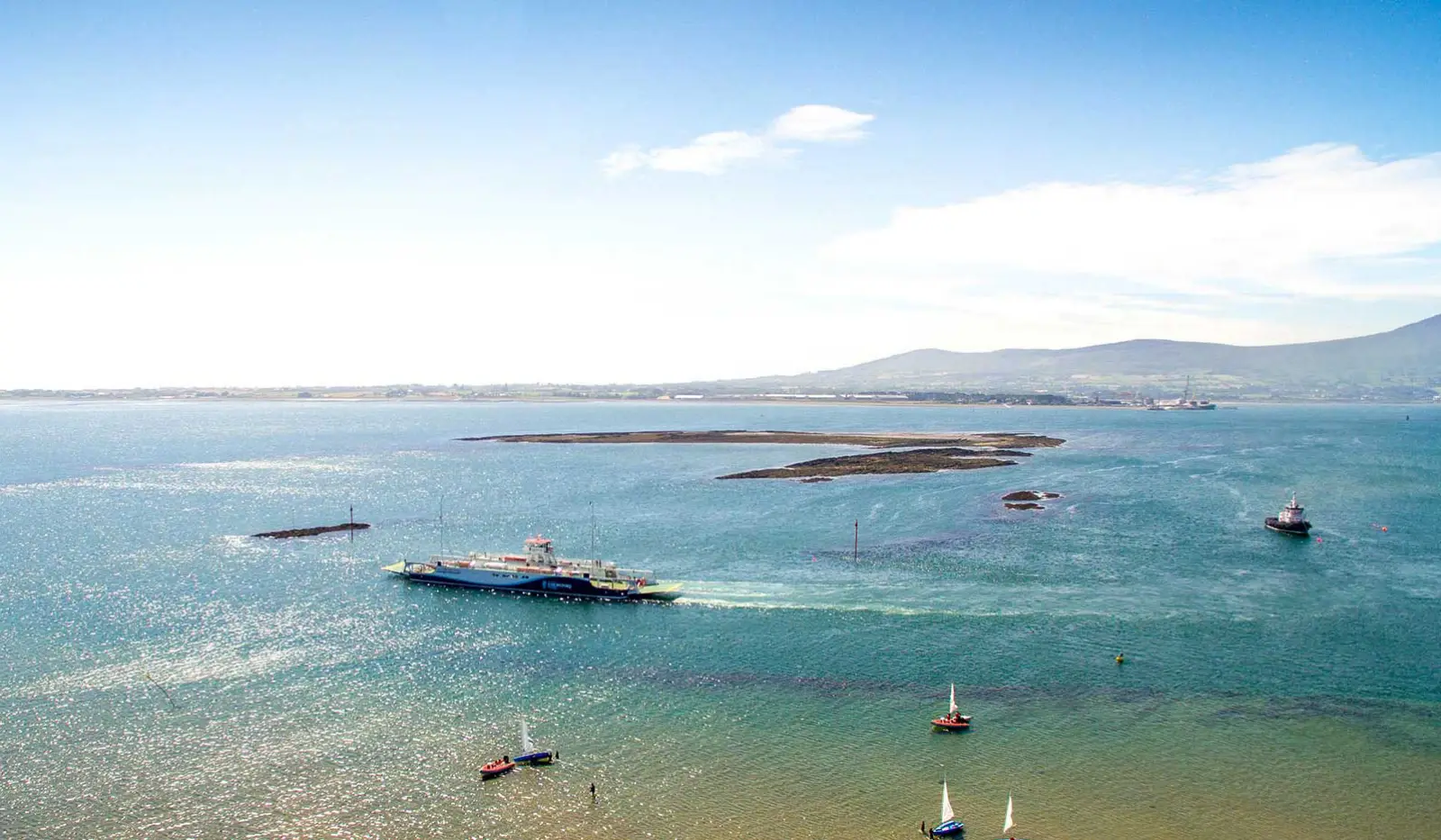
The Carlingford Lough ferry service, which connects counties Louth and Down across one of Ireland’s most scenic waterways, will not operate at any point in 2026, its operators have confirmed. The abrupt announcement has alarmed tourism businesses, local politicians and community groups on both sides of the border, with no explanation given and no date set for resumption.
A brief notice posted on the Carlingford Lough Ferry website stated the service would not run “on any date in 2026.” The company, part of the Frazer Ferry Group, said all outstanding 2026 tickets would have their expiry dates extended “so they can be used when the ferry is back in service,” but gave no timeline for a potential return.
A Vital Cross-Border Link Since 2017
The ferry, which made its maiden voyage in July 2017, carries foot passengers, cyclists and vehicles between Greenore in County Louth and Greencastle in County Down. The 15 to 20 minute crossing saves passengers a road detour of approximately 30 miles (48km) around Newry, cutting journey times between some destinations from around 90 minutes to as little as 30 minutes.
When it launched, the service was heralded as a multimillion-euro cross-border tourism project, promoted as a connector between the Cooley Peninsula and the Mourne Mountains regions. It typically operates from late spring through to October, serving foot passengers, cars, bicycles, guided tours and day-trippers throughout the peak summer season.
Richard Lewis, who operates a bicycle hire company in Carlingford, said the loss would be keenly felt across the region. “It’s just one of the jewels of the crown of Carlingford Lough and the Cooley peninsula and over the Mournes,” he said. “It cut down the journey significantly if you were coming from Newcastle or Kilkeel. Now you’ve got to go all round the lough.”
Business Owners Warn of Summer Footfall Collapse
Eavan Brady, owner of the Coast and Co cafe in Greenore, said the suspension would directly reduce trade during the summer months. “At the moment it means that there won’t be as much footfall in the area,” she told the BBC’s Evening Extra programme. Many visitors had made a point of stopping in Greenore for coffee or food before or after the crossing, she said, and would not otherwise have passed through the village.
Brady also flagged the knock-on impact on seasonal employment. Local businesses typically hire additional staff each summer to meet demand driven by ferry passengers, she said, and young students looking for seasonal work could find fewer opportunities as a result of the suspension.
Sinn Fein councillor Fiona Mhic Conchoille for the Dundalk-Carlingford area described the ferry as “the identity of the lough” and “a really positive example of cross-border tourism cooperation.” She said that while passenger numbers may have declined in recent years, the ferry retained value as a “unique tourist experience” and a novelty for visitors. “People used to go over and sit on the wall and see the ferry as it travelled back and forth across the lough,” she said. “It’s just something we will miss in our area.”
Politicians Criticise Lack of Support and Urgency
Diane Forsythe, Democratic Unionist Party assembly member for South Down, called the suspension “a major blow to South Down tourism.” In a statement, she said the ferry had become “a tourism attraction in its own right” and had helped showcase Carlingford Lough to thousands of visitors.
Forsythe said she had raised concerns about the level of support given to the ferry by tourism bodies for some time, and had discussed the issue with officials from Tourism NI, Tourism Ireland and the Department for the Economy three months before the suspension was announced. “I was disappointed by the lack of urgency shown towards the ferry as an important tourism asset,” she said. “With the progression of the Narrow Water Bridge project, it increasingly feels as though the ferry has been disregarded. I believe there is room for both.”
Fianna Fail TD for Louth Erin McGreehan said she was “deeply disappointed” by the decision, and acknowledged that “the slowness of bureaucracy” had been partly to blame. She told The Irish Times that a proposal was waiting to be examined by the Department for Enterprise, Tourism and Employment, and was supported by the government.
McGreehan said the ferry had “struggled to achieve the level of commercial viability needed to sustain year-round and long-term operations without additional public support,” and called for a structural solution. “The proposal being advanced by Louth County Council is centred around a PSO-style model, similar to public service obligation supports used successfully in other transport sectors, which would recognise the ferry not simply as a private commercial venture, but as critical tourism, regional connectivity and economic infrastructure for the entire Carlingford Lough region,” she said.
Mhic Conchoille said she hoped local councils north and south of the border could engage directly with the ferry operators to establish whether the suspension stemmed from a commercial or operational decision. “We don’t know. We haven’t really been fully informed on it,” she said. “Either way, it is disappointing for the area.”
Narrow Water Bridge Under Construction, But Years Away
The ferry’s suspension comes as a major new cross-border infrastructure project is under construction nearby. The Narrow Water Bridge, being built by main contractor BAM Ireland, will link Warrenpoint in County Down with Omeath in County Louth. Construction began in June 2024 and the 195-metre cable-stayed structure is expected to be completed in late 2027.
When open, the bridge will carry vehicular, cycle and pedestrian traffic and will feature a movable bascule span to allow ships to pass through to the Newry Canal. First Minister Michelle O’Neill confirmed in late 2024 that the project was progressing on schedule. Taoiseach Micheal Martin has called the bridge “a true embodiment” of cross-border cooperation.
Critics, however, argue that the bridge’s eventual completion should not come at the expense of the ferry. Forsythe said she believed there was room for both services, and that treating the ferry as expendable ahead of the bridge’s opening was a mistake. Local councillor Mhic Conchoille agreed, noting that the ferry offered a qualitatively different experience to a road crossing.
Glimmer of Hope for the Future
Despite the uncertainty, some stakeholders remain cautiously optimistic. Brady said the ticket extension gave her reason to believe the ferry could one day return. “I would be hopeful that it will come back again, particularly when they are saying that the tickets will… the expiry date is going to be extended,” she said. “That would give a little glimmer of hope.”
McGreehan said she believed a sustainable future for the service was possible if government support was structured correctly. “It is clear that without structured government partnership and support, services of this nature face enormous challenges in remaining viable,” she said. “The Carlingford Lough Ferry has been much more than a transport link. It is an economic lifeline for communities on both sides of the border.”
In the meantime, businesses across the Cooley Peninsula and the Mourne Mountains region face a summer season without one of their most recognisable visitor draws. Whether the ferry returns in 2027, or at all, may ultimately depend on how quickly political will can translate into practical support for an operator that has received none so far.