Spain has emerged as one of Europe’s most strategically important buffers against the deepening aviation fuel crisis triggered by the war in the Middle East and the effective closure of the Strait of Hormuz. As airlines and energy companies across the continent scramble for contingency plans, Spain’s refining infrastructure and domestic production capacity have placed it in a distinctly stronger position than most of its European neighbours.
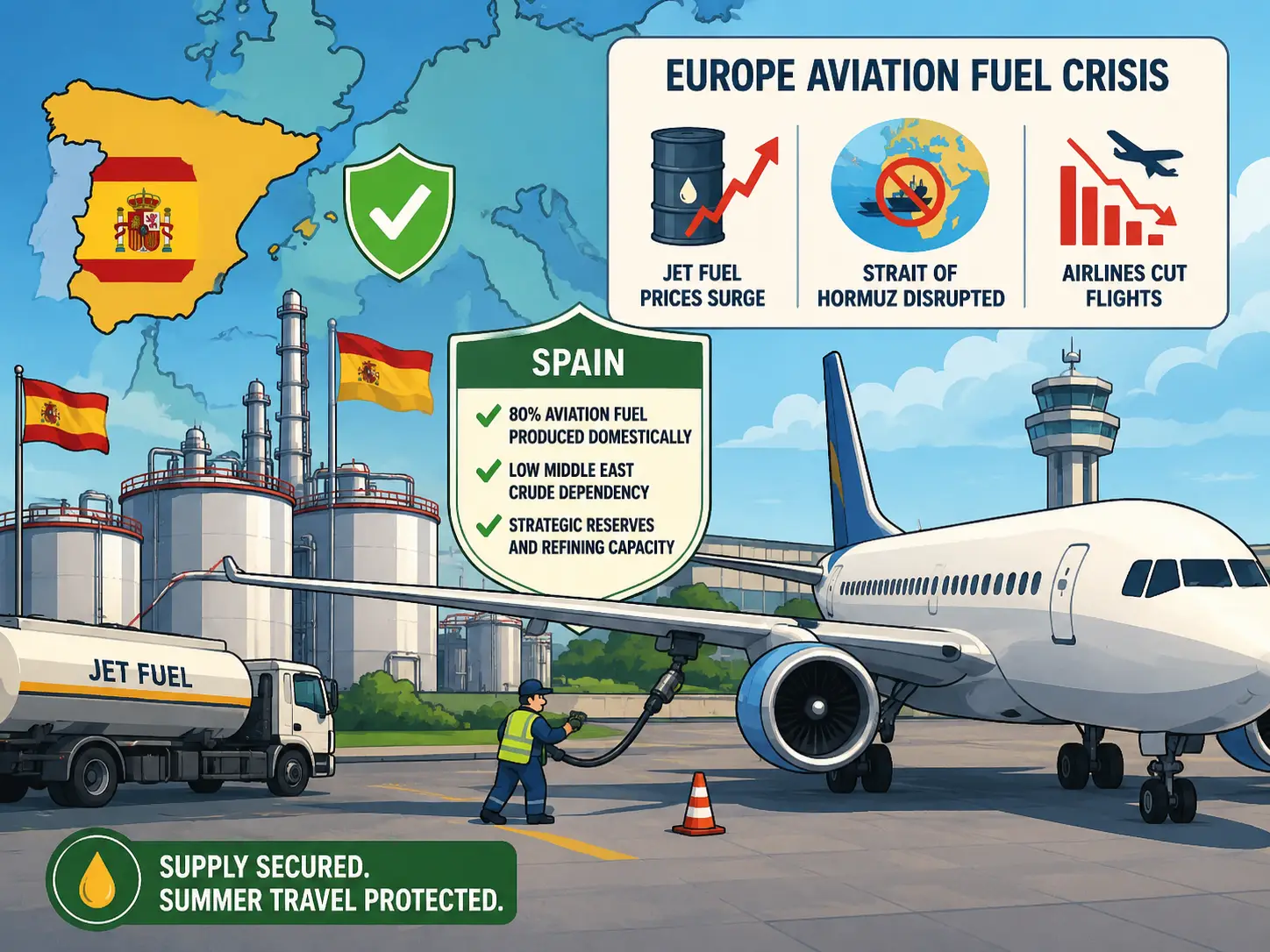
The country’s eight refineries, operated by Repsol, Moeve and BP, are now running at maximum capacity. Spain produces approximately 80% of its aviation kerosene domestically, a far higher share than the European average, and sources only around 7% of its crude oil from the Middle East. The bulk of Spanish crude imports come from the Americas, including the United States, Brazil and Mexico, with a further 30% arriving from African producers such as Nigeria and Libya.
Joan Groizard, Spain’s secretary of state for energy, has sought to calm concerns over supply. He stated that the supply of kerosene is guaranteed and that even if the border were closed immediately, Spain would pass the summer normally. That confidence is grounded in the country’s refining depth: Spain is the third largest refining nation in Europe and holds a total storage capacity of approximately 184 million barrels across 41 companies and more than 138 sites, including strategic reserves managed by CORES, the Corporation of Strategic Reserves of Oil Products.
However, the picture is not entirely reassuring. The International Energy Agency has warned that Europe’s overall aviation kerosene reserves would last only around six weeks, and Spain’s own reserves are estimated at just 31 days. Representatives from Repsol, Moeve and BP met with deputy prime minister and minister for ecological transition Sara Aagesen to brief the government on the situation. The companies confirmed that May deliveries are guaranteed, but supply for June remains a work in progress. Refineries are ramping up production and overseas purchases are being increased to offset a roughly 20% shortfall previously covered by external supplies.
Josu Jon Imaz, chief executive of Repsol, the country’s largest refiner, issued a frank warning at a recent economic forum. He said that Repsol‘s singular focus is to guarantee that there is no shortage of product in Spain over the coming months, and that the company had increased its stocks by 1.2 billion euros in March alone to help prevent supply disruption. Imaz acknowledged that a risk of fuel scarcity exists across Europe, particularly for kerosene, while insisting that Spain remains better placed than its neighbours.
The broader European picture is significantly more alarming. Jet fuel prices have roughly doubled since the conflict began, with the Argus U.S. Jet Fuel Index tracking a spike from approximately 2.17 to over 4.56 dollars per gallon within weeks. S&P Global reported that European jet fuel cash differentials hit record highs in mid-March 2026. Around 45% of all kerosene consumed in Europe had previously passed through the Strait of Hormuz, and with that route severely disrupted, the continent is facing a structural supply gap heading into peak summer travel season.
Major carriers have already begun to react. United Airlines chief executive Scott Kirby announced plans to cut around 5% of scheduled flights, warning that sustained fuel prices at current levels could add 11 billion dollars in annual costs. Scandinavian carrier SAS has cancelled 1,000 flights in April citing fuel costs. KLM has cut 160 European routes, describing them as no longer financially viable. EasyJet reported a first-half pretax loss of between 540 million and 560 million pounds and flagged weaker forward bookings as travellers delay purchasing decisions.
The European Commission has responded with its AccelerateEU plan, published at the end of April 2026, which directly addresses the economic impact of the Middle East crisis on energy prices and aviation. As part of this package, the Commission published a guidance document on EU law applicable to airlines, passengers and transport operators during the fuel crisis, covering issues such as supply surcharges, airport slot rules, public service obligations and passenger rights. Officials are also examining energy solidarity mechanisms that could allow countries with greater refining capacity, including Spain, Italy and the Netherlands, to support other EU member states if fuel shortages become acute.
One dimension under renewed scrutiny is tankering, the practice by which airlines load extra fuel at departure to avoid refuelling at other airports. EU rules under the ReFuelEU framework already require airlines to refuel at least 90% of the fuel needed for operations at the origin airport, with limited exceptions permitted when there is a genuine shortage at the destination. That exemption could grow in relevance if carriers begin treating Spain as a preferred fuelling hub to reduce exposure to shortages elsewhere. Spain’s airline association, known as ALA, says it has not yet detected evidence of systematic tankering at Spanish airports, but the question is likely to become more pressing as summer approaches.
Spain’s advantage rests on a combination of sustained investment in refining infrastructure at a time when much of Europe was shutting down or converting refineries, its Atlantic-facing geography as a natural first port of call for rerouted tankers travelling around the Cape of Good Hope, and its limited dependence on Middle Eastern crude. The country ensures 90% of its inland oil transportation through its pipeline network, compared with just 11% in Germany. With Spain aiming to surpass 100 million international visitors in 2026, the government and energy sector are under acute pressure to ensure that aviation fuel supply holds through the busiest travel months of the year.