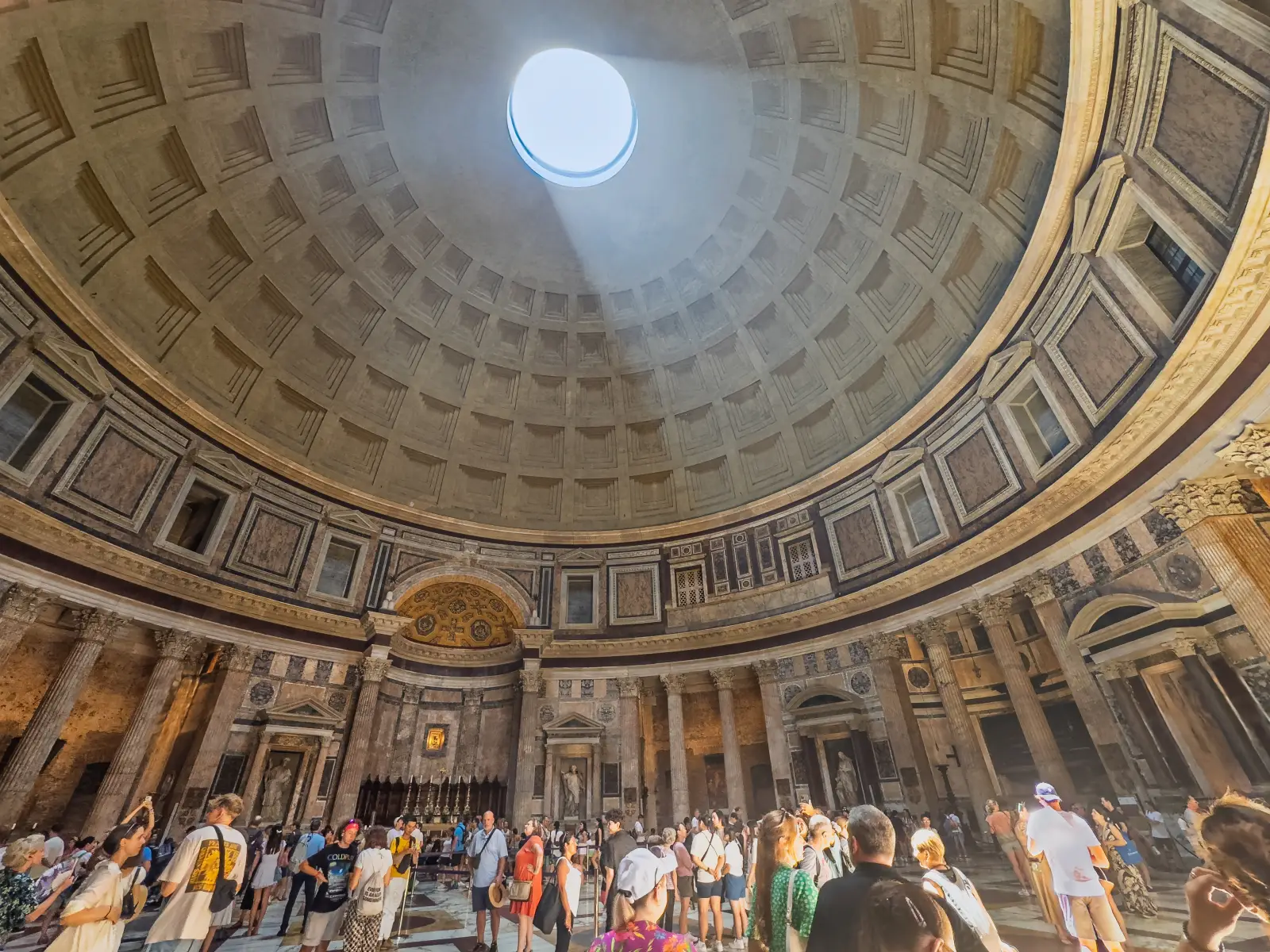
Every April 21 at noon, a beam of sunlight descends through the oculus of the Pantheon and strikes the monument’s bronze entrance doors — a phenomenon that has occurred without interruption for nearly 2,000 years and that scholars say was no accident of architecture.
The alignment falls on Natale di Roma, the anniversary of the founding of Rome in 753 BC and the most symbolically charged date in the Roman calendar. Emperor Hadrian, who oversaw the construction of the current Pantheon between 118 and 128 AD, oriented every stone of the building around this precise moment of the year.
An Optical Machine, Not a Decorative Feature
The oculus is the circular opening of just over eight metres at the apex of the dome, open to the sky with no glass or cover. It is the building’s only source of natural light.
Researchers Robert Hannah and Giulio Magli reconstructed the calculations behind the structure’s orientation and concluded that the inclination of the dome, the position of the opening and the axis of the entrance are technical choices, not decorative ones.
Italy’s Ministry of Culture has described the effect as one of the first special effects in history. The message to those present was unambiguous: on Rome’s birthday, at the height of noon, the emperor entered the building bathed in direct sunlight. Power and cosmos, made to coincide.
How to See It and What to Expect
The phenomenon is visible to any visitor inside the Pantheon at noon and requires only a standard entry ticket. Admission costs five euros full price or three euros reduced, available for purchase online. Advance booking is strongly recommended given the volume of visitors drawn to the Pantheon on Natale di Roma.
The Direzione Musei Nazionali has not organised a dedicated guided visit for this edition, unlike in previous years, but the alignment will be visible to all visitors present at midday.
The Oculus does not mark only April 21. It tracks the equinoxes, solstices and the cardinal moments of the year, functioning as a permanent stone calendar that has required no adjustment in nearly twenty centuries. For those who cannot attend today, the Pantheon repeats the performance at each of those moments, but the alignment with Rome’s birthday remains the one Hadrian built the entire building around.
Photo Credit: Claudine Van Massenhove / Shutterstock.com