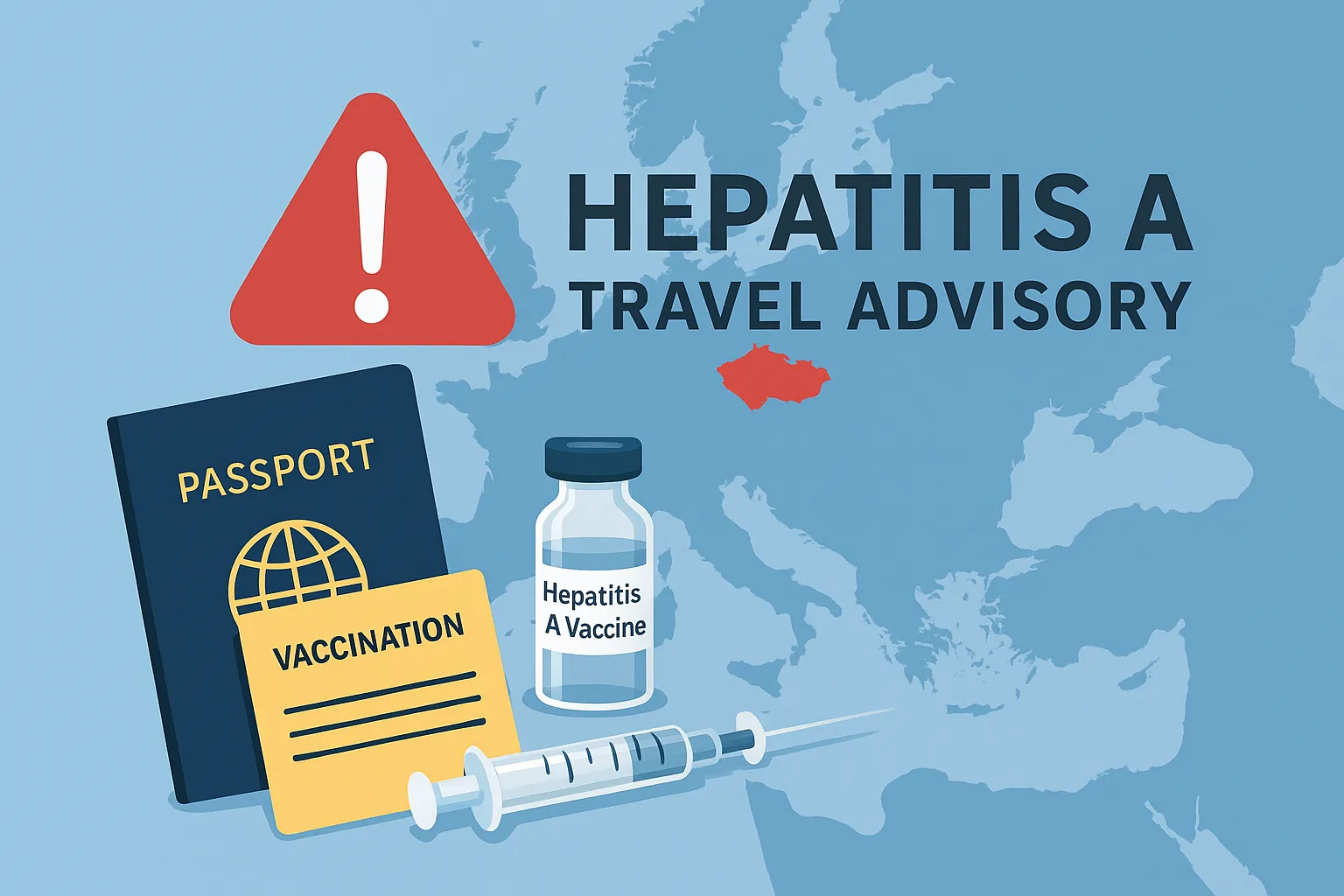
Hepatitis A outbreak in Czechia prompts urgent travel warning as European health officials report a sharp rise in infections across Central Europe. With over 2,000 confirmed cases spanning Czechia, Austria, Hungary, and Slovakia, the outbreak has triggered a regional alert and raised concerns for both local populations and international travelers.
According to the European Centre for Disease Prevention and Control (ECDC), the outbreak has been particularly severe in Czechia, where more than 600 cases and six fatalities have been reported since January 2025. While the disease is generally self-limiting in healthy individuals, severe outcomes have occurred—especially among older adults and those with underlying liver conditions.
Hepatitis A Outbreak in Czechia Prompts Urgent Travel Warning: What to Know
The hepatitis A virus (HAV) is a highly contagious liver infection transmitted primarily through ingestion of contaminated food or water or direct contact with an infectious person. In this current outbreak, the spread has been traced to vulnerable communities living in poor sanitary conditions, including people experiencing homelessness, drug users, and members of the Roma community.
Data from Czech public health agencies indicate that the most affected age groups include young children aged 1–9 and adults between 25–44 years. Alarmingly, 18% of cases in Czechia have been identified within Roma communities, while 67 confirmed cases have occurred among homeless populations. Authorities report that up to 86% of patients required hospitalization.
Outbreak Areas and Risk Profile
Regional hotspots in Czechia include:
| Region | Reported Cases (Jan–May 2025) |
|---|---|
| Prague | 151 |
| Central Bohemia | 113 |
| Moravian–Silesian | 96 |
Further sequencing by the ECDC revealed two closely related hepatitis A subgenotype IB strains circulating within these populations. Cross-border transmission has also been confirmed, with Germany reporting three genetically linked cases.
Groups most at risk include:
- People aged 40 and older
- Individuals with chronic liver disease
- Unvaccinated travelers to endemic areas
- Children in overcrowded schools or camps
Health Advice for Travelers to Czechia
Given the growing number of cases, the ECDC has recommended several protective measures for travelers:
- Get vaccinated: A single dose of hepatitis A vaccine provides protection within two weeks. Two doses offer lifelong immunity. Visit your local travel health clinic or consult the ECDC’s vaccination guidance for details.
- Practice good hygiene: Wash hands frequently, especially after using the restroom or before eating.
- Drink safely: Avoid tap water, ice cubes, and raw or undercooked foods from untrusted sources.
- Monitor symptoms: Be alert for signs such as jaundice (yellowing of skin and eyes), fatigue, dark urine, and nausea.
The vaccine is currently not covered by Czech public health insurance for adults. The full two-dose course costs approximately 1,700 CZK (~€65), though efforts are underway to provide free immunization to vulnerable groups.
Official Response and Public Health Measures
On 18 June 2025, the ECDC released a rapid risk assessment outlining targeted strategies. These include expanded vaccination campaigns, public hygiene education, and increased availability of clean water and soap in shelters and low-income neighborhoods. Genomic sequencing is also being scaled up to trace transmission chains.
In Prague, temporary clinics have been established in coordination with NGOs to reach underserved populations. Additional public health messages have been issued in multiple languages, including Romani, to ensure accessibility across communities.
According to Dr. Petra Holubová, an infectious disease specialist in Brno, “The rapid expansion of hepatitis A this year underscores the importance of proactive vaccination, especially among high-risk populations. We are seeing a strong correlation between low immunization rates and hospitalization severity.”
What This Means for Summer Travel
With peak summer travel season underway, Czechia remains a popular destination for tourists seeking history, architecture, and outdoor festivals. However, the hepatitis A outbreak serves as a reminder that even developed European countries are not immune to health crises.
Travelers are strongly encouraged to consult with a healthcare provider before departure, especially if staying in hostels, attending mass gatherings, or visiting rural areas. If already vaccinated, no further action may be needed; however, those who are unvaccinated should seek immunization as soon as possible.
The situation is evolving. Check for updates from the ECDC, World Health Organization, or your national travel health advisory before departure. In the meantime, extra caution and basic hygiene can go a long way in reducing risk.
For a comprehensive overview of the outbreak and real-time updates, travelers can visit the ECDC’s outbreak page or speak with local travel clinics offering pre-exposure prophylaxis.