Some journeys span centuries before reaching their destination. Egypt’s newest cultural landmark — the Grand Egyptian Museum — is one of them, a project twenty years in the making that now opens its doors beside the Pyramids of Giza with a promise to connect past and present on a global scale.
After years of anticipation and several delays, the Grand Egyptian Museum (GEM) was officially unveiled with a dazzling celebration that combined ancient symbolism and modern spectacle. The Egyptian government presented the $1.2 billion complex as a “bridge between civilizations,” an idea that framed the evening’s luminous ceremony and underscored the museum’s role in reviving Egypt’s place at the heart of world heritage tourism.
Covering more than 500,000 square meters at the edge of the Giza Plateau, the GEM is the largest museum ever built to honor a single civilization. It will display over 100,000 artifacts spanning 7,000 years of history, from the earliest pre-dynastic relics to the Greco-Roman period. Its opening marks a new era for Egyptian cultural tourism, blending high technology, architectural innovation, and one of the richest archaeological collections on Earth.
A spectacle of history and hope
The inauguration brought together nearly 80 world leaders, among them Spain’s King Felipe VI and Colombia’s President Gustavo Petro, for an event staged under the gaze of the pyramids. Music, light shows, and fireworks illuminated the night sky, while ultralight aircraft soared above the museum projecting the message “Welcome to the land of peace.”
During his address, President Abdel Fattah al-Sisi described the museum as a symbol of dialogue and humanity. “We invite you to this land of peace and love, to make this museum a platform for dialogue, a destination for knowledge, and a harbor for humanity,” he said. Al-Sisi added that the opening marks “a new chapter in the story of the present and future of this ancient country.”
The ceremony linked live performances across continents — from an orchestra in Japan, which financed part of the museum’s construction, to segments in Paris, Rio de Janeiro, and New York — emphasizing Egypt’s global cultural reach. Performers dressed as ancient Egyptians filled the museum’s courtyards, celebrating the civilization’s enduring influence while presenting Egypt as a nation looking confidently toward the future.
From Ramses to Tutankhamun
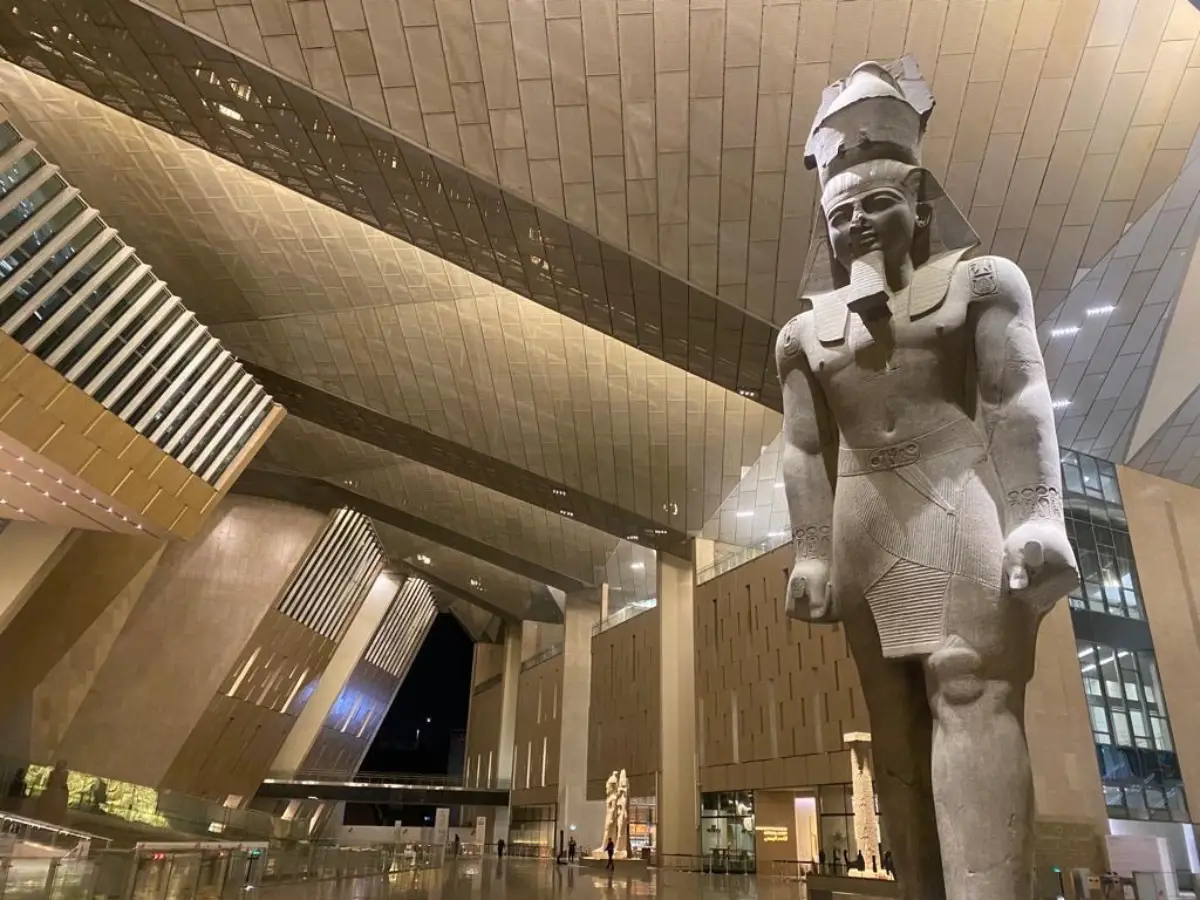
The GEM’s collection includes monumental statues, royal sarcophagi, and thousands of previously unseen treasures. Among its most anticipated exhibits are the colossal statue of Ramses II, which greets visitors in the grand atrium, and the complete funerary collection of Tutankhamun, displayed together for the first time since its discovery in 1922.
In the ceremony’s finale, a golden image of Tutankhamun rose against the night sky as fireworks exploded over the pyramids — a symbolic handoff from the pharaohs of the past to the Egypt of today. Visitors will also see restored solar boats of King Khufu, ancient papyri, and intricately carved reliefs, all curated to trace the evolution of Egyptian civilization through themes of art, religion, and daily life.
The museum’s design reflects that continuum. Its vast triangular structure aligns with the Great Pyramid, and natural light filters through glass facades to highlight statues and reliefs in the galleries. Interactive displays, digital reconstructions, and multilingual guides aim to make the collection accessible to global audiences while maintaining the integrity of the ancient works.
According to Egypt’s Ministry of Tourism and Antiquities, the GEM expects to welcome around five million visitors per year, reinforcing the country’s standing as one of the world’s leading cultural tourism destinations. The opening also coincides with renewed efforts to diversify Egypt’s travel offerings beyond the Red Sea resorts and promote year-round visitation to heritage sites.
“The silence of the stones not only remembers the past but illuminates the future,” said Al-Sisi as he symbolically placed the final stone during the ceremony. With its blend of history, architecture, and aspiration, the Grand Egyptian Museum stands as both a tribute to human creativity and a statement of Egypt’s enduring role as a crossroads of civilizations.
More information on visiting hours, ticketing, and exhibitions is available on the official website of the Grand Egyptian Museum.